Berliner Boersenzeitung - Elephants call each other by name, study finds

EUR -
AED 4.368331
AFN 78.504542
ALL 96.777801
AMD 449.404803
ANG 2.129248
AOA 1090.744922
ARS 1710.125687
AUD 1.715529
AWG 2.141047
AZN 2.02164
BAM 1.958436
BBD 2.391068
BDT 145.265496
BGN 1.997562
BHD 0.448432
BIF 3498.561256
BMD 1.189471
BND 1.506577
BOB 8.221064
BRL 6.273982
BSD 1.187168
BTN 107.887193
BWP 15.624568
BYN 3.385227
BYR 23313.627183
BZD 2.387663
CAD 1.630285
CDF 2622.783306
CHF 0.92093
CLF 0.026091
CLP 1029.784301
CNY 8.271996
CNH 8.267339
COP 4388.849791
CRC 587.470855
CUC 1.189471
CUP 31.520976
CVE 110.413593
CZK 24.261814
DJF 211.41007
DKK 7.467492
DOP 74.337543
DZD 153.628484
EGP 55.941647
ERN 17.842062
ETB 184.546163
FJD 2.628139
FKP 0.868481
GBP 0.867541
GEL 3.199886
GGP 0.868481
GHS 12.946423
GIP 0.868481
GMD 87.434955
GNF 10398.644674
GTQ 9.111262
GYD 248.384272
HKD 9.278639
HNL 31.485496
HRK 7.538384
HTG 155.582841
HUF 381.740417
IDR 19901.927634
ILS 3.69333
IMP 0.868481
INR 109.057794
IQD 1558.206715
IRR 50106.45657
ISK 145.198734
JEP 0.868481
JMD 186.87521
JOD 0.843365
JPY 182.814507
KES 153.442216
KGS 104.018
KHR 4793.567466
KMF 496.611855
KPW 1070.546787
KRW 1716.144602
KWD 0.364704
KYD 0.989331
KZT 596.522793
LAK 25612.25332
LBP 101759.225276
LKR 367.56157
LRD 219.635583
LSL 19.061283
LTL 3.512198
LVL 0.719499
LYD 7.496932
MAD 10.856893
MDL 20.027785
MGA 5358.565244
MKD 61.625714
MMK 2497.947354
MNT 4240.623218
MOP 9.535032
MRU 47.461304
MUR 54.145151
MVR 18.388851
MWK 2061.353348
MXN 20.619547
MYR 4.701383
MZN 75.828729
NAD 19.061251
NGN 1677.890894
NIO 43.648383
NOK 11.589353
NPR 172.613496
NZD 1.987968
OMR 0.457351
PAB 1.187198
PEN 3.98651
PGK 5.15176
PHP 70.259635
PKR 332.436604
PLN 4.202567
PYG 7978.569766
QAR 4.331279
RON 5.095338
RSD 117.411466
RUB 90.844304
RWF 1728.301036
SAR 4.460484
SBD 9.612075
SCR 16.545507
SDG 715.469085
SEK 10.603871
SGD 1.506477
SHP 0.892411
SLE 29.011581
SLL 24942.606537
SOS 677.28871
SRD 45.348593
STD 24619.643503
STN 24.562571
SVC 10.38798
SYP 13155.041117
SZL 19.055345
THB 36.942552
TJS 11.082701
TMT 4.175042
TND 3.402184
TOP 2.86396
TRY 51.626955
TTD 8.067858
TWD 37.388652
TZS 3038.472124
UAH 51.18269
UGX 4208.663966
USD 1.189471
UYU 44.550142
UZS 14410.438518
VES 426.082277
VND 31085.629225
VUV 142.435928
WST 3.246414
XAF 656.82438
XAG 0.010627
XAU 0.000234
XCD 3.214604
XCG 2.139579
XDR 0.816875
XOF 657.183789
XPF 119.331742
YER 281.667624
ZAR 19.078757
ZMK 10706.598345
ZMW 23.179708
ZWL 383.009104
  • CMSD

    -0.0150

    24.145

    -0.06%

  • CMSC

    0.0200

    23.8

    +0.08%

  • SCS

    0.0200

    16.14

    +0.12%

  • NGG

    1.4100

    83.99

    +1.68%

  • GSK

    0.7950

    51.115

    +1.56%

  • RIO

    1.4000

    91.87

    +1.52%

  • RELX

    -0.8100

    38.7

    -2.09%

  • AZN

    1.1900

    95.42

    +1.25%

  • BCE

    0.3900

    25.54

    +1.53%

  • BCC

    -1.2450

    82.155

    -1.52%

  • RYCEF

    0.0000

    17.12

    0%

  • BTI

    0.7700

    59.76

    +1.29%

  • JRI

    -0.0150

    13.715

    -0.11%

  • VOD

    0.2050

    14.435

    +1.42%

  • BP

    0.5100

    37.27

    +1.37%

  • RBGPF

    -0.8300

    82.4

    -1.01%

Elephants call each other by name, study finds
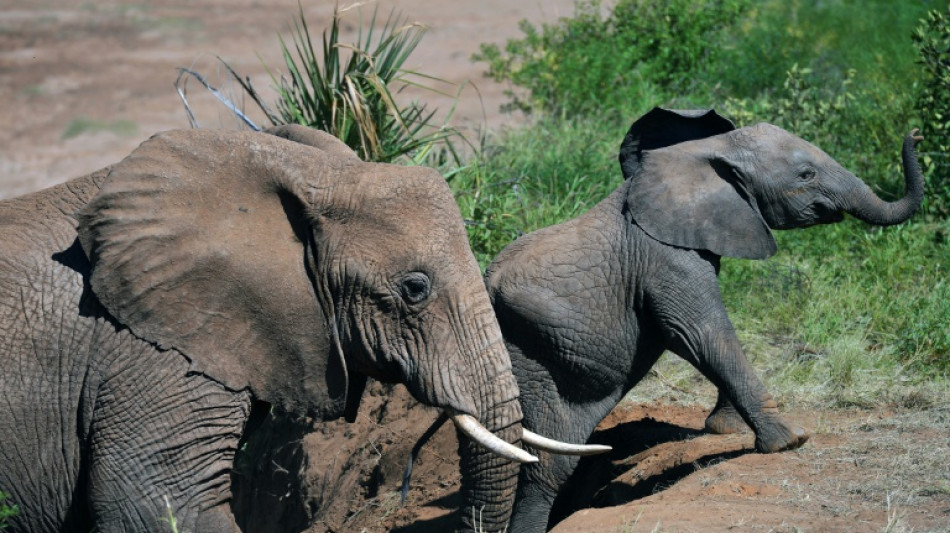
Elephants call each other by name, study finds / Photo: CARL DE SOUZA - AFP/File

Elephants call each other by name, study finds

Elephants call out to each other using individual names that they invent for their fellow pachyderms, a study said on Monday.

Text size:

While dolphins and parrots have been observed addressing each other by mimicking the sound of others from their species, elephants are the first non-human animals known to use names that do not involve imitation, the researchers suggested.

For the new study, a team of international researchers used an artificial intelligence algorithm to analyse the calls of two wild herds of African savannah elephants in Kenya.

The research "not only shows that elephants use specific vocalisations for each individual, but that they recognise and react to a call addressed to them while ignoring those addressed to others," lead study author Michael Pardo said.

"This indicates that elephants can determine whether a call was intended for them just by hearing the call, even when out of its original context," the behavioural ecologist at Colorado State University said in a statement.

The researchers sifted through elephant "rumbles" recorded at Kenya's Samburu National Reserve and Amboseli National Park between 1986 and 2022.

Using a machine learning algorithm, they identified 469 distinct calls, which included 101 elephants issuing a call and 117 receiving one.

Elephant make a wide range of sounds, from loud trumpeting to rumbles so low they cannot be heard by the human ear.

Names were not always used in the elephant calls. But when names were called out, it was often over a long distance, and when adults were addressing young elephants.

Adults were also more likely to use names than calves, suggesting it could take years to learn this particular talent.

The most common call was "a harmonically rich, low-frequency sound," according to the study in the journal Nature Ecology & Evolution.

- Say my name -

When the researchers played a recording to an elephant of their friend or family member calling out their name, the animal responded positively and "energetically," the researchers said.

But the same elephant was far less enthusiastic when played the names of others.

Unlike those mischievous parrots and dolphins, the elephants did not merely imitate the call of the intended recipient.

This suggests that elephants and humans are the only two animals known to invent "arbitrary" names for each other, rather than merely copying the sound of the recipient.

"The evidence provided here that elephants use non-imitative sounds to label others indicates they have the ability for abstract thought," senior study author George Wittemyer said.

The researchers called for more research into the evolutionary origin of this talent for name-calling, given that the ancestors of elephants diverged from primates and cetaceans around 90 million years ago.

Despite our differences, humans and elephants share many similarities such as "extended family units with rich social lives, underpinned by highly developed brains," Save the Elephants CEO Frank Pope said.

"That elephants use names for one another is likely only the start of the revelations to come."

(H.Schneide--BBZ)