Berliner Boersenzeitung - Webb spots giant star clusters shaping galaxy in early universe

EUR -
AED 4.277337
AFN 76.971308
ALL 96.539099
AMD 443.649903
ANG 2.084865
AOA 1068.023931
ARS 1670.170535
AUD 1.754436
AWG 2.096448
AZN 1.9742
BAM 1.955579
BBD 2.345435
BDT 142.473912
BGN 1.955579
BHD 0.43905
BIF 3440.711472
BMD 1.164693
BND 1.50853
BOB 8.047091
BRL 6.335467
BSD 1.164469
BTN 104.700177
BWP 15.471253
BYN 3.347922
BYR 22827.992243
BZD 2.342036
CAD 1.6108
CDF 2599.595791
CHF 0.937064
CLF 0.02737
CLP 1073.707555
CNY 8.234499
CNH 8.234698
COP 4424.200415
CRC 568.835767
CUC 1.164693
CUP 30.864377
CVE 110.25255
CZK 24.206977
DJF 207.366584
DKK 7.473932
DOP 74.531584
DZD 151.064942
EGP 55.309188
ERN 17.470402
ETB 180.625704
FJD 2.632731
FKP 0.873164
GBP 0.874723
GEL 3.138845
GGP 0.873164
GHS 13.246504
GIP 0.873164
GMD 85.022604
GNF 10118.85737
GTQ 8.919993
GYD 243.632489
HKD 9.06683
HNL 30.670537
HRK 7.536379
HTG 152.442786
HUF 381.91584
IDR 19438.210099
ILS 3.76861
IMP 0.873164
INR 104.758942
IQD 1525.527736
IRR 49048.181833
ISK 149.057092
JEP 0.873164
JMD 186.388953
JOD 0.825787
JPY 180.84192
KES 150.63299
KGS 101.852136
KHR 4662.473509
KMF 491.500098
KPW 1048.223551
KRW 1716.537243
KWD 0.357526
KYD 0.97049
KZT 588.913499
LAK 25252.148505
LBP 104281.524439
LKR 359.18944
LRD 204.956856
LSL 19.736071
LTL 3.439037
LVL 0.704511
LYD 6.330285
MAD 10.755485
MDL 19.813763
MGA 5194.413442
MKD 61.63304
MMK 2445.387464
MNT 4131.602963
MOP 9.338146
MRU 46.437756
MUR 53.657551
MVR 17.951252
MWK 2019.271982
MXN 21.202091
MYR 4.788046
MZN 74.435387
NAD 19.736071
NGN 1688.89839
NIO 42.855161
NOK 11.772943
NPR 167.520083
NZD 2.015268
OMR 0.44693
PAB 1.164568
PEN 3.914358
PGK 4.941442
PHP 68.676135
PKR 326.469235
PLN 4.229415
PYG 8009.095606
QAR 4.244621
RON 5.092734
RSD 117.386745
RUB 89.464862
RWF 1694.308677
SAR 4.371215
SBD 9.586117
SCR 15.776956
SDG 700.559902
SEK 10.953447
SGD 1.508575
SHP 0.873822
SLE 27.6056
SLL 24423.037799
SOS 664.324984
SRD 44.990951
STD 24106.803566
STN 24.497234
SVC 10.189849
SYP 12877.826534
SZL 19.720773
THB 37.124621
TJS 10.684394
TMT 4.088074
TND 3.416014
TOP 2.804302
TRY 49.551599
TTD 7.894109
TWD 36.442065
TZS 2841.579126
UAH 48.88768
UGX 4119.534819
USD 1.164693
UYU 45.544857
UZS 13931.426851
VES 296.474979
VND 30701.32018
VUV 141.34849
WST 3.247877
XAF 655.882937
XAG 0.019966
XAU 0.000277
XCD 3.147643
XCG 2.098763
XDR 0.815708
XOF 655.882937
XPF 119.331742
YER 277.837661
ZAR 19.726999
ZMK 10483.641498
ZMW 26.92296
ZWL 375.030826
  • RBGPF

    0.0000

    78.35

    0%

  • SCS

    -0.0900

    16.14

    -0.56%

  • CMSD

    -0.0700

    23.25

    -0.3%

  • RYCEF

    -0.0500

    14.62

    -0.34%

  • CMSC

    -0.0500

    23.43

    -0.21%

  • NGG

    -0.5000

    75.41

    -0.66%

  • GSK

    -0.1600

    48.41

    -0.33%

  • VOD

    -0.1630

    12.47

    -1.31%

  • BTI

    -1.0300

    57.01

    -1.81%

  • RIO

    -0.6700

    73.06

    -0.92%

  • RELX

    -0.2200

    40.32

    -0.55%

  • BCE

    0.3300

    23.55

    +1.4%

  • JRI

    0.0400

    13.79

    +0.29%

  • BCC

    -1.2100

    73.05

    -1.66%

  • BP

    -1.4000

    35.83

    -3.91%

  • AZN

    0.1500

    90.18

    +0.17%

Webb spots giant star clusters shaping galaxy in early universe
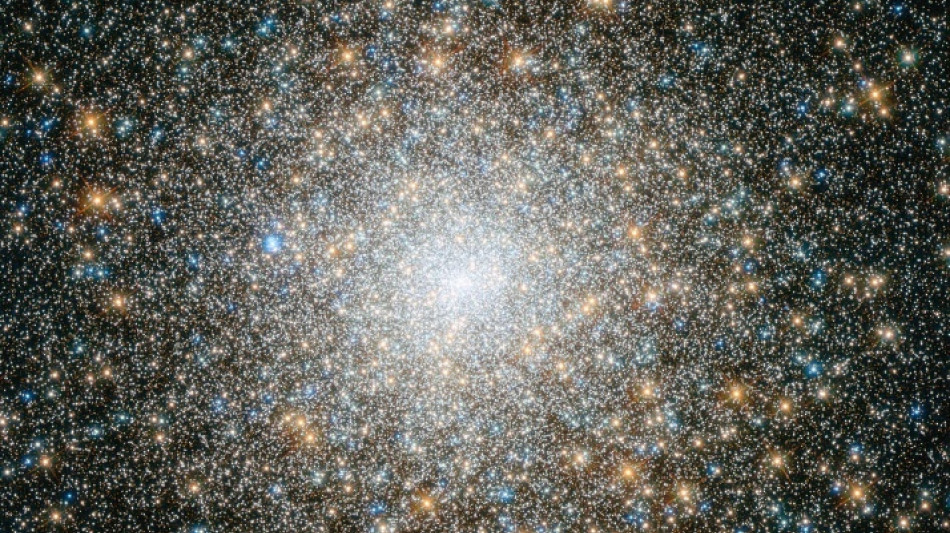
Webb spots giant star clusters shaping galaxy in early universe / Photo: - - ESA/HUBBLE/AFP/File

Webb spots giant star clusters shaping galaxy in early universe

The James Webb space telescope has discovered massive clusters of stars in the early universe so huge and densely packed that they influenced how their galaxy formed, astronomers said on Monday.

Text size:

The five clumps of stars, known as globular proto-clusters, are the earliest ever observed, dating back to 460 million years after the Big Bang when the universe was three percent its current age.

They were spotted in the Cosmic Gems Arc, an infant galaxy discovered by the Hubble telescope in 2018.

Looking into space means looking back in time, and the galaxy exists in what is called the epoch of reionisation, when the first stars and galaxies emerged and lit up the universe.

It is difficult to see that far back, but the Webb telescope's ability to detect infrared wavelengths has allowed it peer farther back into this cosmic dawn than ever before.

The discovery of the five globular proto-clusters marks "the first time we have been able to observe this type of object at this distance," said Adelaide Claeyssens, a co-author of the new study in the journal Nature.

It should help scientists better understand the "formation of star clusters that we can see in the nearby universe -- which are now very old -- and their influence on the formation of galaxies," the Stockholm University astronomer told AFP.

- Black hole seeds? -

There is nothing like these clusters in the universe we see around us, said lead study author Angela Adamo, also from Stockholm University.

Our home galaxy, the Milky Way, is now home to around 170 globular clusters.

But there were once thousands of them, before they were broken up and scattered when the galaxy expanded, Adamo told AFP.

Those that did survive are relative lightweights, making up an "insignificant" mass compared to all the other stars in the galaxy.

However the five clusters in the Cosmic Gems Arc are true heavyweights, representing nearly a third of their galaxy's total mass.

The young stars are also packed closely together.

Imagine there were a million stars jammed into the four light years of space that separate the Sun and its nearest star Proxima Centauri, Adamo said.

A separate study recently suggested that stars near the heart of globular proto-clusters are up to 10,000 more massive than the Sun.

Adamo said that such huge stars produce immense amounts of radiation, which means they "shape how galaxies form stars" and how gas is distributed around the galaxies.

And at the end of their short and violent lives, some of these behemoth stars likely create black holes, she added.

Some could even become the seeds that grow into the supermassive black holes squatting at the centre of galaxies, Adamo speculated.

To find out more, the researchers want to study more globular proto-clusters near the cosmic dawn. The James Webb Space telescope will help in this hunt, Adamo said.

But it will be the European Southern Observatory's Extremely Large Telescope, expected to start scanning the skies in 2028, that will help scientists "understand the physical processes within this galaxy," Adamo said.

So we have to wait a few more years to find out more about what happened over 13.2 billion years ago.

(O.Joost--BBZ)