Berliner Boersenzeitung - Meteorites strike Mars far more often than thought, probe finds

EUR -
AED 4.368331
AFN 78.504542
ALL 96.777801
AMD 449.404803
ANG 2.129248
AOA 1090.744922
ARS 1710.125687
AUD 1.715529
AWG 2.141047
AZN 2.02164
BAM 1.958436
BBD 2.391068
BDT 145.265496
BGN 1.997562
BHD 0.448432
BIF 3498.561256
BMD 1.189471
BND 1.506577
BOB 8.221064
BRL 6.273982
BSD 1.187168
BTN 107.887193
BWP 15.624568
BYN 3.385227
BYR 23313.627183
BZD 2.387663
CAD 1.630285
CDF 2622.783306
CHF 0.92093
CLF 0.026091
CLP 1029.784301
CNY 8.271996
CNH 8.267339
COP 4388.849791
CRC 587.470855
CUC 1.189471
CUP 31.520976
CVE 110.413593
CZK 24.261814
DJF 211.41007
DKK 7.467492
DOP 74.337543
DZD 153.628484
EGP 55.941647
ERN 17.842062
ETB 184.546163
FJD 2.628139
FKP 0.868481
GBP 0.867541
GEL 3.199886
GGP 0.868481
GHS 12.946423
GIP 0.868481
GMD 87.434955
GNF 10398.644674
GTQ 9.111262
GYD 248.384272
HKD 9.278639
HNL 31.485496
HRK 7.538384
HTG 155.582841
HUF 381.740417
IDR 19901.927634
ILS 3.69333
IMP 0.868481
INR 109.057794
IQD 1558.206715
IRR 50106.45657
ISK 145.198734
JEP 0.868481
JMD 186.87521
JOD 0.843365
JPY 182.814507
KES 153.442216
KGS 104.018
KHR 4793.567466
KMF 496.611855
KPW 1070.546787
KRW 1716.144602
KWD 0.364704
KYD 0.989331
KZT 596.522793
LAK 25612.25332
LBP 101759.225276
LKR 367.56157
LRD 219.635583
LSL 19.061283
LTL 3.512198
LVL 0.719499
LYD 7.496932
MAD 10.856893
MDL 20.027785
MGA 5358.565244
MKD 61.625714
MMK 2497.947354
MNT 4240.623218
MOP 9.535032
MRU 47.461304
MUR 54.145151
MVR 18.388851
MWK 2061.353348
MXN 20.619547
MYR 4.701383
MZN 75.828729
NAD 19.061251
NGN 1677.890894
NIO 43.648383
NOK 11.589353
NPR 172.613496
NZD 1.987968
OMR 0.457351
PAB 1.187198
PEN 3.98651
PGK 5.15176
PHP 70.259635
PKR 332.436604
PLN 4.202567
PYG 7978.569766
QAR 4.331279
RON 5.095338
RSD 117.411466
RUB 90.844304
RWF 1728.301036
SAR 4.460484
SBD 9.612075
SCR 16.545507
SDG 715.469085
SEK 10.603871
SGD 1.506477
SHP 0.892411
SLE 29.011581
SLL 24942.606537
SOS 677.28871
SRD 45.348593
STD 24619.643503
STN 24.562571
SVC 10.38798
SYP 13155.041117
SZL 19.055345
THB 36.942552
TJS 11.082701
TMT 4.175042
TND 3.402184
TOP 2.86396
TRY 51.626955
TTD 8.067858
TWD 37.388652
TZS 3038.472124
UAH 51.18269
UGX 4208.663966
USD 1.189471
UYU 44.550142
UZS 14410.438518
VES 426.082277
VND 31085.629225
VUV 142.435928
WST 3.246414
XAF 656.82438
XAG 0.010627
XAU 0.000234
XCD 3.214604
XCG 2.139579
XDR 0.816875
XOF 657.183789
XPF 119.331742
YER 281.667624
ZAR 19.078757
ZMK 10706.598345
ZMW 23.179708
ZWL 383.009104
  • SCS

    0.0200

    16.14

    +0.12%

  • RBGPF

    -0.8300

    82.4

    -1.01%

  • RYCEF

    0.0000

    17.12

    0%

  • CMSC

    0.0300

    23.78

    +0.13%

  • CMSD

    0.0300

    24.16

    +0.12%

  • BCC

    -0.9300

    83.4

    -1.12%

  • GSK

    1.1700

    50.32

    +2.33%

  • JRI

    0.0500

    13.73

    +0.36%

  • BCE

    -0.0500

    25.15

    -0.2%

  • RIO

    0.0400

    90.47

    +0.04%

  • NGG

    1.0800

    82.58

    +1.31%

  • RELX

    -0.3900

    39.51

    -0.99%

  • VOD

    0.0600

    14.23

    +0.42%

  • BTI

    -0.1700

    58.99

    -0.29%

  • BP

    0.2300

    36.76

    +0.63%

  • AZN

    1.2800

    94.23

    +1.36%

Meteorites strike Mars far more often than thought, probe finds
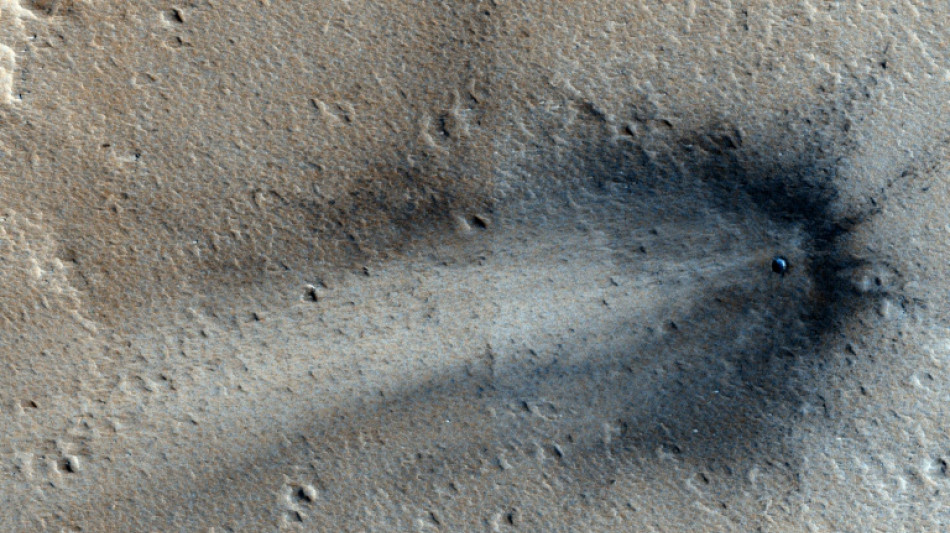
Meteorites strike Mars far more often than thought, probe finds / Photo: Handout - NASA/JPL-Caltech/Univ. of Arizona/AFP/File

Meteorites strike Mars far more often than thought, probe finds

Mars is bombarded with basketball-sized meteorites on a nearly daily basis, fives times more often than previously estimated, seismic recordings from a NASA spacecraft have revealed.

Text size:

Before the new study was published on Friday, the best guess for how many meteorites strike Mars was made by looking at images taken by orbiting spacecrafts or models based on craters on the Moon.

But NASA's InSight probe, which landed on a Martian plain called Elysium Planitia in 2018, has allowed scientists to listen to the internal rumblings of the red planet for the first time.

Mars is roughly twice as big as the Moon and is much closer to our solar system's main asteroid belt, making it a prime target for large rocks hurtling through space.

Most meteorites taking a shot at Earth break apart in our atmosphere. But the Martian atmosphere is 100 times thinner than Earth's, giving it little protection.

Rather than scouring through images taken from far away, the international team of researchers behind the new study in Nature Astronomy were able to listen in on meteorites smashing into Mars.

"Listening for impacts seems to be more effective than looking for them if we want to understand how often they occur," study co-author Gareth Collins of Imperial College London said in a statement.

The researchers used the data from InSight's seismometer to estimate that every year Mars is hit by between 280 to 360 meteorites, which all blast craters bigger than eight metres (26 feet) wide.

"This rate was about five times higher than the number estimated from orbital imagery alone," study co-author Geraldine Zenhaeusern of the ETH Zurich university said.

- Mars missions, take note -

Frequent, intense dust storms make it particularly difficult for spacecrafts orbiting Mars to see small meteorite craters down below.

New craters are easiest to spot in flat and dusty areas, but "this type of terrain covers less than half of the surface of Mars," Zenhaeusern said.

"The sensitive InSight seismometer, however, could hear every single impact within the landers' range," she added.

The scientists tracked a particular acoustic signal which is produced when meteorites strike Mars to estimate the diameter of craters and their distance from InSight.

They then calculated the number of craters made in one year near the lander, before extrapolating that number across the entire planet.

"This is the first paper of its kind to determine how often meteorites impact the surface of Mars from seismological data," said Domenico Giardini, who works on the InSight mission.

This data should be taken into account in "planning for future missions to Mars," he added.

The researchers estimated that a big meteorite strike makes a 30-metre crater on Mars about once a month -- something that may linger in the minds of astronauts hoping to walk on the red surface one day.

(T.Burkhard--BBZ)