Berliner Boersenzeitung - Methane rising faster than other greenhouse gases: researchers

EUR -
AED 4.228897
AFN 72.544603
ALL 96.183662
AMD 434.229157
ANG 2.061288
AOA 1055.928483
ARS 1608.200783
AUD 1.625385
AWG 2.075586
AZN 1.956154
BAM 1.959533
BBD 2.316513
BDT 141.128872
BGN 1.968276
BHD 0.434856
BIF 3414.980192
BMD 1.151504
BND 1.471235
BOB 7.976196
BRL 6.034567
BSD 1.150196
BTN 106.089037
BWP 15.682946
BYN 3.426227
BYR 22569.474238
BZD 2.313207
CAD 1.576633
CDF 2608.156684
CHF 0.906193
CLF 0.026536
CLP 1047.776192
CNY 8.010147
CNH 7.929762
COP 4265.757296
CRC 540.24567
CUC 1.151504
CUP 30.51485
CVE 110.475953
CZK 24.447343
DJF 204.811085
DKK 7.472275
DOP 70.205887
DZD 152.237997
EGP 60.200932
ERN 17.272557
ETB 181.174658
FJD 2.547069
FKP 0.865734
GBP 0.863685
GEL 3.131737
GGP 0.865734
GHS 12.518905
GIP 0.865734
GMD 84.639353
GNF 10083.517103
GTQ 8.815834
GYD 240.758681
HKD 9.02418
HNL 30.449068
HRK 7.536477
HTG 150.750475
HUF 391.080654
IDR 19547.928299
ILS 3.595824
IMP 0.865734
INR 106.424571
IQD 1506.670433
IRR 1521194.078995
ISK 143.201496
JEP 0.865734
JMD 180.925476
JOD 0.816406
JPY 183.220375
KES 149.234346
KGS 100.698929
KHR 4611.886464
KMF 493.994725
KPW 1036.403966
KRW 1714.0307
KWD 0.353201
KYD 0.958426
KZT 555.408136
LAK 24682.022961
LBP 102995.121174
LKR 358.152334
LRD 210.470063
LSL 19.349464
LTL 3.400091
LVL 0.696533
LYD 7.372077
MAD 10.805486
MDL 20.012126
MGA 4788.142922
MKD 61.653234
MMK 2418.334396
MNT 4116.047513
MOP 9.275872
MRU 45.857361
MUR 53.68307
MVR 17.80246
MWK 1994.007542
MXN 20.353348
MYR 4.511602
MZN 73.586935
NAD 19.349464
NGN 1575.601776
NIO 42.322837
NOK 11.08236
NPR 169.747291
NZD 1.972077
OMR 0.442684
PAB 1.150191
PEN 3.970264
PGK 4.959556
PHP 68.741757
PKR 321.293307
PLN 4.26821
PYG 7465.417237
QAR 4.204128
RON 5.094269
RSD 117.401537
RUB 94.518744
RWF 1678.605284
SAR 4.321598
SBD 9.271517
SCR 16.144156
SDG 692.054169
SEK 10.733385
SGD 1.471432
SHP 0.863926
SLE 28.330837
SLL 24146.471141
SOS 656.152919
SRD 43.263728
STD 23833.803528
STN 24.547513
SVC 10.064174
SYP 127.674013
SZL 19.33492
THB 37.259785
TJS 11.041287
TMT 4.036021
TND 3.397187
TOP 2.772544
TRY 50.902244
TTD 7.79986
TWD 36.722026
TZS 3002.549389
UAH 50.705321
UGX 4342.272682
USD 1.151504
UYU 46.75888
UZS 13906.49396
VES 513.854247
VND 30264.398299
VUV 137.705052
WST 3.171483
XAF 657.211941
XAG 0.014246
XAU 0.000229
XCD 3.111996
XCG 2.072849
XDR 0.817361
XOF 657.211941
XPF 119.331742
YER 274.636692
ZAR 19.256299
ZMK 10364.926801
ZMW 22.398673
ZWL 370.78375
  • RBGPF

    0.1000

    82.5

    +0.12%

  • CMSD

    -0.0400

    22.95

    -0.17%

  • CMSC

    0.0000

    22.99

    0%

  • BCC

    1.7200

    71.72

    +2.4%

  • NGG

    -0.0100

    90.89

    -0.01%

  • RIO

    2.0300

    89.86

    +2.26%

  • JRI

    -0.0500

    12.54

    -0.4%

  • AZN

    2.1100

    192.01

    +1.1%

  • RELX

    0.3300

    34.47

    +0.96%

  • BCE

    0.6521

    25.9

    +2.52%

  • GSK

    0.3800

    53.77

    +0.71%

  • BP

    0.2300

    42.9

    +0.54%

  • RYCEF

    0.3800

    16.5

    +2.3%

  • VOD

    0.1900

    14.6

    +1.3%

  • BTI

    1.0100

    60.94

    +1.66%

Methane rising faster than other greenhouse gases: researchers
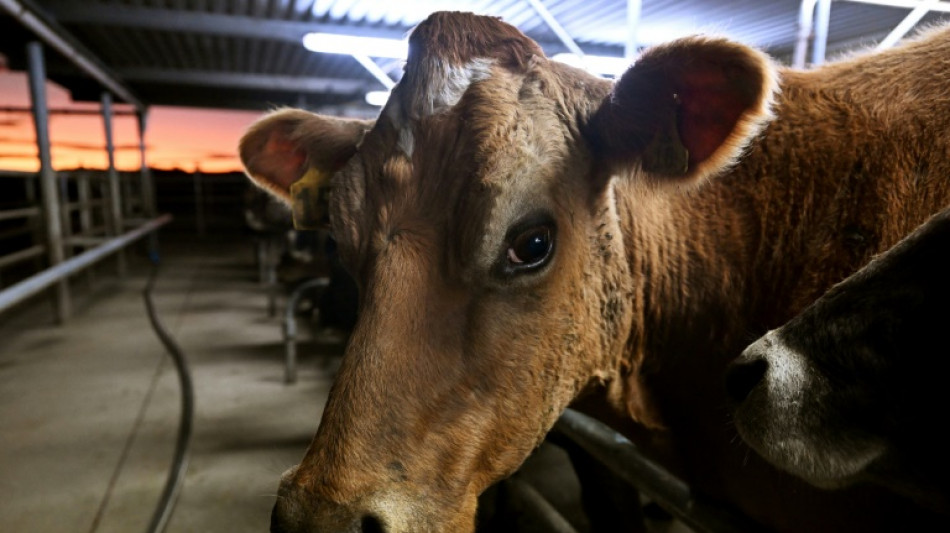
Methane rising faster than other greenhouse gases: researchers / Photo: William WEST - AFP/File

Methane rising faster than other greenhouse gases: researchers

Concentrations in the atmosphere of the powerful greenhouse gas methane are rising at an accelerating pace, threatening efforts by countries to meet their climate targets, researchers warned on Tuesday.

Text size:

"Methane is rising faster in relative terms than any major greenhouse gas and is now 2.6-fold higher than in pre-industrial times," said an international group of researchers under the aegis of the Global Carbon Project in a study published in Environmental Research Letters.

Methane is the second most abundant greenhouse gas produced by human activity after carbon dioxide, with agriculture, energy production and organic waste rotting in landfills the major sources.

In the first 20 years, its impact on the atmosphere is about 80 times more powerful that of carbon dioxide but it breaks down more quickly than CO2.

That opens a possibility to sharply reduce climate impact in the short term. But the researchers found that despite efforts to cut methane emissions, atmospheric concentrations of the gas are still rising.

- Rising in most countries -

An average of 6.1 million tonnes of methane were added to atmosphere per year in the 2000s.

That rose to 20.9 million tonnes per year in the 2010s. It hit 41.8 million tonnes in 2020.

"Anthropogenic (human-made) emissions have continued to increase in almost every other country in the world, with the exception of Europe and Australia, which show a slow declining trend," Global Carbon Project executive director Pep Canadell, one of the study's co-authors, told AFP.

The largest increases have come from China and southeast Asia and have been primarily linked to coal extraction, oil and gas production and landfills, the researchers found.

The La Nina weather phenomenon has also led to an increase in methane from natural sources, they said.

A drop in nitrogen oxides pollution in 2020, when use of transport plunged due to the Covid-19 pandemic, had a paradoxical impact. It is key in preventing methane from accumulating in the atmosphere.

- 'Mirage' -

Rising methane pollution is undermining efforts to keep the Earth's average temperature from rising by more than 2.0 degrees Celsius above pre-industrial levels.

A "Global Methane Pledge" was launched in 2021 by the European Union and United States to cut global methane emissions by 30 percent from 2020 levels, by the cutoff date of 2030.

More than 150 countries have signed up -- but not China, India or Russia.

"Right now, the goals of the Global Methane Pledge seem as distant as a desert oasis," said lead author of the Environmental Research Letters paper, Stanford University scientist Rob Jackson.

"We all hope they aren't a mirage."

China and the United States are preparing to host a summit on greenhouse gasses other than CO2 later this year, potentially raising the prospect of further pledges by governments.

(K.Lüdke--BBZ)