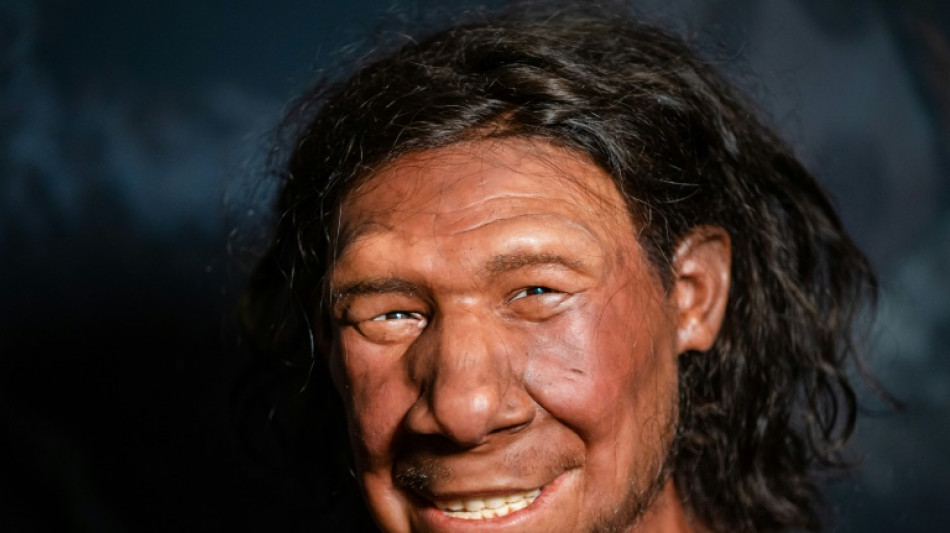
Was a lack of get-up-and-go the death of the Neanderthals? / Photo: Bart Maat - ANP/AFP/File

A new study posits a very surprising answer to one of history's great mysteries -- what killed off the Neanderthals?
Could it be that they were unadventurous, insular homebodies who never strayed far enough from home?
Scientists studying the remains of a Neanderthal found in France said Wednesday that these human relatives were socially isolated from each other for tens of thousands of years, which could have fatally reduced their genetic diversity.
Up to now, the main theories for their demise were climate change, a disease outbreak, and even violence -- or interbreeding -- with Homo Sapiens.
Neanderthals populated Europe and Asia for a long time -- including a decent stint living alongside early modern humans -- until they abruptly died off 40,000 years ago.
That was the last moment when more than one species of human coexisted on Earth, French archaeologist Ludovic Slimak told AFP.
It was a "profoundly enigmatic moment, because we do not know how an entire humanity, which existed from Spain to Siberia, could suddenly go extinct," he said.
Slimak is the lead author of a new study in the journal Cell Genomics, which looked at the fossilised remains of a Neanderthal discovered in France's Rhone Valley in 2015.
The remains were found in Mandrin cave, which is known to have been home to both Neanderthals and Homo Sapiens over time.
The Neanderthal, dubbed Thorin in reference to the dwarf in J.R.R. Tolkien's "The Hobbit", is a rare find.
Thorin is the first Neanderthal unearthed in France since 1978 -- and one of only roughly 40 discovered in all of Eurasia.
- 50,000 years alone -
The archaeologists had spent a decade unsuccessfully trying to recover DNA from Mandrin cave when they found Thorin, Slimak said.
"As soon as the body came out of the ground," they sent a piece of molar to geneticists in Copenhagen for analysis, he added.
When the results came back, the team was stunned. Archaeological data had suggested the body was 40,000 to 45,000 years old, but the genomic analysis found it was from 105,000 years ago.
"One of the teams must have gotten it wrong," Slimak said.
It took seven years to get the story straight.
Analysing isotopes from Thorin's bones and teeth showed that he lived in an extremely cold climate, which matched an ice age only experienced by later Neanderthals around 40,000 years ago.
But Thorin's genome did not match those of previously discovered European Neanderthals at that time. Instead it resembled the genome of Neanderthals some 100,000 years ago, which had caused the confusion.
It turned out that Thorin was a member of an isolated and previously unknown community that had descended from some of Europe's earliest Neanderthal populations, the researchers said.
"The lineage leading to Thorin would have separated from the lineage leading to the other late Neanderthals around 105,000 years ago," senior study author Martin Sikora of the University of Copenhagen said in a statement.
This other lineage then spent a massive 50,000 years "without any genetic exchange with classic European Neanderthals," including some that only lived a two-week walk away, Slimak said.
- Dangers of inbreeding -
This kind of extended social isolation is unimaginable for the Neanderthals' cousins, the Homo Sapiens, particularly because the Rhone Valley then was a great migration corridor between northern Europe and the Mediterranean Sea.
Archaeological finds have long suggested that Neanderthals lived in a small area, ranging just a few dozen kilometres from their home.
Homo Sapiens, in comparison, had "infinitely larger" social circles, spreading over tens of thousands of square kilometres, Slimak said.
Neanderthals were also known to have lived in small groups -- so not venturing far likely meant there were not many options for a mate outside of their own family.
This kind of inbreeding reduces the genetic diversity in a species, which can spell doom over the long term.
Rather than single-handedly killing off the Neanderthals, their lack of intermingling could have made them more vulnerable to some of the other popular theories for their demise.
"When you are isolated for a long time, you limit the genetic variation that you have, which means you have less ability to adapt to changing climates and pathogens," said study co-author Tharsika Vimala, a population geneticist at the University of Copenhagen.
"It also limits you socially because you're not sharing knowledge or evolving as a population," she said.
(F.Schuster--BBZ)