Berliner Boersenzeitung - Thunderstorms are a 'boiling pot' of gamma rays, scientists find

EUR -
AED 4.321909
AFN 75.902
ALL 95.771107
AMD 434.467785
ANG 2.106391
AOA 1080.330027
ARS 1642.274312
AUD 1.625962
AWG 2.118295
AZN 1.985882
BAM 1.96238
BBD 2.377953
BDT 144.865714
BGN 1.963074
BHD 0.445872
BIF 3513.892011
BMD 1.176831
BND 1.494673
BOB 8.158284
BRL 5.796837
BSD 1.180659
BTN 111.287441
BWP 15.808002
BYN 3.336559
BYR 23065.882674
BZD 2.374541
CAD 1.605985
CDF 2725.54041
CHF 0.915221
CLF 0.026641
CLP 1048.521452
CNY 8.008392
CNH 8.002473
COP 4400.052486
CRC 541.588257
CUC 1.176831
CUP 31.186015
CVE 110.63689
CZK 24.298083
DJF 210.243129
DKK 7.472605
DOP 70.211831
DZD 155.647877
EGP 62.040143
ERN 17.652461
ETB 184.342777
FJD 2.57014
FKP 0.86476
GBP 0.864176
GEL 3.153737
GGP 0.86476
GHS 13.282534
GIP 0.86476
GMD 85.908987
GNF 10361.476442
GTQ 9.015457
GYD 247.018217
HKD 9.214544
HNL 31.386969
HRK 7.538657
HTG 154.634526
HUF 355.073961
IDR 20429.781797
ILS 3.419051
IMP 0.86476
INR 111.146603
IQD 1546.685821
IRR 1545061.090179
ISK 143.796851
JEP 0.86476
JMD 185.96351
JOD 0.834342
JPY 184.35583
KES 151.987652
KGS 102.879134
KHR 4735.676856
KMF 493.092378
KPW 1059.089938
KRW 1725.280964
KWD 0.361998
KYD 0.983899
KZT 546.773254
LAK 25909.651267
LBP 105366.039227
LKR 380.181465
LRD 216.662884
LSL 19.263123
LTL 3.474875
LVL 0.711853
LYD 7.467976
MAD 10.82119
MDL 20.312934
MGA 4902.165513
MKD 61.626661
MMK 2470.881826
MNT 4211.762597
MOP 9.52313
MRU 47.236169
MUR 55.099474
MVR 18.187949
MWK 2047.150739
MXN 20.28109
MYR 4.611415
MZN 75.198752
NAD 19.263287
NGN 1601.972297
NIO 43.445112
NOK 10.868008
NPR 178.045885
NZD 1.972016
OMR 0.452493
PAB 1.180659
PEN 4.089512
PGK 5.137987
PHP 71.222983
PKR 328.964472
PLN 4.2283
PYG 7226.166922
QAR 4.303639
RON 5.239285
RSD 117.378579
RUB 87.440025
RWF 1730.903477
SAR 4.448625
SBD 9.452608
SCR 16.208029
SDG 706.681291
SEK 10.842374
SGD 1.491351
SHP 0.878623
SLE 28.948494
SLL 24677.547872
SOS 674.762384
SRD 44.049995
STD 24358.020485
STN 24.581269
SVC 10.330637
SYP 130.091513
SZL 19.257568
THB 37.882439
TJS 11.033723
TMT 4.130676
TND 3.42477
TOP 2.833526
TRY 53.386632
TTD 7.986779
TWD 36.903646
TZS 3065.225138
UAH 51.696576
UGX 4415.805578
USD 1.176831
UYU 47.210295
UZS 14306.969264
VES 583.95408
VND 30962.416997
VUV 138.896796
WST 3.182259
XAF 658.127258
XAG 0.014651
XAU 0.000249
XCD 3.180444
XCG 2.127834
XDR 0.818499
XOF 658.163731
XPF 119.331742
YER 280.790888
ZAR 19.301631
ZMK 10592.883433
ZMW 22.491219
ZWL 378.939021
  • RBGPF

    0.0000

    63.18

    0%

  • CMSC

    -0.0400

    22.97

    -0.17%

  • CMSD

    0.0000

    23.42

    0%

  • BCE

    0.3400

    24.57

    +1.38%

  • GSK

    -0.0300

    50.5

    -0.06%

  • RYCEF

    -0.0500

    17.45

    -0.29%

  • NGG

    -1.9400

    85.91

    -2.26%

  • BCC

    -1.4800

    72.76

    -2.03%

  • RIO

    -2.4000

    103.11

    -2.33%

  • RELX

    -1.5900

    34.16

    -4.65%

  • VOD

    -0.4400

    15.69

    -2.8%

  • AZN

    -2.4000

    182.52

    -1.31%

  • JRI

    -0.0200

    13.15

    -0.15%

  • BP

    -0.8200

    43.81

    -1.87%

  • BTI

    -1.4800

    58.08

    -2.55%

Thunderstorms are a 'boiling pot' of gamma rays, scientists find
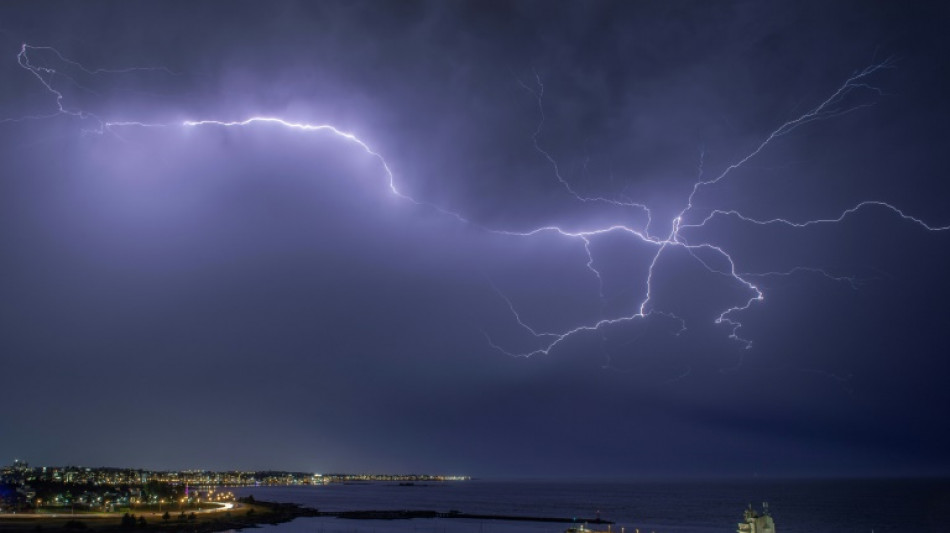
Thunderstorms are a 'boiling pot' of gamma rays, scientists find / Photo: Mariana SUAREZ - AFP/File

Thunderstorms are a 'boiling pot' of gamma rays, scientists find

Big thunderstorms continuously emit gamma rays that are undetectable from the ground, two studies said on Wednesday, upending what was previously thought -- and potentially pointing towards a clue in the mystery of how lightning is sparked.

Text size:

Despite the fact that 40,000 thunderstorms generate more than eight million lightning strikes above our heads every day, they "remain poorly understood", physicist Joseph Dwyer said in an analysis of the new research in the journal Nature.

Normally when people think of gamma rays -- bursts of an incredibly high-energy form of light -- they are coming from out of this world, such as solar flares, exploding stars or black holes.

However in the 1990s, NASA satellites tasked with hunting down high-energy particles from such cosmic sources detected gamma rays coming from Earth.

Other than inside nuclear reactors, nothing on our planet had been thought capable of generating gamma rays.

Since then, two different types of gamma rays have been observed inside thunderstorms -- both invisible to the naked eye.

Gamma-ray glows can last for a few minutes over a region roughly 20 kilometres (12 miles) wide, while more powerful "flashes" last less than a millisecond.

"As it turns out, essentially all big thunderstorms generate gamma rays all day long in many different forms," Steven Cummer, a researcher at Duke University and a co-author of one of the studies, said in a statement.

- Bubbling cauldron of gamma rays -

To find out more about what is happening inside thunderstorms, the international team of researchers used an NASA ER-2 airplane.

The scientific aircraft, based the American U-2 spy plane, can fly more than twice as high as a commercial airliner, soaring far above storm clouds.

Over a month in 2023, the plane left a Florida air force based to fly at an altitude of 20 kilometres over active storms, capturing evidence that gamma radiation is much more common than had been thought.

The storms almost continuously generated gamma-ray glows for hours across thousands of square kilometres, all of which were closely linked to the most intense areas of the storm.

The storms resemble "a huge gamma-glowing 'boiling pot' in both pattern and behaviour," said the author of the first Nature study, which was authored by Martino Marisaldi of Norway's University of Bergen.

The second study revealed that glows could intensify into what it called "flickering" gamma-ray flashes. These could be the elusive "missing link" between glows and flashes, it added.

These observations "blur the line between these two types of emission, suggesting that gamma-ray glows often morph into intense pulses", Dwyer explained.

Lightning often follows these intense gamma ray emissions, which suggests they might play some role in sparking lightning strikes, according to the second study.

"How lightning is initiated inside thunderstorms is one of the greatest mysteries in the atmospheric sciences," Dwyer said.

"It is amazing that, more than two decades into the 21st century, Earth's atmosphere has enough surprises in store to motivate an entirely new line of research."

(S.G.Stein--BBZ)