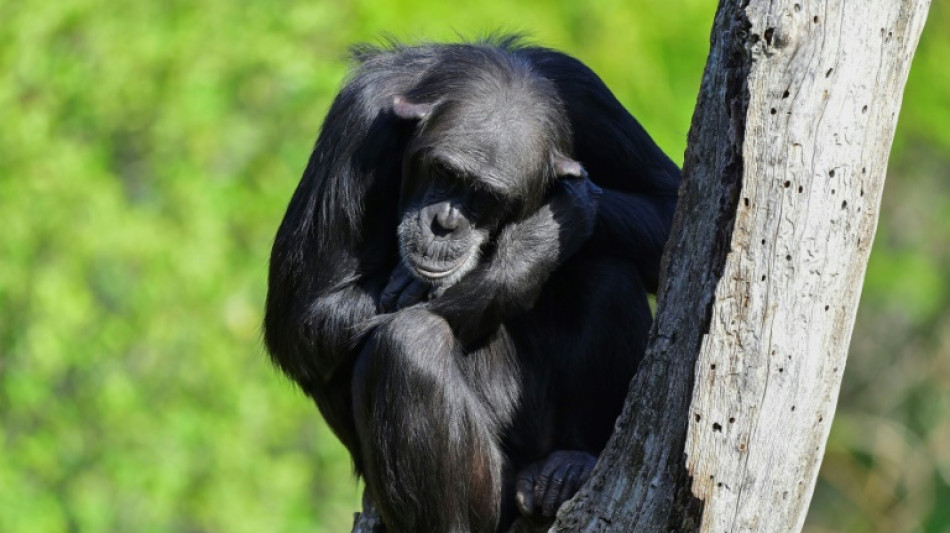
Chimps are upping their tool game, says study / Photo: Jose Jordan - AFP/File

"Planet of the Apes" may have been onto something.
Chimpanzees are steadily honing their tool-using skills -- a process unfolding over millennia, driven by the exchange of ideas through migrations between populations, according to a new study published Thursday in Science.
The finding in chimps -- humans' closest living relatives -- holds relevance for us too, as it supports the idea that, deep in the mists of time, our own ape ancestors leveraged social connections to improve their technologies, lead author Cassandra Gunasekaram told AFP.
Scientists have long marveled at chimps' ability to pass down intricate behaviors, like tool use, from one generation to the next.
Yet while human civilization has leapt from the Stone Age to the Space Age, chimpanzee "culture" -- defined as socially learned behaviors -- seemed to have remained static.
Gunasekaram, a doctoral student at the University of Zurich, set out to challenge this assumption.
- Connections spark innovation -
She and colleagues combined genetic data tracing ancient chimpanzee migrations across Africa with observations of 15 distinct foraging behaviors across dozens of populations and the four subspecies.
These behaviors were categorized into three levels: those requiring no tools, those with simple tools, like using chewed leaves as a sponge to absorb water from tree holes, and the most complex, which involve toolsets.
One striking example of toolset use comes from Congo, where chimps use a stout stick to bore a tunnel into the ground to reach a termite nest, then modify a plant stem by chewing its tip into a brush to "fish" for termites in the tunnel they've made.
The study found that advanced tool use strongly correlated with populations connected by genetic exchanges over the last 5,000–15,000 years, suggesting such behaviors spread when groups interacted.
Areas where three subspecies overlap exhibited the most complex tool use, highlighting how cross-group connections foster cultural knowledge.
By contrast, simpler behaviors, such as foraging without tools, seemed less tied to migration and likely evolved independently in different regions.
- Foraging efficiently -
Gunasekaram said this mirrors how trading ideas and incremental innovation have been critical to human technological progress, taking us from early abacuses to modern smartphones.
"They've become so complex that one person alone could not reinvent them from scratch," she said.
But unlike humans, chimps have far fewer opportunities to encounter new individuals and ideas -- migrations occur gradually, driven by sexually mature females moving to new communities to avoid inbreeding.
Analyzing ancient genetic flows helped the team overcome one of the biggest challenges in studying the evolution of chimpanzee culture: the limited window of observation, as the species has only been researched scientifically for about a century.
What's more, "Chimpanzee tools are made of sticks and stems, which are all perishable," Gunasekaram explained, making it nearly impossible to trace how their artifacts have evolved over time.
So, will chimps one day rival human ingenuity? Hardly. But given enough time, they could become more efficient foragers.
For example, some populations are already more advanced in cracking nuts with hammers and anvils made of stone , and one particularly innovative group has even invented a stabilizer for the anvil, said Gunasekaram.
(G.Gruner--BBZ)