Berliner Boersenzeitung - World's tiniest pacemaker is smaller than grain of rice

EUR -
AED 4.204786
AFN 72.131522
ALL 95.999785
AMD 432.40092
ANG 2.049533
AOA 1049.907549
ARS 1600.516512
AUD 1.633909
AWG 2.060887
AZN 1.943184
BAM 1.955796
BBD 2.309895
BDT 140.729685
BGN 1.957052
BHD 0.433001
BIF 3404.692377
BMD 1.144937
BND 1.467597
BOB 7.924982
BRL 6.10469
BSD 1.146897
BTN 105.862225
BWP 15.628033
BYN 3.393492
BYR 22440.773758
BZD 2.306495
CAD 1.569761
CDF 2584.123556
CHF 0.90381
CLF 0.026697
CLP 1054.13247
CNY 7.896174
CNH 7.904373
COP 4228.895119
CRC 539.601148
CUC 1.144937
CUP 30.340842
CVE 110.265235
CZK 24.466209
DJF 204.229543
DKK 7.471896
DOP 70.46015
DZD 153.144657
EGP 60.431974
ERN 17.174062
ETB 179.018681
FJD 2.551715
FKP 0.860737
GBP 0.863673
GEL 3.12551
GGP 0.860737
GHS 12.454972
GIP 0.860737
GMD 84.152708
GNF 10054.767863
GTQ 8.795019
GYD 239.939463
HKD 8.963452
HNL 30.358065
HRK 7.534712
HTG 150.375066
HUF 392.446831
IDR 19449.052236
ILS 3.600072
IMP 0.860737
INR 105.821702
IQD 1502.403197
IRR 1513292.432889
ISK 144.20515
JEP 0.860737
JMD 179.950383
JOD 0.811718
JPY 182.703386
KES 148.337757
KGS 100.124438
KHR 4598.96962
KMF 493.468258
KPW 1030.44363
KRW 1715.448554
KWD 0.351988
KYD 0.955702
KZT 561.461195
LAK 24574.94498
LBP 102700.170069
LKR 356.927642
LRD 209.870447
LSL 19.262157
LTL 3.380703
LVL 0.692561
LYD 7.317984
MAD 10.801676
MDL 20.006955
MGA 4762.010134
MKD 61.639593
MMK 2403.69357
MNT 4086.255615
MOP 9.24532
MRU 45.885897
MUR 53.251062
MVR 17.689468
MWK 1988.604232
MXN 20.439555
MYR 4.503092
MZN 73.172957
NAD 19.262241
NGN 1589.046972
NIO 42.20009
NOK 11.164686
NPR 169.37936
NZD 1.970105
OMR 0.443929
PAB 1.146797
PEN 3.954991
PGK 5.014989
PHP 68.684226
PKR 320.228483
PLN 4.271887
PYG 7398.983435
QAR 4.169009
RON 5.095425
RSD 117.37025
RUB 92.411407
RWF 1673.603562
SAR 4.29649
SBD 9.218713
SCR 17.510961
SDG 688.107329
SEK 10.803727
SGD 1.467125
SHP 0.859
SLE 28.107741
SLL 24008.777972
SOS 654.301392
SRD 42.990121
STD 23697.893319
STN 24.499945
SVC 10.035021
SYP 126.544188
SZL 19.255957
THB 37.130895
TJS 10.992623
TMT 4.007281
TND 3.391707
TOP 2.756734
TRY 50.576236
TTD 7.778017
TWD 36.716884
TZS 2982.257478
UAH 50.575008
UGX 4311.990346
USD 1.144937
UYU 46.070098
UZS 13847.908522
VES 506.869099
VND 30103.267553
VUV 135.392596
WST 3.13165
XAF 655.958396
XAG 0.014405
XAU 0.000229
XCD 3.094251
XCG 2.066904
XDR 0.815802
XOF 655.955531
XPF 119.331742
YER 273.125117
ZAR 19.293513
ZMK 10305.812598
ZMW 22.32295
ZWL 368.669387
  • RBGPF

    0.1000

    82.5

    +0.12%

  • RELX

    -0.0400

    34.14

    -0.12%

  • NGG

    0.0900

    90.9

    +0.1%

  • BCC

    0.3800

    70

    +0.54%

  • RYCEF

    -1.1300

    16.12

    -7.01%

  • BCE

    -0.1100

    25.57

    -0.43%

  • GSK

    -0.8900

    53.39

    -1.67%

  • CMSC

    -0.1500

    22.99

    -0.65%

  • CMSD

    -0.1100

    22.99

    -0.48%

  • JRI

    -0.2300

    12.59

    -1.83%

  • RIO

    -2.8700

    87.83

    -3.27%

  • AZN

    -2.6000

    189.9

    -1.37%

  • VOD

    0.1000

    14.41

    +0.69%

  • BTI

    0.0400

    59.93

    +0.07%

  • BP

    0.5100

    42.67

    +1.2%

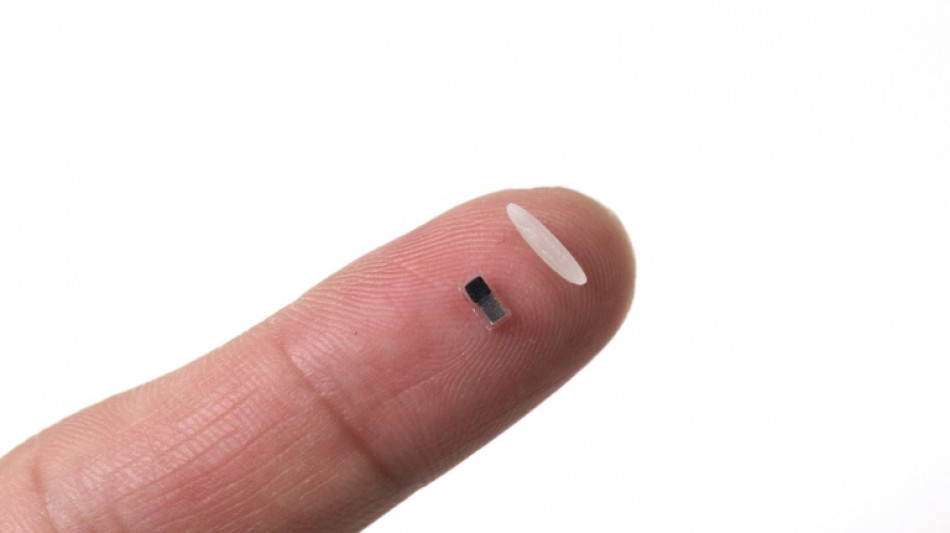
World's tiniest pacemaker is smaller than grain of rice
World's tiniest pacemaker is smaller than grain of rice / Photo: John A. Rogers - Northwestern University/AFP

World's tiniest pacemaker is smaller than grain of rice

Scientists said Wednesday they have developed the world's tiniest pacemaker, a temporary heartbeat regulator smaller than a grain of rice that can be injected and controlled by light before dissolving.

Text size:

While still years away from being tested in humans, the wireless pacemaker was hailed as a "transformative breakthrough" that could spur advances in other areas of medicine.

Millions of people across the world have permanent pacemakers, which stimulate hearts with electrical pulses to ensure they beat normally.

The US-led team of researchers behind the new device said they were motivated to help the one percent of children born with congenital heart defects who need a temporary pacemaker in the week after surgery.

The pacemaker could also help adults restore a normal heartbeat as they recover from heart surgery.

Currently, temporary pacemakers require surgery to sew electrodes onto heart muscles, with wires connecting to a powered device on the patient's chest.

When the pacemaker is no longer needed, doctors or nurses pull out the wires, which can sometimes cause damage.

Neil Armstrong, the first person to walk on the Moon, died from internal bleeding after his temporary pacemaker was removed in 2012.

But the newly developed pacemaker is wireless. And at just one millimetre thick and 3.5 millimetres long, it can fit into the tip of a syringe.

It has also been designed to dissolve into the body when no longer needed, sparing patients invasive surgery.

- 'Significant leap forward' -

The pacemaker is paired to a soft patch worn on the patient's chest, according to a study describing the device in the journal Nature.

When the patch detects irregular heartbeats, it automatically flashes light that tells the pacemaker what heartbeat it should stimulate.

The pacemaker is powered by what is called a galvanic cell, which uses the body's fluids to convert chemical energy into electrical pulses that stimulate the heart.

So far, the pacemaker has worked effectively in tests on mice, rats, pigs, dogs and human heart tissue in the lab, according to the study.

Senior study author John Rogers of Northwestern University in the United States told AFP he estimated the pacemaker could be tested in humans in two to three years.

His lab has launched a start-up to pursue this goal, he added.

In the future, the underlying technology could also "create unique and powerful strategies to address societal challenges in human health," Rogers said.

Bozhi Tian, whose lab at the University of Chicago has also developed light-activated pacemakers but was not involved in the latest research, called it a "significant leap forward".

"This new pacemaker is a transformative breakthrough in medical technology," he told AFP.

"It's a paradigm shift in temporary pacing and bioelectronic medicine, opening up possibilities far beyond cardiology -- including nerve regeneration, wound healing and integrated smart implants."

Heart disease is the world's leading cause of death, according to the World Health Organization.

(P.Werner--BBZ)