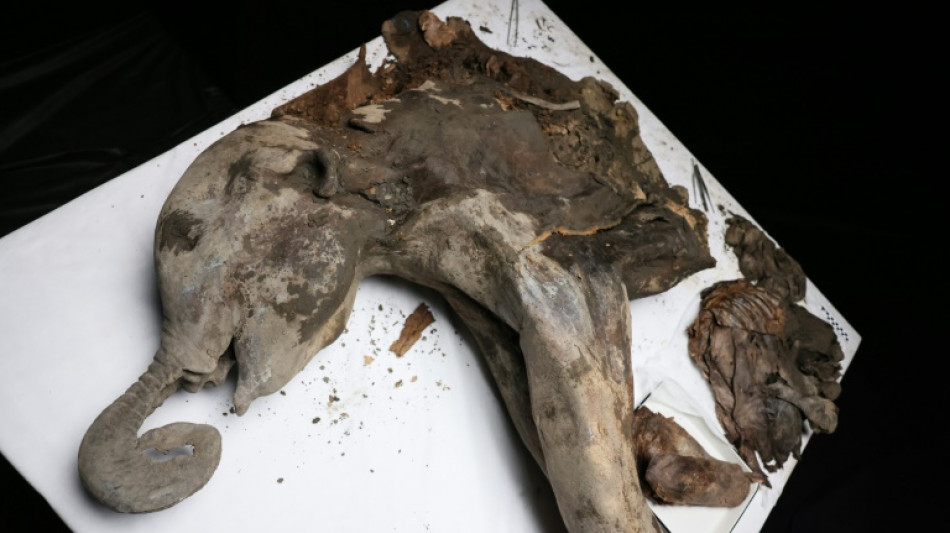
Yana, a 130,000-year-old baby mammoth, goes under the scalpel / Photo: STRINGER - AFP

Making incisions and carefully taking samples, the scientists at a laboratory in Russia's far east looked like pathologists carrying out a post-mortem.
But the body they were dissecting is a baby mammoth who died around 130,000 years ago.
Discovered last year, the calf -- nicknamed Yana, for the river basin where she was found -- is in a remarkable state of preservation, giving scientists a glimpse into the past and, potentially, the future as climate change thaws the permafrost in which she was found.
Yana's skin has kept its greyish-brown colour and clumps of reddish hairs. Her wrinkled trunk is curved and points to her mouth. The orbits of her eyes are perfectly recognisable and her sturdy legs resemble those of a modern-day elephant.
This necropsy -- an autopsy on an animal -- "is an opportunity to look into the past of our planet", said Artemy Goncharov, head of the Laboratory of Functional Genomics and Proteomics of Microorganisms at the Institute of Experimental Medicine in Saint Petersburg.
Scientists hope to find unique ancient bacteria and carry out genetic analysis of the plants and spores Yana ate to learn more about the place and time she lived.
The calf largely avoided the ravages of time because she lay for thousands of years encased in permafrost in the Sakha region in Siberia.
Measuring 1.2 metres (nearly four feet) at the shoulder and two metres long, and weighing 180 kilogrammes (nearly 400 pounds), Yana could be the best-preserved mammoth specimen ever found, retaining internal organs and soft tissues, the Russian scientists said.
- Stomach, intestines -
Dissecting her body is a treasure trove for the half-dozen scientists that were carrying out the necropsy in late March at the Mammoth Museum at North-Eastern Federal University in the regional capital, Yakutsk.
Wearing white sterile bodysuits, goggles and facemasks, the zoologists and biologists spent several hours working on the front quarters of the mammoth, a species that died out almost 4,000 years ago.
"We can see that many organs and tissues are very well preserved," Goncharov said.
"The digestive tract is partly preserved, the stomach is preserved. There are still fragments of the intestines, in particular the colon," enabling scientists to take samples, he said.
They are "searching for ancient microorganisms" preserved inside the mammoth, so they can study their "evolutionary relationship with modern microorganisms," he said.
While one scientist cut Yana's skin with scissors, another made an incision in the inner wall with a scalpel. They then placed tissue samples in test tubes and bags for analysis.
Another table held the mammoth's hindquarters, which remained embedded in a cliff when the front quarters fell below.
The scent emanating from the mammoth was reminiscent of a mixture of fermented earth and flesh, macerated in the Siberian subsoil.
"We are trying to reach the genitals," said Artyom Nedoluzhko, director of the Paleogenomics Laboratory of the European University at Saint Petersburg.
"Using special tools, we want to go into her vagina in order to gather material to understand what microbiota lived in her when she was alive."
- 'Milk tusks' -
Yana was first estimated to have died around 50,000 years ago, but is now dated at "more than 130,000 years" following analysis of the permafrost layer where she lay, said Maxim Cheprasov, director of the Mammoth Museum.
As for her age at death, "it's already clear that she is over a year old because her milk tusks have already appeared," he added.
Both elephants and mammoths have early milk tusks that later fall out.
Scientists are yet to determine why Yana died so young.
At the time when this herbivore mammal was chewing grass, "here on the territory of Yakutia there were not yet any humans", Cheprasov said, since they appeared in modern-day Siberia between 28,000 and 32,000 years ago.
The secret to Yana's exceptional preservation lies in the permafrost: the soil in this region of Siberia that is frozen year-round and acts like a gigantic freezer, preserving the carcasses of prehistoric animals.
The discovery of Yana's exposed body came about because of thawing permafrost, which scientists believe is due to global warming.
The study of the microbiology of such ancient remains also explores the "biological risks" of global warming, Goncharov said.
Some scientists are researching whether the melting permafrost could release potentially harmful pathogens, he explained.
"There are some hypotheses or conjectures that in the permafrost there could be preserved pathogenic microorganisms, which when it thaws can get into the water, plants and the bodies of animals -- and humans," he said.
(G.Gruner--BBZ)