Berliner Boersenzeitung - Wildfire tears through California forest as temperatures rocket

EUR -
AED 4.343054
AFN 77.464136
ALL 96.578481
AMD 443.001294
ANG 2.116924
AOA 1084.432259
ARS 1696.425045
AUD 1.722632
AWG 2.13043
AZN 2.015092
BAM 1.955364
BBD 2.363473
BDT 143.548016
BGN 1.986001
BHD 0.442401
BIF 3475.425631
BMD 1.182587
BND 1.500966
BOB 8.109193
BRL 6.256361
BSD 1.173439
BTN 107.717999
BWP 16.277373
BYN 3.32206
BYR 23178.695489
BZD 2.360074
CAD 1.622687
CDF 2578.039008
CHF 0.928842
CLF 0.026073
CLP 1029.489324
CNY 8.24689
CNH 8.21806
COP 4228.657801
CRC 580.770597
CUC 1.182587
CUP 31.338542
CVE 110.240437
CZK 24.267271
DJF 208.973438
DKK 7.466899
DOP 73.933527
DZD 153.154875
EGP 55.703589
ERN 17.738798
ETB 182.791072
FJD 2.661179
FKP 0.866817
GBP 0.872725
GEL 3.18162
GGP 0.866817
GHS 12.79115
GIP 0.866817
GMD 86.329235
GNF 10278.709772
GTQ 9.006993
GYD 245.515296
HKD 9.221278
HNL 30.954103
HRK 7.533317
HTG 153.905708
HUF 382.153287
IDR 19840.785951
ILS 3.707232
IMP 0.866817
INR 108.414214
IQD 1537.357457
IRR 49816.456691
ISK 145.777895
JEP 0.866817
JMD 184.718842
JOD 0.838501
JPY 184.146504
KES 151.256298
KGS 103.416722
KHR 4722.947667
KMF 496.686746
KPW 1064.451335
KRW 1710.44627
KWD 0.362349
KYD 0.977982
KZT 590.738376
LAK 25359.349612
LBP 105085.885516
LKR 363.548997
LRD 217.091629
LSL 18.94048
LTL 3.491871
LVL 0.715335
LYD 7.466336
MAD 10.748905
MDL 19.97255
MGA 5308.817127
MKD 61.616271
MMK 2482.599361
MNT 4215.258085
MOP 9.4253
MRU 46.916546
MUR 54.292994
MVR 18.271409
MWK 2034.84661
MXN 20.533372
MYR 4.736855
MZN 75.57955
NAD 18.94048
NGN 1680.526824
NIO 43.180379
NOK 11.555294
NPR 172.348599
NZD 2.007958
OMR 0.454249
PAB 1.173539
PEN 3.936823
PGK 5.018882
PHP 69.733624
PKR 328.342141
PLN 4.208885
PYG 7847.251532
QAR 4.278347
RON 5.101724
RSD 117.373848
RUB 88.840205
RWF 1711.518652
SAR 4.433442
SBD 9.606873
SCR 16.856244
SDG 711.330129
SEK 10.584272
SGD 1.505082
SHP 0.887246
SLE 28.859447
SLL 24798.24684
SOS 669.450838
SRD 45.081425
STD 24477.153012
STN 24.494542
SVC 10.267712
SYP 13078.904017
SZL 18.935781
THB 36.920787
TJS 10.972155
TMT 4.139053
TND 3.416239
TOP 2.847384
TRY 51.246799
TTD 7.971224
TWD 37.116428
TZS 3004.130641
UAH 50.599026
UGX 4148.075755
USD 1.182587
UYU 44.440098
UZS 14242.826515
VES 416.584326
VND 31036.982812
VUV 141.323792
WST 3.258724
XAF 655.810877
XAG 0.011483
XAU 0.000237
XCD 3.196
XCG 2.114929
XDR 0.815618
XOF 655.810877
XPF 119.331742
YER 281.814608
ZAR 19.0597
ZMK 10644.701884
ZMW 23.02187
ZWL 380.792372
  • RBGPF

    -0.8100

    83.23

    -0.97%

  • SCS

    0.0200

    16.14

    +0.12%

  • RELX

    0.0600

    39.9

    +0.15%

  • CMSC

    0.1000

    23.75

    +0.42%

  • GSK

    0.5000

    49.15

    +1.02%

  • VOD

    0.2300

    14.17

    +1.62%

  • NGG

    1.3200

    81.5

    +1.62%

  • RYCEF

    0.3000

    17.12

    +1.75%

  • AZN

    1.2600

    92.95

    +1.36%

  • BTI

    0.9400

    59.16

    +1.59%

  • RIO

    3.1300

    90.43

    +3.46%

  • BCE

    0.4900

    25.2

    +1.94%

  • BP

    1.1000

    36.53

    +3.01%

  • CMSD

    0.0900

    24.13

    +0.37%

  • JRI

    0.0100

    13.68

    +0.07%

  • BCC

    -1.1800

    84.33

    -1.4%

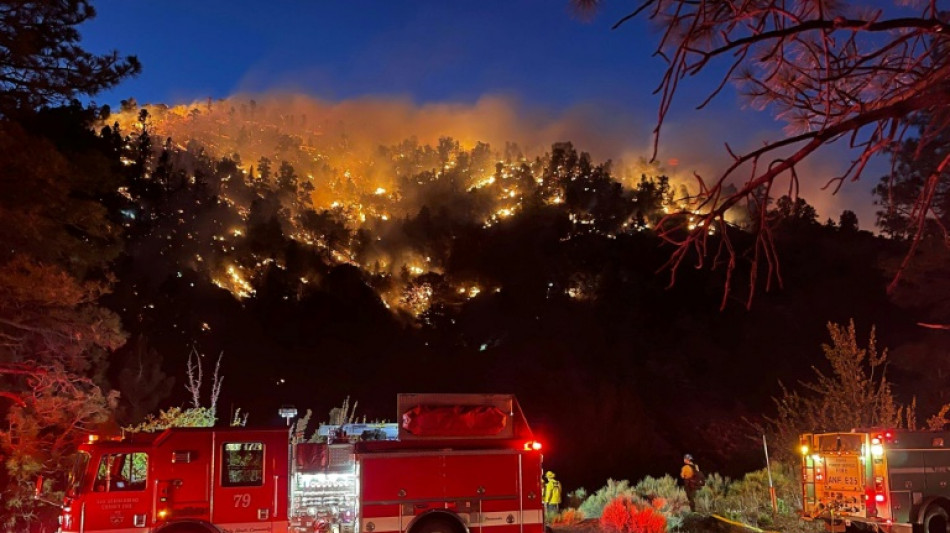
Wildfire tears through California forest as temperatures rocket
Wildfire tears through California forest as temperatures rocket / Photo: - - San Bernardino County Fire/AFP

Wildfire tears through California forest as temperatures rocket

A wildfire was burning out of control Monday in forest outside Los Angeles after a weekend of record-breaking temperatures, and as forecasters warn of fire danger across the parched US West.

Text size:

Almost 1,000 acres (400 hectares) had been charred by the Sheep fire since it erupted in the Los Angeles national forest on Saturday evening.

Thousands were warned to evacuate their homes in the community of Wrightwood, with the fire just five percent contained.

Firefighters battling the blaze said it was ripping through an area with thick vegetation.

"The terrain is very steep -- it's a bad area," Alison Hesterly of Cal Fire San Bernardino told the Los Angeles Times.

Over 200 firefighters were battling the blaze, including from the air.

"They're really focusing hard on the edges on the northwest side and the south end to secure those edges, to hope that the wind won't blow the fire out of the containment lines," Hesterly said.

"That's a huge focus for today — securing those high-risk areas with hose lines and hand lines."

Video on social media showed towering flames gripping trees and being fanned by strong winds.

The fire erupted as parts of California and the West were smothered in extreme heat, with temperatures in Palm Springs on Saturday hitting 114 Fahrenheit (45.5 Celsius), the highest for the day since records began.

The Southwest has been baked by a once-in-a-thousand-years drought that has left vegetation exceedingly dry and flammable.

Fire chiefs are warning that 2022 looks set to be a terrible year for wildfire.

"Given the fuel conditions, the fire conditions that we're here talking about, I foresee a very tough four, five, six months in front of us," Orange County Fire Authority Chief Brian Fennessy said last week.

The National Weather Service said Monday that fire danger was widespread across the region.

"An expansive area of critical fire weather conditions is expected across the Southwest into the southern and central Rockies and High Plains," the NWS said on its website.

"Red Flag Warnings have been raised today for large portions of southeastern Utah, southwestern Colorado, northern and central Arizona and New Mexico today.

"Dry and windy conditions will promote the rapid spread of fires across these areas."

In New Mexico, hundreds of thousands of acres of forest have been consumed in wildfires that have been burning for months.

US President Joe Biden on Saturday flew over some of the blazes, before being briefed on efforts to combat the fires.

Temperature variations and wildfires are both expected parts of the natural cycle.

But global warming, driven chiefly by humanity's unchecked burning of fossil fuels, has knocked the climate out of kilter.

Hot periods are hotter than they were and weather cycles are less stable.

This has exacerbated droughts and vastly increases the risk of disastrous wildfires.

(K.Müller--BBZ)