Berliner Boersenzeitung - Webb telescope: NASA to reveal deepest image ever taken of Universe

EUR -
AED 4.211393
AFN 72.244796
ALL 95.982096
AMD 432.319357
ANG 2.052753
AOA 1051.557417
ARS 1603.424201
AUD 1.641243
AWG 2.064125
AZN 1.954004
BAM 1.955435
BBD 2.309469
BDT 140.703754
BGN 1.960126
BHD 0.435819
BIF 3404.065016
BMD 1.146736
BND 1.467326
BOB 7.923522
BRL 6.112796
BSD 1.146686
BTN 105.842257
BWP 15.625085
BYN 3.392867
BYR 22476.027392
BZD 2.30607
CAD 1.583471
CDF 2588.183773
CHF 0.912745
CLF 0.026638
CLP 1051.798264
CNY 7.908585
CNH 7.921286
COP 4222.512346
CRC 539.499363
CUC 1.146736
CUP 30.388506
CVE 110.244435
CZK 24.575006
DJF 204.191911
DKK 7.505507
DOP 70.446859
DZD 153.116438
EGP 59.873831
ERN 17.201041
ETB 178.984913
FJD 2.555735
FKP 0.866182
GBP 0.866311
GEL 3.131037
GGP 0.866182
GHS 12.452677
GIP 0.866182
GMD 84.289519
GNF 10052.124908
GTQ 8.79336
GYD 239.895251
HKD 8.97946
HNL 30.352338
HRK 7.568004
HTG 150.351954
HUF 394.179508
IDR 19448.701448
ILS 3.605729
IMP 0.866182
INR 106.170389
IQD 1502.119799
IRR 1515669.760861
ISK 144.837141
JEP 0.866182
JMD 179.916439
JOD 0.813081
JPY 183.185402
KES 148.312334
KGS 100.281732
KHR 4598.142277
KMF 494.243657
KPW 1032.019272
KRW 1723.258101
KWD 0.352542
KYD 0.955522
KZT 561.355287
LAK 24570.416711
LBP 102681.246162
LKR 356.863432
LRD 209.830859
LSL 19.258608
LTL 3.386014
LVL 0.69365
LYD 7.316635
MAD 10.799685
MDL 20.003269
MGA 4761.111877
MKD 61.628504
MMK 2408.293814
MNT 4109.908675
MOP 9.243576
MRU 45.877442
MUR 53.33513
MVR 17.717506
MWK 1988.229122
MXN 20.584147
MYR 4.516425
MZN 73.288336
NAD 19.258608
NGN 1588.807126
NIO 42.19213
NOK 11.176343
NPR 169.34741
NZD 1.985003
OMR 0.440925
PAB 1.146586
PEN 3.954262
PGK 5.014065
PHP 68.334433
PKR 320.169477
PLN 4.298483
PYG 7397.620071
QAR 4.168222
RON 5.117429
RSD 117.34811
RUB 91.632507
RWF 1673.28787
SAR 4.303626
SBD 9.233195
SCR 17.507734
SDG 689.18878
SEK 10.871865
SGD 1.469547
SHP 0.860349
SLE 28.152796
SLL 24046.494883
SOS 654.177972
SRD 43.05769
STD 23735.121842
STN 24.495431
SVC 10.033128
SYP 126.777699
SZL 19.252409
THB 37.071728
TJS 10.99055
TMT 4.013576
TND 3.391067
TOP 2.761065
TRY 50.645643
TTD 7.776549
TWD 36.918714
TZS 2986.942825
UAH 50.565468
UGX 4311.195803
USD 1.146736
UYU 46.061408
UZS 13845.417319
VES 507.665371
VND 30152.278788
VUV 137.132233
WST 3.13652
XAF 655.834663
XAG 0.014239
XAU 0.000228
XCD 3.099112
XCG 2.066515
XDR 0.815648
XOF 655.834663
XPF 119.331742
YER 273.554311
ZAR 19.360243
ZMK 10322.005017
ZMW 22.318837
ZWL 369.248554
  • RBGPF

    0.1000

    82.5

    +0.12%

  • CMSD

    -0.1100

    22.99

    -0.48%

  • VOD

    0.1000

    14.41

    +0.69%

  • CMSC

    -0.1500

    22.99

    -0.65%

  • RYCEF

    -1.1300

    16.12

    -7.01%

  • GSK

    -0.8900

    53.39

    -1.67%

  • BTI

    0.0400

    59.93

    +0.07%

  • BCE

    -0.1100

    25.57

    -0.43%

  • RELX

    -0.0400

    34.14

    -0.12%

  • NGG

    0.0900

    90.9

    +0.1%

  • AZN

    -2.6000

    189.9

    -1.37%

  • JRI

    -0.2300

    12.59

    -1.83%

  • RIO

    -2.8700

    87.83

    -3.27%

  • BCC

    0.3800

    70

    +0.54%

  • BP

    0.5100

    42.67

    +1.2%

Webb telescope: NASA to reveal deepest image ever taken of Universe
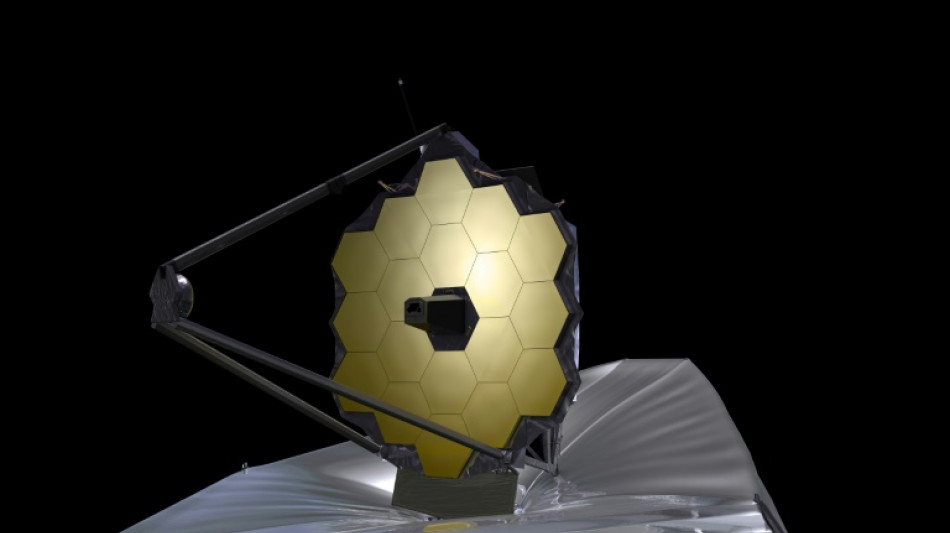
Webb telescope: NASA to reveal deepest image ever taken of Universe / Photo: HO - NASA/AFP/File

Webb telescope: NASA to reveal deepest image ever taken of Universe

NASA administrator Bill Nelson said Wednesday the agency will reveal the "deepest image of our Universe that has ever been taken" on July 12, thanks to the newly operational James Webb Space Telescope.

Text size:

"If you think about that, this is farther than humanity has ever looked before," Nelson said during a press briefing at the Space Telescope Science Institute in Baltimore, the operations center for the $10 billion observatory that was launched in December last year and is now orbiting the Sun a million miles (1.5 million kilometers) away from Earth.

A wonder of engineering, Webb is able to gaze further into the cosmos than any telescope before it, thanks to its enormous primary mirror and its instruments that focus on infrared, allowing it to peer through dust and gas.

"It's going to explore objects in the solar system and atmospheres of exoplanets orbiting other stars, giving us clues as to whether potentially their atmospheres are similar to our own," added Nelson, speaking via phone while isolating with Covid.

"It may answer some questions that we have: Where do we come from? What more is out there? Who are we? And of course, it's going to answer some questions that we don't even know what the questions are."

Webb's infrared capabilities allow it to see deeper back in time to the Big Bang, which happened 13.8 billion years ago.

Because the Universe is expanding, light from the earliest stars shifts from the ultraviolet and visible wavelengths it was emitted in, to longer infrared wavelengths -- which Webb is equipped to detect at an unprecedented resolution.

At present, the earliest cosmological observations date to within 330 million years of the Big Bang, but with Webb's capacities, astronomers believe they will easily break the record.

- 20 year life -

In more good news, NASA deputy administrator Pam Melroy revealed that, thanks to an efficient launch by NASA's partner Arianespace, the telescope could stay operational for 20 years, double the lifespan that was originally envisaged.

"Not only will those 20 years allow us to go deeper into history, and time, but we will go deeper into science because we have the opportunity to learn and grow and make new observations," she said.

NASA also intends to share Webb's first spectroscopy of a faraway planet, known as an exoplanet, on July 12, said NASA's top scientist Thomas Zurbuchen.

Spectroscopy is a tool to analyze the chemical and molecular composition of distant objects and a planetary spectrum can help characterize its atmosphere and other properties such as whether it has water and what its ground is like.

"Right from the beginning, we'll look at these worlds out there that keep us awake at night as we look into the starry sky and wonder as we're looking out there, is there life elsewhere?" said Zurbuchen.

Nestor Espinoza, as STSI astronomer, told AFP that previous exoplanet spectroscopies carried out using existing instruments were very limited compared to what Webb could do.

"It's like being in a room that is very dark and you only have a little pinhole you can look through," he said, of current technology. Now, with Webb, "You've opened a huge window, you can see all the little details."

(T.Burkhard--BBZ)