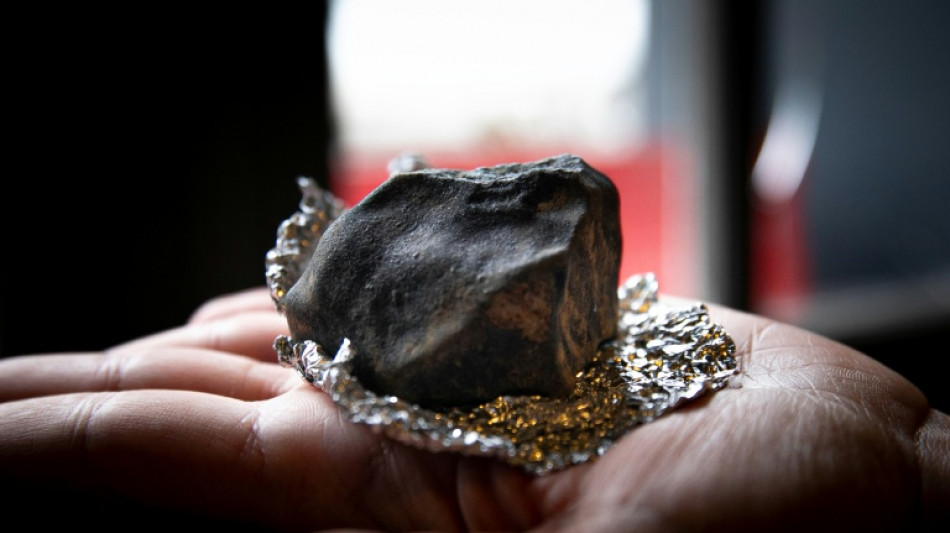
Amateur astronomers help track asteroid to French impact site / Photo: Lou BENOIST - AFP/File

With help from amateur astronomers, scientists tracked how an asteroid travelled from space, broke up in Earth's atmosphere and sent fiery fragments shooting to the ground, gathering new information about how these space rocks disintegrate.
Asteroid 2023 CX1 briefly lit up the sky as it disintegrated over northwestern France at around 4:00 pm (1400 GMT) on February 13, 2023.
Seven hours earlier, a Hungarian astronomer had spotted the small asteroid -- which was less than a metre (yard) wide and weighed 650 kilogrammes (more than 1,400 pounds) -- roughly 200,000 kilometres (125,000 miles) from Earth.
In the following minutes and hours, scientists at NASA and the European Space Agency were able to calculate the location and timeline of its descent with unprecedented accuracy.
Observatories around the world then joined forces to study every aspect of its journey, using a range of scientific instruments.
Among those swiftly mobilising were professional and amateur astronomers from France's FRIPON/Vigie-Ciel network, which launched around a decade ago with a mission to detect and collect meteorites -- the fragments of asteroids that make it to the ground.
"We received dozens of photos and videos" of the asteroid's seconds-long journey through the atmosphere, said meteorite specialist Brigitte Zanda of France's National Museum of Natural History, which is part of the network.
Collaborating with the public -- including sifting through images posted on social media -- allowed scientists to observe the phenomenon with "unmatched precision", Zanda told AFP.
In particular, there was an "extremely useful video showing the object fragmenting, which lets us see how many pieces it broke into -- and how this happened", she said.
- 'Brutal' break-up -
The first meteorite, weighing 93 grams (3.3 ounces), was found two days later in the northwestern French commune of Saint-Pierre-le-Viger with the help of locals.
In all, around a dozen meteorites were collected and added to the museum's collection.
After two-and-a-half years, all the information gathered about the asteroid was published in a study in Nature Astronomy this week.
So far only 11 asteroids have been detected before impact -- and meteorites were only recovered from four of them, said the study.
2023 CX1 likely broke off from a larger rock in the Massalia asteroid family in the asteroid belt between Mars and Jupiter, according to the study.
As the asteroid entered our planet's atmosphere, it disintegrated "very brutally in two stages" around 28 kilometres above Earth, Zanda said.
During the process, it lost 98 percent of its mass -- and released a huge amount of energy.
"This is maybe only the second time we have observed fragmentation like this," Zanda said. "It probably depends on the speed, angle of impact and internal structure of the rock."
None of the fiery meteorites that made it to Earth damaged anything.
However simulations showed that this particular kind of fragmentation has the potential to cause more damage than a more gradual disintegration -- such as the way a much-bigger asteroid exploded over the Russian city of Chelyabinsk in 2013.
As that 20-metre-wide asteroid descended, "there were five successive fragments, each releasing a small amount of energy," Zanda said.
Still, the resulting shockwave shattered windows across the city, injuring more than 1,000 people.
(Y.Berger--BBZ)