Berliner Boersenzeitung - NASA launches mission to study space weather

EUR -
AED 4.228503
AFN 74.840624
ALL 94.127157
AMD 419.440648
AOA 1056.983085
ARS 1714.468211
AUD 1.637112
AWG 2.073955
AZN 1.950676
BAM 1.955006
BBD 2.309662
BDT 141.612509
BHD 0.432406
BIF 3405.166219
BMD 1.151398
BND 1.477291
BOB 13.503283
BRL 5.830796
BSD 1.146785
BTN 109.670334
BWP 15.669958
BYN 3.355692
BYR 22567.392285
BZD 2.306364
CAD 1.613764
CDF 2619.429118
CHF 0.929011
CLF 0.027077
CLP 1065.67602
CNY 7.777978
CNH 7.76506
COP 3596.597548
CRC 521.3657
CUC 1.151398
CUP 30.512035
CVE 110.223124
CZK 24.224279
DJF 204.208229
DKK 7.475034
DOP 66.740007
DZD 152.814845
EGP 58.895254
ERN 17.270963
ETB 185.09302
FJD 2.551953
FKP 0.866575
GBP 0.855817
GEL 3.010936
GGP 0.866575
GHS 13.400327
GIP 0.866575
GMD 85.203176
GNF 10066.170305
GTQ 8.750675
GYD 239.928428
HKD 9.029698
HNL 30.915197
HRK 7.539468
HTG 149.93741
HUF 362.251506
IDR 20800.57272
ILS 3.52022
IMP 0.866575
INR 109.786852
IQD 1508.330811
IRR 1583171.652906
ISK 142.611766
JEP 0.866575
JMD 181.368494
JOD 0.816293
JPY 184.639837
KES 148.988918
KGS 100.689588
KHR 4651.645831
KMF 495.674681
KRW 1652.261255
KWD 0.356715
KYD 0.955654
KZT 543.986636
LAK 26113.696403
LBP 102690.567426
LKR 385.18519
LRD 207.581137
LSL 19.124868
LTL 3.399777
LVL 0.696469
LYD 7.339702
MAD 10.805289
MDL 20.194399
MGA 4953.884174
MKD 61.500033
MMK 2417.754444
MNT 4140.683274
MOP 9.265636
MRU 46.182736
MUR 54.115187
MVR 17.800805
MWK 1998.826461
MXN 19.954239
MYR 4.709529
MZN 73.585828
NAD 19.124701
NGN 1564.899128
NIO 42.199753
NOK 10.995214
NPR 175.460149
NZD 1.961308
OMR 0.442725
PAB 1.146834
PEN 3.90218
PGK 5.059572
PHP 70.575491
PKR 318.483874
PLN 4.308605
PYG 6853.91987
QAR 4.195922
RON 5.248038
RSD 117.399938
RUB 91.792409
RWF 1688.041399
SAR 4.296631
SBD 9.304565
SCR 15.503035
SDG 690.838534
SEK 10.992565
SGD 1.477306
SLE 28.428769
SOS 655.405463
SRD 43.459473
STD 23831.604944
STN 24.488251
SVC 10.034316
SZL 19.020452
THB 38.458972
TJS 10.591076
TMT 4.041405
TND 3.396052
TRY 54.68183
TTD 7.783232
TWD 37.322094
TZS 3046.025658
UAH 51.161808
UGX 4295.181671
USD 1.151398
UYU 46.132474
UZS 13767.291304
VES 858.593013
VND 30255.27383
VUV 137.628024
WST 3.169249
XAF 655.662347
XAG 0.019692
XAU 0.000282
XCD 3.11171
XCG 2.066735
XDR 0.815434
XOF 659.750559
XPF 119.331742
YER 274.375111
ZAR 18.983379
ZMK 10363.964701
ZMW 21.415376
ZWL 370.749546
  • JRI

    0.1100

    12.87

    +0.85%

  • CMSC

    0.1200

    21.81

    +0.55%

  • BCC

    -2.3000

    75.38

    -3.05%

  • GSK

    -1.1500

    52.07

    -2.21%

  • CMSD

    -0.0200

    22.02

    -0.09%

  • NGG

    1.5100

    80.39

    +1.88%

  • RIO

    3.5200

    97.18

    +3.62%

  • AZN

    -1.9600

    171.34

    -1.14%

  • BCE

    -0.6300

    21.7

    -2.9%

  • BTI

    -1.3800

    61.69

    -2.24%

  • RBGPF

    0.0000

    69.21

    0%

  • RYCEF

    1.3900

    19.86

    +7%

  • BP

    0.9000

    44.22

    +2.04%

  • VOD

    0.0100

    16.14

    +0.06%

  • RELX

    -1.6200

    36.61

    -4.43%

NASA launches mission to study space weather
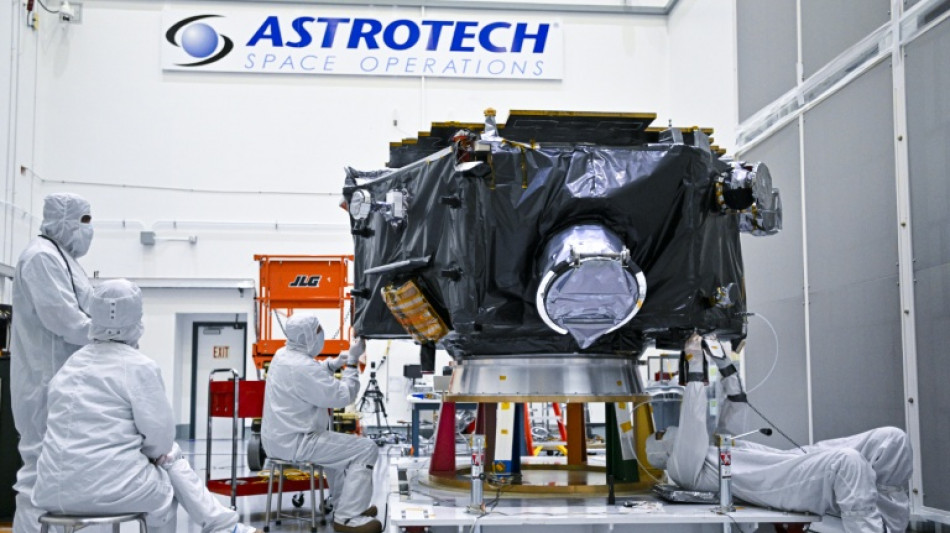
NASA launches mission to study space weather / Photo: Miguel J. Rodriguez Carrillo - AFP

NASA launches mission to study space weather

The United States launched three spacecraft on Wednesday in an effort to better monitor space weather such as solar storms, which can interfere with technology and power systems on Earth.

Text size:

The three probes blasted off from Florida's Kennedy Space Center aboard a Falcon 9 rocket, built by the private company SpaceX.

Once in space, the probes will begin a long journey to reach the Lagrange 1 point -- a spot approximately 1.5 million kilometers (930,000 miles) from the Sun that offers a stable vantage point for observation.

The "Interstellar Mapping and Acceleration Probe" (IMAP) will use its instruments to study the Sun's high-energy particles and the protective magnetic bubble surrounding our solar system known as the heliosphere, data that can offer insight into space weather and cosmic radiation.

Solar storms are high-radiation events caused by flares on the Sun's surface, and are very difficult to predict.

They can impact activities on Earth, including aviation, mobile communications and power grids -- and potentially endanger astronauts and satellites in space.

The Space Weather Follow-on (SWFO-L1) spacecraft, operated by the National Oceanic and Atmospheric Administration (NOAA), aims to detect the weather patterns in advance.

"It can't stop an incoming threat, but it can give us time to prepare," said Irene Parker of NOAA.

With notice, authorities could shelter astronauts, warn aircraft pilots of forthcoming disruptions of GPS systems and adapt power grids in anticipation.

And the Carruthers Geocorona Observatory, the third passenger on the rocket, will study the Earth's exosphere in a bid to better understand how space weather affects it.

(K.Lüdke--BBZ)