Berliner Boersenzeitung - Oldest European human fossil possibly found in Spain

EUR -
AED 4.097449
AFN 71.405838
ALL 90.616631
AMD 401.812176
ANG 1.996881
AOA 1024.222003
ARS 1713.62359
AUD 1.586729
AWG 2.011067
AZN 1.901136
BAM 1.949248
BBD 2.247416
BDT 138.524382
BGN 1.950072
BHD 0.421299
BIF 3348.664286
BMD 1.11571
BND 1.425553
BOB 13.529886
BRL 6.07404
BSD 1.115884
BTN 105.894855
BWP 15.416733
BYN 3.286955
BYR 21867.912013
BZD 2.244137
CAD 1.557179
CDF 2582.868583
CHF 0.919211
CLF 0.028029
CLP 1106.739931
CNY 7.431859
CNH 7.423714
COP 3564.257673
CRC 507.410374
CUC 1.11571
CUP 26.778989
CVE 109.89512
CZK 24.353323
DJF 198.284384
DKK 7.473331
DOP 67.635085
DZD 151.572144
EGP 62.471162
ERN 16.735647
ETB 180.144444
FJD 2.503323
FKP 0.834157
GBP 0.833173
GEL 2.905153
GGP 0.834157
GHS 12.999654
GIP 0.834157
GMD 82.562922
GNF 9875.80474
GTQ 8.530327
GYD 233.890121
HKD 8.751695
HNL 29.991191
HRK 7.552251
HTG 146.193844
HUF 365.770399
IDR 20257.942776
ILS 3.508417
IMP 0.834157
INR 105.955892
IQD 1691.514361
IRR 2084608.919934
ISK 136.009279
JEP 0.834157
JMD 177.313208
JOD 0.791082
JPY 175.639543
KES 144.89766
KGS 97.567376
KHR 4552.758153
KMF 492.028411
KPW 1004.138774
KRW 1488.758952
KWD 0.347165
KYD 0.92987
KZT 505.929434
LAK 25123.453969
LBP 99922.520078
LKR 371.142489
LRD 189.679884
LSL 18.595196
LTL 3.294401
LVL 0.674882
LYD 7.172858
MAD 10.971273
MDL 19.973579
MGA 5047.215888
MKD 61.373706
MMK 2342.889781
MNT 4014.19357
MOP 9.016372
MRU 45.247533
MUR 52.751181
MVR 17.238138
MWK 1934.449804
MXN 20.968745
MYR 4.527778
MZN 71.305434
NAD 18.595196
NGN 1501.980106
NIO 41.06198
NOK 10.263084
NPR 169.431569
NZD 1.980129
OMR 0.42899
PAB 1.115989
PEN 3.862019
PGK 5.077909
PHP 71.054021
PKR 308.685923
PLN 4.404209
PYG 6537.027277
QAR 4.067528
RON 5.337002
RSD 117.453044
RUB 90.005057
RWF 1647.141366
SAR 4.188821
SBD 8.990619
SCR 15.366815
SDG 671.103544
SEK 10.959674
SGD 1.42586
SHP 0.834925
SLE 25.553845
SLL 23395.881486
SOS 637.665207
SRD 41.972449
STD 23092.94018
STN 24.418688
SVC 9.763183
SYP 14506.458423
SZL 18.59018
THB 37.692586
TJS 10.270839
TMT 3.904984
TND 3.336784
TOP 2.686361
TRY 55.727254
TTD 7.56557
TWD 36.423355
TZS 2946.810525
UAH 50.610698
UGX 4742.208913
USD 1.11571
UYU 44.860819
UZS 13383.494263
VES 990.169911
VND 28789.217736
VUV 133.012093
WST 3.094869
XAF 655.957
XAG 0.022737
XAU 0.000287344858
XCD 3.015262
XCG 2.010941
XDR 0.788865
XOF 655.957
XPF 119.331742
YER 263.534658
ZAR 18.66081
ZMK 10042.73102
ZMW 22.500973
ZWL 359.258099
SSP 6409.974876
MXV 2.363292
  • CMSD

    -0.1200

    19.81

    -0.61%

  • JRI

    0.0000

    10.77

    0%

  • BCC

    -1.8200

    74.15

    -2.45%

  • CMSC

    -0.2228

    19.53

    -1.14%

  • BCE

    0.2000

    20.34

    +0.98%

  • RIO

    0.0100

    94.17

    +0.01%

  • AZN

    -2.7400

    161.47

    -1.7%

  • GSK

    -1.1800

    48.17

    -2.45%

  • RBGPF

    0.0000

    65

    0%

  • NGG

    0.8800

    75.82

    +1.16%

  • RYCEF

    -0.7300

    19.08

    -3.83%

  • BTI

    -0.4500

    54.4

    -0.83%

  • BP

    0.4700

    43.99

    +1.07%

  • RELX

    -0.0600

    33.18

    -0.18%

  • VOD

    -0.1800

    16.15

    -1.11%

Oldest European human fossil possibly found in Spain
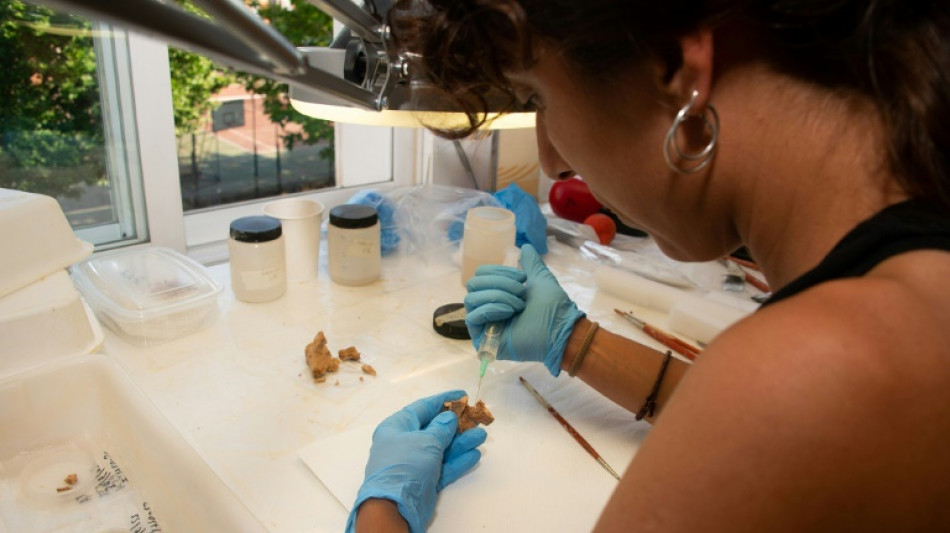
Oldest European human fossil possibly found in Spain / Photo: Maria Dolors GUILLEN - Equipo de Investigacion de Atapuerca/AFP

Oldest European human fossil possibly found in Spain

A jawbone fragment discovered in northern Spain last month could be the oldest known fossil of a human ancestor found to date in Europe, Spanish paleontologists said Friday.

Text size:

The researchers said the fossil found at an archaeological site on June 30 in northern Spain's Atapuerca mountain range is around 1.4 million years old.

Until now, the oldest hominid fossil found in Europe was a jawbone found at the same site in 2007 which was determined to be 1.2 million years old.

Atapuerca contains one of the richest records of prehistoric human occupation in Europe.

Researchers will now have to "complete" their first estimate for the age of the jawbone fragment using scientific dating techniques, palaeoanthropologist Jose-Maria Bermudez de Castro, the co-director of the Atapuerca research project, said during a news conference.

But since the jawbone fragment was found some two metres below the layer of earth where the jawbone in 2007 was found, "it is logical and reasonable to think it is older," he added.

The scientific dating of the jawbone fragment will be carried out at the National Centre for Research on Human Evolution in Burgos, a city located about 10 kilometres (six miles) from Atapuerca.

The process should take between six to eight months to complete, Bermudez de Castro said.

The analysis could help identify which hominid species the jawbone fragment belongs to and better understand the human beings evolved on the European continent.

Scientists have so far been unable to determine with certainty which species the jawbone discovered in 2007 belonged to.

The fossil could correspond to the species called Homo antecessor, discovered in the 1990s.

The Atapuerca Foundation which runs the archaeological site said in a statement that is "very likely" that the jawbone fragment "belongs to one of the first populations that colonised Europe".

The archaeological site of Atapuerca was in 2000 included on UNESCO's list of world heritage sites, giving it access to United Nations conservation funding.

It contains thousands of hominid fossils and tools including a flint discovered in 2013 that is 1.4 million years old.

(Y.Yildiz--BBZ)