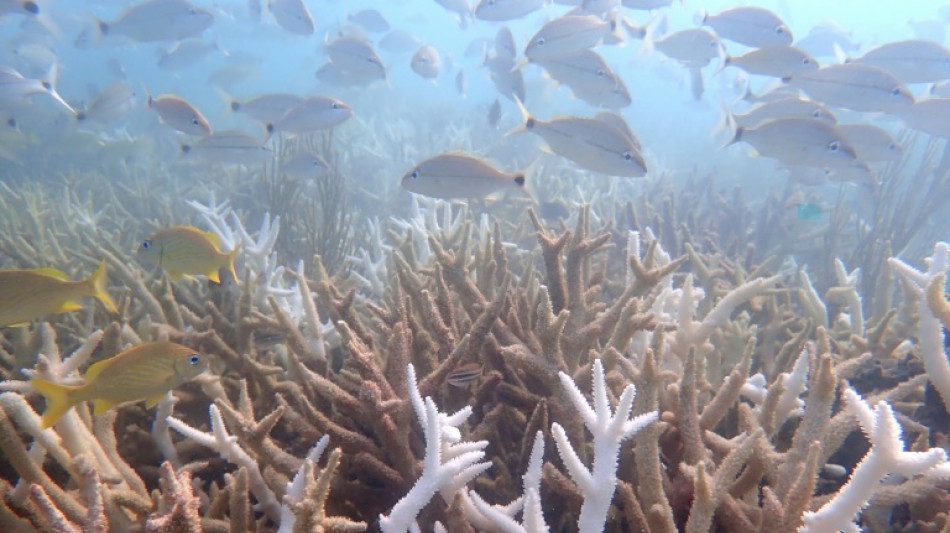
'Functionally extinct': Heat wave left Florida coral species on brink / Photo: Shayle Matsuda - Shedd Aquarium/AFP

A record-breaking marine heat wave in 2023 left two ecologically vital coral species "functionally extinct" in Florida's Coral Reef, a study said Thursday, highlighting the growing dangers a warming climate poses for the world's oceans.
Elkhorn and staghorn corals, which take their names from the antler shapes they resemble and belong to the Acropora family, are fast-growing "reef builder" species that long dominated waters off Florida and in the Caribbean.
Both species -- but particularly elkhorn -- created complex branch-like structures akin to the dense canopy of a forest, providing crucial habitats for fish and acting as natural barriers against strong waves and coastal erosion.
The pair have been declining since the 1970s from threats including climate change, disease and unsustainable fishing, which combined to leave them critically endangered.
But the 2023 heat wave -- which persisted for almost three months and brought record-high ocean temperatures off Florida -- proved a death knell for the two species in the Florida Coral Reef, the world's third-largest barrier reef.
"The numbers of these species that are left on the reef today are now so low that they're no longer able to perform their functional role in the ecosystem," Ross Cunning, a research biologist at the Shedd Aquarium in Chicago and co–first author of the paper that was published in Science, told AFP.
"This is something that demonstrates the level of climate pressures on our natural world and something we all need to take extremely seriously," he added.
Research to determine how many remain in the Caribbean is underway, but the picture appears bleak there, too.
- Restoration efforts -
Coral are made up of tiny individual animals called polyps, which maintain a symbiotic relationship with microscopic algae that live within their tissues. When the algae are stressed by heat or pollution, however, they leave, causing the coral to "bleach" and become vulnerable to disease and death.
Recovery is sometimes possible.
But the new research, which involved diver surveys to track more than 52,000 colonies of staghorn and elkhorn coral across 391 sites, unfortunately confirmed scientists' worst fears: the two species were nearly totally wiped out, with mortality ranging 98-100 percent in the Florida Keys and Dry Tortugas off the state's south coast.
They fared better off southeast Florida, on the northern extent of the reef tract, where mortality rates were around 38 percent thanks to slightly cooler conditions.
In a blow to conservation efforts the losses impacted both wild and restored Acropora, grown in nurseries then planted onto the reef as part of restoration projects that have been in place since the 2000s.
It's not yet well understood what made the elkhorn and staghorn coral more sensitive to heat than other coral species that did not experience the same catastrophic losses.
Scientists have been safeguarding many of Florida's remaining Acropora in aquariums and nurseries, and have since added survivors of the 2023 heat wave. The idea is to study the genes that helped them withstand heat, and possibly introduce new genetic diversity from populations outside of Florida that might boost resilience.
"Restoration is more critical than ever to preventing a complete extinction," said Cunning. "But we know that the way that we perform restoration fundamentally needs to change -- we can't continue just planting out as much coral as possible."
Ultimately, efforts to help coral adapt must go hand-in-hand with action to curb climate change and save the reefs -- which support a quarter of all ocean life, provide food and income for hundreds of millions of people, protect shorelines from waves and floods and are even responsible for beloved sandy white beaches.
"Coral reefs may be some of the first ecosystems on our planet to be feeling impacts at this level from extreme heat waves due to climate change," said Cunning. "But what does that mean for the next ecosystem?"
(B.Hartmann--BBZ)