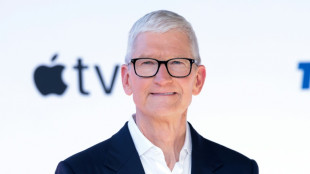
Google unveils $6.4 bn investment in Germany / Photo: Tobias SCHWARZ - AFP

Google unveiled its biggest-ever investment in Germany on Tuesday, pledging 5.5 billion euros ($6.4 billion) for a new data centre and other projects, as Europe seeks to catch up in the AI race.
It comes after AI chip juggernaut Nvidia and Deutsche Telekom last week announced plans for a high-tech hub in Germany aimed at helping industry speed up adoption of artificial intelligence.
The cash injections are a boost for Germany, whose economy is struggling, as well as Europe as it seeks to catch up with AI leaders the United States and China.
"We are driving growth in Germany," Chancellor Friedrich Merz said as Google announced the investments, which are to be made by 2029.
"Our country is and will remain one of the most attractive places for investment in the world," he said.
Google's plans include a new data centre and expansion of an existing centre in the western state of Hesse, providing computing power for artificial intelligence.
It also plans to expand its offices in Berlin, Frankfurt and Munich, and outlined various projects aimed at reducing its greenhouse gas emissions.
These included buying renewable wind and solar energy and a "heat recovery project" that would see excess heat produced by a data centre re-used by local residents.
The plans will support around 9,000 jobs a year in Germany, Google said.
"Google is deepening its roots in Germany, extending our investments in the country and creating new avenues for AI-driven transformation," said Philipp Justus, Google's country manager for Germany.
- Boost the digital sector -
Merz's coalition, which took power this year, is seeking to attract more foreign investment to boost the digital sector with prospects for the country's traditional industrial titans increasingly bleak.
The recently unveiled Nvidia project involves a one-billion-euro investment for a computing hub in the southern city of Munich designed to enable European companies, from big industry players to start-ups, better access to AI.
Germany is quickly building up its data centres -- by 2030, the country's data centre computing power will increase by 70 percent, according to digital business association Bitkom.
Europe still lags far behind, however -- as of last year the continent's data centres had computing capacity of 16 gigawatts, compared with 48 in the US and 38 in China, according to the group.
While the investments will be broadly welcomed in Germany as Merz seeks to reboot the economy, some are nevertheless concerned about the reliance on US tech giants in sensitive areas such as AI.
Increasingly uneasy ties between Europe and the US since President Donald Trump returned to power have fuelled calls for more "digital sovereignty" -- meaning the region's data should be stored at home, where European rules and norms apply, rather than handed to US firms.
Google made a nod to these concerns on Tuesday, emphasising in its announcement that it offered "sovereign" cloud computing that allowed customers to adopt "AI capabilities, while adhering to local requirements and European values".
Kristina Sinemus, a senior official responsible for digital affairs in Hesse, also played down concerns that working with US tech giants could threaten data security.
"We don't automatically hand over all the data to the US with a US investor," she said, stressing that agreements could ensure data was kept at home.
"We need to stop thinking in black and white terms, because it's a bit more complex than that."
(A.Berg--BBZ)