Berliner Boersenzeitung - Strange 'inside-out' planetary system baffles astronomers

EUR -
AED 4.306892
AFN 75.646395
ALL 95.724676
AMD 440.383498
AOA 1075.402786
ARS 1618.291285
AUD 1.660634
AWG 2.110932
AZN 1.998313
BAM 1.955283
BBD 2.358476
BDT 143.861942
BHD 0.442483
BIF 3480.679195
BMD 1.17274
BND 1.492105
BOB 8.091859
BRL 5.874493
BSD 1.17099
BTN 108.630262
BWP 15.720841
BYN 3.360911
BYR 22985.699188
BZD 2.355077
CAD 1.623248
CDF 2697.30186
CHF 0.925863
CLF 0.026604
CLP 1047.072999
CNY 8.007515
CNH 8.003896
COP 4264.671791
CRC 541.956627
CUC 1.17274
CUP 31.077603
CVE 110.235837
CZK 24.379388
DJF 208.524835
DKK 7.473758
DOP 70.511346
DZD 155.090971
EGP 62.282523
ERN 17.591096
ETB 183.744691
FJD 2.593519
FKP 0.871268
GBP 0.871893
GEL 3.155128
GGP 0.871268
GHS 12.886591
GIP 0.871268
GMD 86.200888
GNF 10274.281963
GTQ 8.95763
GYD 244.98519
HKD 9.185254
HNL 31.099773
HRK 7.535913
HTG 153.539382
HUF 375.515762
IDR 20041.301486
ILS 3.558339
IMP 0.871268
INR 109.170935
IQD 1533.994185
IRR 1543472.109781
ISK 143.297523
JEP 0.871268
JMD 185.141021
JOD 0.831519
JPY 186.659169
KES 151.529913
KGS 102.556542
KHR 4687.759864
KMF 492.551108
KPW 1055.463642
KRW 1741.014707
KWD 0.362014
KYD 0.975842
KZT 553.363609
LAK 25823.168542
LBP 104866.057933
LKR 369.552236
LRD 215.463
LSL 19.212217
LTL 3.462796
LVL 0.709379
LYD 7.444031
MAD 10.884021
MDL 20.175663
MGA 4859.714374
MKD 61.623698
MMK 2463.648667
MNT 4191.379097
MOP 9.446501
MRU 46.804618
MUR 54.556297
MVR 18.131
MWK 2030.462846
MXN 20.666065
MYR 4.649959
MZN 75.008877
NAD 19.212217
NGN 1594.344064
NIO 43.088601
NOK 11.170234
NPR 173.80802
NZD 2.00417
OMR 0.451071
PAB 1.17099
PEN 3.952054
PGK 5.068659
PHP 70.219557
PKR 326.614995
PLN 4.284167
PYG 7572.996582
QAR 4.269071
RON 5.092392
RSD 117.338958
RUB 90.423579
RWF 1710.047611
SAR 4.395737
SBD 9.450111
SCR 17.808289
SDG 704.81699
SEK 10.873585
SGD 1.494779
SLE 28.878761
SOS 669.222959
SRD 43.917976
STD 24273.345166
STN 24.49352
SVC 10.246289
SYP 129.623549
SZL 19.216916
THB 37.771646
TJS 11.130156
TMT 4.110453
TND 3.421695
TRY 52.380465
TTD 7.946898
TWD 37.224875
TZS 3038.69612
UAH 50.876041
UGX 4332.853754
USD 1.17274
UYU 47.247501
UZS 14239.233045
VES 558.033909
VND 30885.274174
VUV 138.291232
WST 3.206844
XAF 655.783514
XAG 0.015387
XAU 0.000247
XCD 3.169388
XCG 2.110442
XDR 0.815584
XOF 655.783514
XPF 119.331742
YER 278.115659
ZAR 19.218277
ZMK 10556.069282
ZMW 22.278106
ZWL 377.621722
  • RBGPF

    -13.5000

    69

    -19.57%

  • NGG

    -0.0300

    90.29

    -0.03%

  • CMSD

    0.0400

    22.63

    +0.18%

  • RELX

    -0.0400

    33.3

    -0.12%

  • RIO

    1.1300

    98.26

    +1.15%

  • BCE

    -0.5400

    23.35

    -2.31%

  • BTI

    -0.0400

    58.81

    -0.07%

  • GSK

    -0.1500

    58.21

    -0.26%

  • RYCEF

    -0.2700

    16.96

    -1.59%

  • CMSC

    0.0400

    22.43

    +0.18%

  • BP

    0.5400

    46.44

    +1.16%

  • JRI

    0.0400

    13.02

    +0.31%

  • BCC

    -0.4100

    80.17

    -0.51%

  • VOD

    -0.1600

    15.69

    -1.02%

  • AZN

    -0.9600

    204.03

    -0.47%

Strange 'inside-out' planetary system baffles astronomers
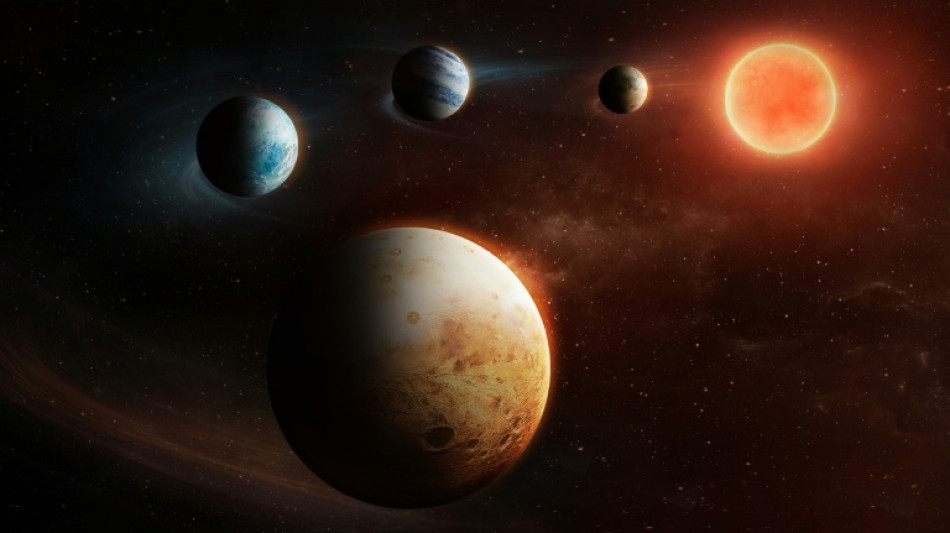
Strange 'inside-out' planetary system baffles astronomers / Photo: Handout - ESA/AFP

Strange 'inside-out' planetary system baffles astronomers

Surprised astronomers said Thursday they have discovered a star with planets in a bizarre order that defies scientific expectations -- and suggests these faraway worlds formed in a manner never seen before.

Text size:

In our Solar System, the four planets closest to the Sun are small and rocky, while the four farther out are gas giants.

Scientists had thought this planetary order -- rocky first, then gaseous -- was consistent across the universe.

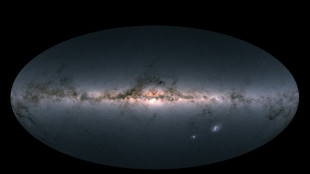
However, a star called LHS 1903 discovered in the Milky Way's thick disc suggests otherwise.

An international team of astronomers analysing data from several different telescopes had already spotted three planets orbiting the red dwarf star, which is cooler and less bright than our Sun.

The closest planet to the star was rocky, followed by two gas giants. That is the order scientists expect.

But digging into observations made by Europe's exoplanet-probing Cheops space telescope revealed a fourth planet farther out in the system -- and it is rocky.

"That makes this an inside-out system, with a planet order of rocky-gaseous-gaseous-and then rocky again," explained Thomas Wilson, the lead author of a new study describing the discovery in the journal Science.

"Rocky planets don't usually form so far away from their home star," the planetary astrophysicist from University of Warwick in the UK said in a statement.

- One planet after another -

Inner planets are expected to be small and rocky because intense radiation from the nearby star blasts most of the gas away from their rocky core.

But farther out in the cold reaches of the system, a thick atmosphere can form around cores, creating gas giants.

Puzzled by the weird LHS 1903 planetary system, the team of astronomers tried to figure out what could have happened.

After ruling out several possibilities, they came up with a scenario: what if the planets formed one at a time?

According to the most widely accepted theory, planets form simultaneously in a massive ring of gas and dust called a protoplanetary disc. This involves tiny dust grains clumping together then snowballing into cores that eventually evolve into mighty planets.

However, by the time the fourth planet orbiting LHS 1903 formed, "the system may have already run out of gas," Wilson said.

"Yet here is a small, rocky world, defying expectations," he added.

"It seems that we have found first evidence for a planet which formed in what we call a gas-depleted environment."

Since the 1990s, astronomers have discovered more than 6,000 planets outside our Solar System -- called exoplanets -- mostly by spotting slight changes in brightness as they cross in front of their star.

"Historically, our planet formation theories are based on what we see and know about our Solar System," said Isabel Rebollido, a planetary disc researcher at the European Space Agency.

"As we are seeing more and more different exoplanet systems, we are starting to revisit these theories."

(T.Renner--BBZ)