Artemis astronauts glimpse Moon's 'Grand Canyon' ahead of historic lunar flyby / Photo: Handout - NASA/AFP

The Artemis astronauts have taken in sights of the Moon never before seen by human eyes, crew members reported on Sunday as their spacecraft crossed the two-thirds mark on their journey to a long-anticipated lunar flyby.
As the astronauts went to bed in the early hours of Sunday, closing out the fourth day of their 10-day mission, they were nearly 200,000 miles (321,869 kilometers) from Earth and 82,000 miles from the Moon, according to NASA's online dashboard.
The US space agency published on Sunday an image taken by the Artemis crew, showing a distant Moon with the Orientale basin visible.
"This mission marks the first time the entire basin has been seen with human eyes," NASA said. The massive crater, which resembles a bullseye, had been photographed before by orbiting cameras.
Speaking to Canadian children live from space, astronaut Christina Koch said the crew was most excited to see the basin -- sometimes known as the Moon's "Grand Canyon."
"It's very distinctive and no human eyes previously had seen this crater until today, really, when we were privileged enough to see it," Koch said during the question-and-answer session hosted by the Canadian Space Agency.
The next major milestone is expected overnight Sunday into Monday, at which point the astronauts will enter the "lunar sphere of influence," where the Moon's gravity will have stronger pull on the spacecraft than Earth's.
If all proceeds smoothly, as the Orion spacecraft whips around the Moon the astronauts -- Americans Koch, Reid Wiseman and Victor Glover along with Canadian Jeremy Hansen -- could set a record by venturing farther from Earth than any human before.
- Flyby plans reviewed -
NASA said the Artemis crew has completed a manual piloting demonstration and reviewed their lunar flyby plan, including reviewing the surface features they must analyze and photograph during their time circling the Moon.
Earlier, the astronauts kicked off their day with a meal that included scrambled eggs and coffee, NASA said, and had woken up to the tune of Chappell Roan's pop smash "Pink Pony Club."
"Morale is high on board," commander Reid Wiseman told Houston's Mission Control center as the space crew's work day began.
The father of two girls was in high spirits in part because he had the chance to speak with his daughters from space.
"We're up here, we're so far away, and for a moment, I was reunited with my little family," he told a live press conference. "It was just the greatest moment of my entire life."
It's a feat Wiseman has dubbed "Herculean" and which humanity has not accomplished in more than half-a-century.
The astronauts have had geology training in order to be able to photograph and describe lunar features, including ancient lava flows and impact craters.
They'll see the Moon from a unique vantage point compared with the Apollo missions of the 1960s and 70s.
Apollo flights flew some 70 miles above the lunar surface, but the Artemis 2 crew will be just over 4,000 miles at their closest approach, which will allow them to see the complete, circular surface of the Moon, including regions near both poles.
- Never before seen -
The Artemis 2 astronauts have already seen brand-new perspectives.
"Last night, we did have our first view of the moon far side, and it was just absolutely spectacular," Koch, the mission specialist, said during a live interview from space.
John Honeycutt, manager of NASA's Space Launch System program, shared at a briefing Saturday a new image transmitted by the astronauts.
"On the far left, you can see features of the Moon that have never been seen by human eyes until yesterday," Honeycutt said, explaining that only robotic imagers had previously "seen" that region.
The Artemis 2 crew has been busy taking photographs including with smartphones, devices NASA recently approved to take aboard spaceflights.
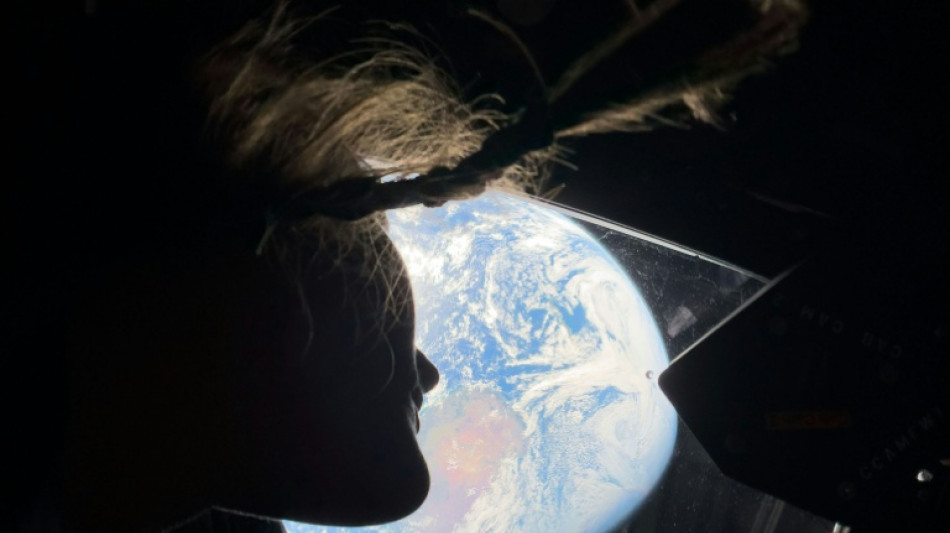
The space agency had previously released images from Orion that included a full portrait of Earth, featuring its deep blue oceans and billowing clouds.
The Artemis 2 mission is part of a longer-term plan to repeatedly return to the Moon, with the goal of establishing a permanent lunar base that will offer a platform for further exploration.
It's a highly anticipated journey that demands exacting precision -- but there's still room for the astronauts to live out their childhood dreams of spaceflight.
"It just makes me feel like a little kid," said Hansen recently, describing the joy of floating.
(Y.Berger--BBZ)