Berliner Boersenzeitung - Giant step for humankind: Artemis crew to set space distance record

EUR -
AED 4.297021
AFN 73.701381
ALL 95.402513
AMD 434.241071
ANG 2.093917
AOA 1073.932683
ARS 1632.563026
AUD 1.638657
AWG 2.108676
AZN 1.988026
BAM 1.954633
BBD 2.356993
BDT 143.584292
BGN 1.951449
BHD 0.44167
BIF 3481.508397
BMD 1.169862
BND 1.494302
BOB 8.086173
BRL 5.872007
BSD 1.170201
BTN 110.934781
BWP 15.817491
BYN 3.295133
BYR 22929.289176
BZD 2.353595
CAD 1.600383
CDF 2714.078892
CHF 0.924021
CLF 0.02671
CLP 1051.23342
CNY 7.99887
CNH 8.003187
COP 4240.046719
CRC 532.182333
CUC 1.169862
CUP 31.001335
CVE 110.433944
CZK 24.392772
DJF 208.384722
DKK 7.474697
DOP 69.314082
DZD 155.145875
EGP 62.008399
ERN 17.547925
ETB 184.106986
FJD 2.57972
FKP 0.865839
GBP 0.866944
GEL 3.152727
GGP 0.865839
GHS 13.032313
GIP 0.865839
GMD 85.987077
GNF 10268.479608
GTQ 8.940625
GYD 244.832809
HKD 9.168148
HNL 31.141585
HRK 7.538
HTG 153.268512
HUF 365.220878
IDR 20312.30857
ILS 3.477356
IMP 0.865839
INR 110.83182
IQD 1532.518817
IRR 1539537.987924
ISK 143.600486
JEP 0.865839
JMD 183.500466
JOD 0.829426
JPY 187.352137
KES 150.970964
KGS 102.280191
KHR 4691.14572
KMF 492.511719
KPW 1052.836528
KRW 1736.800314
KWD 0.359965
KYD 0.975214
KZT 542.026457
LAK 25672.615598
LBP 104819.608215
LKR 373.886822
LRD 214.96177
LSL 19.343637
LTL 3.454298
LVL 0.707637
LYD 7.42271
MAD 10.828533
MDL 20.145889
MGA 4853.75659
MKD 61.710764
MMK 2456.685675
MNT 4186.801833
MOP 9.446661
MRU 46.794504
MUR 54.726535
MVR 18.074627
MWK 2036.729175
MXN 20.434466
MYR 4.623879
MZN 74.765619
NAD 19.36168
NGN 1606.2429
NIO 42.951484
NOK 10.871256
NPR 177.495292
NZD 2.002113
OMR 0.449836
PAB 1.170201
PEN 4.11324
PGK 5.082756
PHP 72.096258
PKR 326.069677
PLN 4.256746
PYG 7280.654072
QAR 4.262098
RON 5.100714
RSD 117.42374
RUB 87.726178
RWF 1708.583002
SAR 4.3879
SBD 9.389234
SCR 17.208205
SDG 702.499104
SEK 10.872303
SGD 1.497183
SHP 0.87342
SLE 28.807824
SLL 24531.410279
SOS 668.581498
SRD 43.824202
STD 24213.775097
STN 24.859561
SVC 10.239888
SYP 129.54475
SZL 19.361372
THB 38.296561
TJS 10.970904
TMT 4.100365
TND 3.373589
TOP 2.816746
TRY 52.72538
TTD 7.95725
TWD 36.992232
TZS 3035.791158
UAH 51.579212
UGX 4359.397812
USD 1.169862
UYU 46.5722
UZS 14120.230776
VES 566.936695
VND 30832.874772
VUV 138.479066
WST 3.177199
XAF 655.562883
XAG 0.01628
XAU 0.000257
XCD 3.16161
XCG 2.109041
XDR 0.816234
XOF 654.540519
XPF 119.331742
YER 279.186955
ZAR 19.57512
ZMK 10530.159935
ZMW 22.087815
ZWL 376.694988
  • BCC

    -3.3500

    79.26

    -4.23%

  • RBGPF

    -0.5300

    63.47

    -0.84%

  • CMSC

    0.0000

    22.83

    -0%

  • RIO

    -1.5700

    96.92

    -1.62%

  • BCE

    -0.1200

    23.38

    -0.51%

  • CMSD

    -0.0200

    23.18

    -0.09%

  • JRI

    0.0100

    12.82

    +0.08%

  • BTI

    -0.6600

    57.81

    -1.14%

  • GSK

    -2.7950

    51.675

    -5.41%

  • NGG

    -1.0700

    86.38

    -1.24%

  • RYCEF

    -0.3200

    14.88

    -2.15%

  • RELX

    -0.2700

    35.74

    -0.76%

  • VOD

    -0.0500

    15.44

    -0.32%

  • AZN

    -2.1400

    184.54

    -1.16%

  • BP

    0.3450

    46.695

    +0.74%

Giant step for humankind: Artemis crew to set space distance record
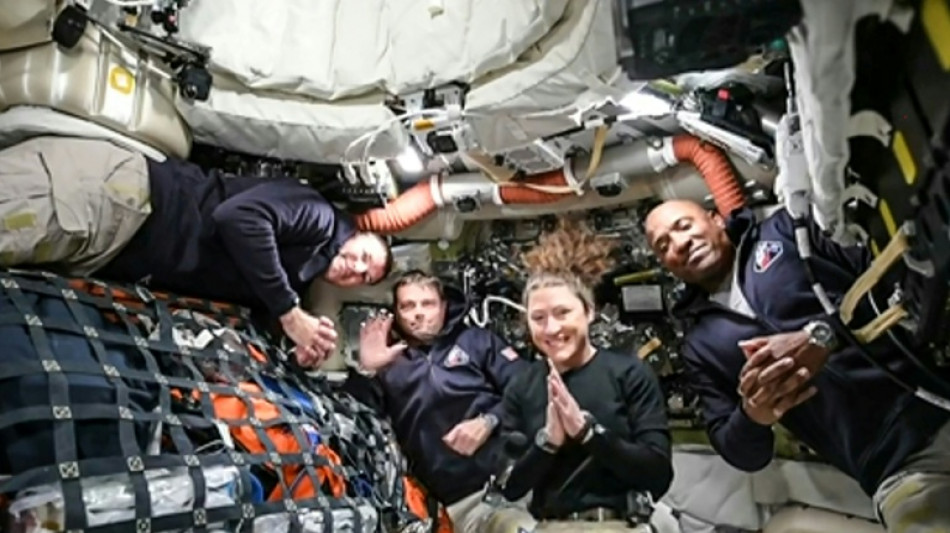
Giant step for humankind: Artemis crew to set space distance record / Photo: Handout - NASA TV/AFP

Giant step for humankind: Artemis crew to set space distance record

Four Artemis II astronauts are taking a giant step for humankind Monday when they shoot deeper into space than anyone before and glimpse parts of the Moon never seen by the naked eye.

Text size:

The NASA mission swept earlier into the Moon's gravitational sphere of influence, meaning their spacecraft is now in the natural satellite's neighborhood, with lunar gravity outmuscling any pull from Earth.

The Orion capsule will whip around the Moon, setting the crew up to reach an estimated record 252,757 miles (406,772 kilometers) from Earth, before starting the journey home. This will surpass the 1972 distance record set on Apollo 13 by 4,102 miles.

Swooping around the far side of the Moon, the crew of four will witness previously hidden lunar territory -- the sphere looming large through their capsule windows.

The Moon will appear to the astronauts "about the size of a basketball held at arm's length," Noah Petro, head of the US space agency's planetary geology lab, told AFP.

Adding to the historic nature of the mission led by Reid Wiseman, the Artemis II crew includes several firsts.

Victor Glover will be the first person of color to fly around the Moon, Christina Koch will be the first woman, and Canadian Jeremy Hansen the first non-American.

- Human eye vs camera -

The astronauts have already started seeing features never previously glimpsed directly.

An image sent back by the crew showed the Moon's Orientale basin visible, a massive crater that before had only been viewed by orbiting, uncrewed cameras.

Speaking to Canadian children live from space, Koch said the crew was most excited to see the basin -- sometimes known as the Moon's "Grand Canyon."

"It's very distinctive and no human eyes previously had seen this crater until today, really, when we were privileged enough to see it," Koch said during a question-and-answer session hosted by the Canadian Space Agency.

Near the end of their flyby, the astronauts will witness a solar eclipse, when the Sun will be behind the Moon.

Despite the technological advancements since the Apollo missions, NASA still relies on the eyesight of its astronauts to learn more about the Moon.

"The human eye is basically the best camera that could ever or will ever exist," Kelsey Young, the lead scientist for the Artemis II mission, told AFP. "The number of receptors in the human eye far outweighs what a camera is able to do."

And while the Orion crew will still be at a substantial distance from the Moon, their flyby is key to preparing for a later crewed mission to the planet's surface itself.

Over the next day, "they will be on the far side of the Moon, they will eclipse that record, and we're going to learn an awful lot about the spacecraft," NASA administrator Jared Isaacman told CNN on Sunday.

The information will be "pretty paramount to set up for subsequent missions like Artemis III in 2027 and, of course, the lunar landing itself on Artemis IV in 2028," he added.

The four astronauts will also spend some time testing their "Orion crew survival system" spacesuits.

The orange suits protect the crewmembers during launch and reentry, but are also available for emergency use -- they can provide up to six days of breathable air.

(G.Gruner--BBZ)