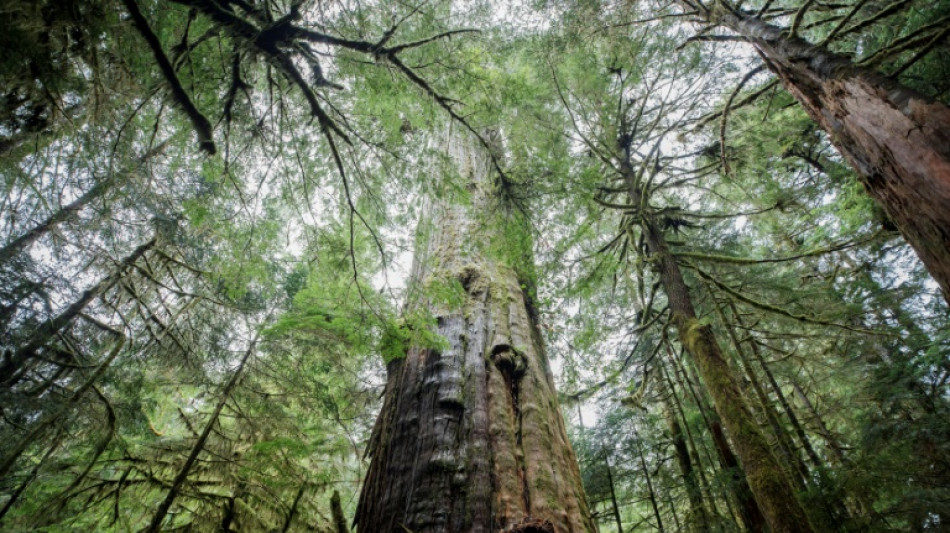
Even modest climate change imperils northern forests: study / Photo: COLE BURSTON - AFP/File

Even relatively moderate heating and rainfall loss could dramatically alter the make-up of Earth's northern forests, risking their biodiversity rich ecosystems and undermining their ability to store planet-warming carbon pollution, researchers said Wednesday.
Boreal forests cover much of Russia, Alaska and Canada and are a major carbon sink, but they are menaced by more frequent wildfires and invasive species outbreaks linked to climate change.
To assess how higher temperatures and less rainfall may impact the tree species most commonly found in the forests, a team of researchers based in the United States and Australia conducted a unique five-year experiment.
Between 2012-2016 they grew some 4,600 saplings of nine tree species -- including spruce, fir and pine -- in forest sites in northeastern Minnesota.
Using undersoil cables and infrared lamps, the saplings were warmed around the clock at two different temperatures -- one lot at 1.6 degrees Celsius hotter than ambient, the second at 3.1C warmer.
In additional, moveable tarps were positioned over half the plots before storms to capture rainwater and mimic the type of precipitation shifts that climate change is anticipated to bring.
The study, published in Nature, found that even the trees grown under 1.6C of warming experienced major problems, including reduced growth and increased mortality.
"I thought we'd see modest declines -- of a few percent -- in survival and growth for even the boreal species like spruce and fir, but we saw very large increases in mortality and decreases in growth in a number of species," lead author Peter Reich told AFP.
The team found that warming on its own, or combined with reduced rainfall, increased juvenile mortality in all nine tree species studied.
- 'Exponential negative effects' -
The 2015 Paris goals committed nations to work towards limiting temperature rises to "well below" two degrees Celsius above pre-industrial levels, and to work towards a safer 1.5C cap.
Wednesday's research suggests that even this relatively modest heating would have profound impacts on boreal ecosystems.
Current government plans put Earth on course to warm as much as 2.7C this century.
Previous research has shown that boreal forests are likely to experience both positive and negative effects from climate change, such as a longer growing season in the far north.
The experiment showed that modest warming -- in the 1.6C sample -- enhanced the growth of some hardwood species such as maple and oak. These are currently scarce in boreal forests but abundant in more temperate, southerly forests.
The team however suggested that the southern hardwoods are likely too rare to fill the void left by other species such as conifers, which fared very poorly in the experiment.
Reich, director of the University of Michigan's Institute for Global Change Biology, said that increased CO2 levels were likely to have "modest positive effects" on some species.
"But as CO2 and temperatures continue to rise, plants will be saturated with CO2, so further increases will have less and less effect," he said.
"Whereas the negative effects of climate change will get worse exponentially."
Reich said that warming was likely to impact boreal forests' ability to store carbon due to poorer plant regeneration.
"Additionally, more fires, which will accompany warming, will cause greater losses of carbon back to the atmosphere too," he said.
(B.Hartmann--BBZ)