French football's pioneering British champions / Photo: Kenzo TRIBOUILLARD - AFP

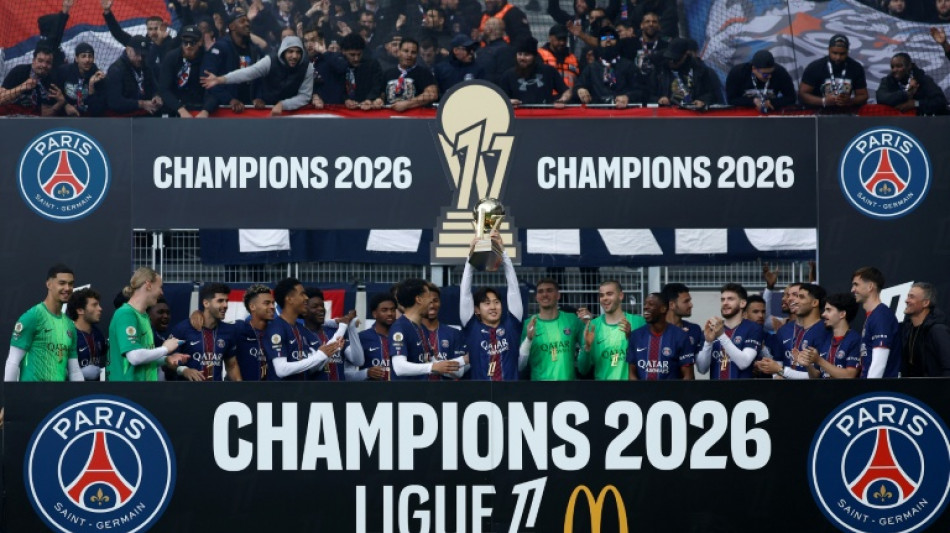
French giants Paris Saint-Germain secured a 14th league title last week to continue their recent Ligue 1 domination.
But tucked away in the nearby Meudon forest, just outside Paris, nestled between oaks and chestnuts, are the very first French football champions, Standard Athletic Club -- still thriving today as a private sports club.
Back in May 1894, Standard defeated the "formidable" White Rovers to become the first team recognised as French champions, by the Union of French Athletic Sports Societies (USFSA).
A club set up by mostly Englishmen ruled France, by beating a team of Scots.
The next year, Standard lifted the sparkling new Gordon Bennett trophy -- donated by the owner of the New York Herald newspaper -- by outclassing the White Rovers again.
It is a far cry from the football played at Standard today, where a motley crew of enthusiasts ranging from 17 years old to 60 turns out on Sunday mornings to play friendlies against familiar foes.
But the club is very proud of its illustrious past, which is not merely confined to its late 19th century results.
It also has links to the British royal family –- the club's badge is the Royal Standard -- and lent its name to Belgium's Standard Liege, and its red and black striped shirts to Italian giants AC Milan.
Standard also provided most of the France team that played in the only ever Olympic cricket match, back in 1900, losing to Great Britain in the final.
"What made the name of this club is being the first ever champions of France in football," club president Richard Parkin told AFP on a sunny Sunday morning.
"There's a quiet pride, but it's a little bit tongue in cheek," he added, pointing to the five stars emblazoned on the club jersey and worn by young, old, dashing and portly alike.
- Queen's visits -
The club's story began 136 years ago when "some English boys and young fellows" met at The Horse Shoe bar in Rue Copernic, near the Arc de Triomphe, and formed the club.
An account believed to be by one of the club's founding members, Alfred Hunter, tells of how the Brits "used to kick a football about on the open space opposite the (Grand) Lac" in the Bois de Boulogne, west of Paris, during the "rather severe" winter of 1889-90.
That gave them the idea to form a club, which instantly made its name.
And unlike almost all the other early pioneers of football in Paris, and France, it still exists.
Of the six teams that contested the first USFSA French football championship in 1894, Standard is the only one to have survived.
The White Rovers, along with the International Athletic Club and Cercle Athletique de Neuilly, did not make it to the end of the century, while Cercle Pedestre d'Asnieres disappeared during World War I.
Only Club Francais –- who won the title in 1896 -– managed to survive until the professional era, which began in 1932, only to fold three years later.
In contrast, of the 12 founding members of the English football league, only one –- Accrington, who folded in the 19th century -- is not currently a professional league team.
"I suspect that this place is still around because it's not just a football club. If we were just around to be a football club, then I suspect that we might have folded as well," said Parkin.
Not only did Standard survive, but it gained the royal seal of approval, and its honorary chairman is the British ambassador to France.
Queen Elizabeth II twice visited the club, first in 1957 to inaugurate Standard's rebuilt clubhouse, which had been blown up by the retreating Nazis -- who had used it as a radar jamming station -- at the end of World War II.
Elizabeth visited the club again with Prince Philip on a state visit in 1972.
"One of the things that keeps us going, even if we struggle sometimes to get a team out, is we're part of this institution, and we want to make sure that we keep playing," said Parkin.
- Olympic medal -
Standard has moved away from its British, and footballing, roots over the years and now boasts 65 different nationalities amongst its membership.
It is a multi-sports club with numerous sections, including tennis, squash, bridge and cricket -- in which they remain the reigning Olympic silver medallists.
Back in 1900, Standard's president Philip Tomalin was asked by Pierre de Coubertin -- the father of the modern Olympics -- to organise an international cricket tournament.
Tomalin selected a team made up mostly of British players from Standard and their main rivals and French champions Albion.
A straight final was played between hosts France and Britain –- represented by the Devonshire County Wanderers, a team made up of amateurs from Devon and Somerset.
Britain unsurprisingly thrashed France's team of Brits.
But the club is the proud owner of the Olympic runners-up medal awarded to their former member Arthur McEvoy. Rather incredibly, they purchased it on eBay in 2022 and the medal now resides in the clubhouse.
McEvoy had been the football team's goalkeeper and was also a handy bowler, taking three wickets in the Olympic final.
(G.Gruner--BBZ)