Berliner Boersenzeitung - French farmers suffer arid crops, heat-stricken animals

EUR -
AED 4.244341
AFN 74.542873
ALL 91.662739
AMD 419.706365
ANG 2.06914
AOA 1060.940373
ARS 1743.579935
AUD 1.617948
AWG 2.08172
AZN 1.953562
BAM 1.950709
BBD 2.328772
BDT 142.677606
BGN 1.945567
BHD 0.435972
BIF 3449.087277
BMD 1.155709
BND 1.465986
BOB 14.394368
BRL 5.915151
BSD 1.156207
BTN 110.418282
BWP 15.576614
BYN 3.511526
BYR 22651.887671
BZD 2.325391
CAD 1.60354
CDF 2666.219569
CHF 0.945537
CLF 0.027498
CLP 1085.776744
CNY 7.752782
CNH 7.750563
COP 3575.0804
CRC 520.851823
CUC 1.155709
CUP 30.626277
CVE 109.978428
CZK 24.256587
DJF 205.897054
DKK 7.47521
DOP 68.053849
DZD 153.893666
EGP 59.287042
ERN 17.335628
ETB 186.636501
FJD 2.55076
FKP 0.854223
GBP 0.856525
GEL 3.00797
GGP 0.854223
GHS 13.250359
GIP 0.854223
GMD 84.941842
GNF 10164.37122
GTQ 8.827997
GYD 241.897591
HKD 9.064494
HNL 31.032541
HRK 7.526902
HTG 151.119495
HUF 364.313429
IDR 20394.788864
ILS 3.520265
IMP 0.854223
INR 110.544043
IQD 1514.646712
IRR 1588636.979361
ISK 139.620499
JEP 0.854223
JMD 182.636472
JOD 0.819368
JPY 178.100459
KES 149.582964
KGS 101.066883
KHR 4688.883542
KMF 491.175864
KPW 1040.138067
KRW 1555.404617
KWD 0.356698
KYD 0.963506
KZT 521.739525
LAK 25868.81711
LBP 103541.041486
LKR 380.112824
LRD 201.751674
LSL 18.669714
LTL 3.412507
LVL 0.699077
LYD 7.313071
MAD 10.804453
MDL 20.036876
MGA 4977.095713
MKD 61.481567
MMK 2426.70133
MNT 4155.788199
MOP 9.339424
MRU 46.492658
MUR 54.456492
MVR 17.856027
MWK 2004.901822
MXN 19.651674
MYR 4.699924
MZN 73.861043
NAD 18.669875
NGN 1531.556633
NIO 42.550047
NOK 10.770095
NPR 176.672699
NZD 1.998341
OMR 0.444368
PAB 1.156177
PEN 3.888252
PGK 5.219377
PHP 72.618926
PKR 320.536521
PLN 4.32614
PYG 6847.276454
QAR 4.214618
RON 5.249804
RSD 117.302148
RUB 97.223622
RWF 1705.478148
SAR 4.335612
SBD 9.260699
SCR 15.995897
SDG 695.156856
SEK 11.257878
SGD 1.46701
SHP 0.855542
SLE 28.37307
SLL 24234.621153
SOS 660.786755
SRD 43.822733
STD 23920.833715
STN 24.436748
SVC 10.116814
SYP 15026.522921
SZL 18.672668
THB 38.34753
TJS 10.694794
TMT 4.056537
TND 3.374507
TOP 2.782669
TRY 56.192063
TTD 7.847687
TWD 36.660581
TZS 3061.136754
UAH 51.502169
UGX 4474.302535
USD 1.155709
UYU 46.539336
UZS 13596.453891
VES 960.911223
VND 29982.547033
VUV 135.508198
WST 3.162006
XAF 655.957
XAG 0.018096
XAU 0.000267
XCD 3.12336
XCG 2.083761
XDR 0.817146
XOF 655.957
XPF 119.331742
YER 273.961186
ZAR 18.709453
ZMK 10402.767068
ZMW 22.315335
ZWL 372.137683
SSP 6528.886994
MXV 2.228514
  • NGG

    0.4800

    76.86

    +0.62%

  • RYCEF

    0.4100

    19.54

    +2.1%

  • BCC

    0.3900

    75.44

    +0.52%

  • VOD

    0.0700

    17.4

    +0.4%

  • BCE

    0.1400

    23.39

    +0.6%

  • RIO

    0.5700

    99.96

    +0.57%

  • CMSD

    -0.0200

    20.32

    -0.1%

  • RELX

    -0.0200

    33.8

    -0.06%

  • RBGPF

    0.2800

    68.02

    +0.41%

  • CMSC

    0.0100

    20.45

    +0.05%

  • JRI

    -0.0700

    12.01

    -0.58%

  • GSK

    0.0100

    48.13

    +0.02%

  • BTI

    0.3800

    55.24

    +0.69%

  • AZN

    0.5300

    160.17

    +0.33%

  • BP

    0.0200

    46.1

    +0.04%

French farmers suffer arid crops, heat-stricken animals
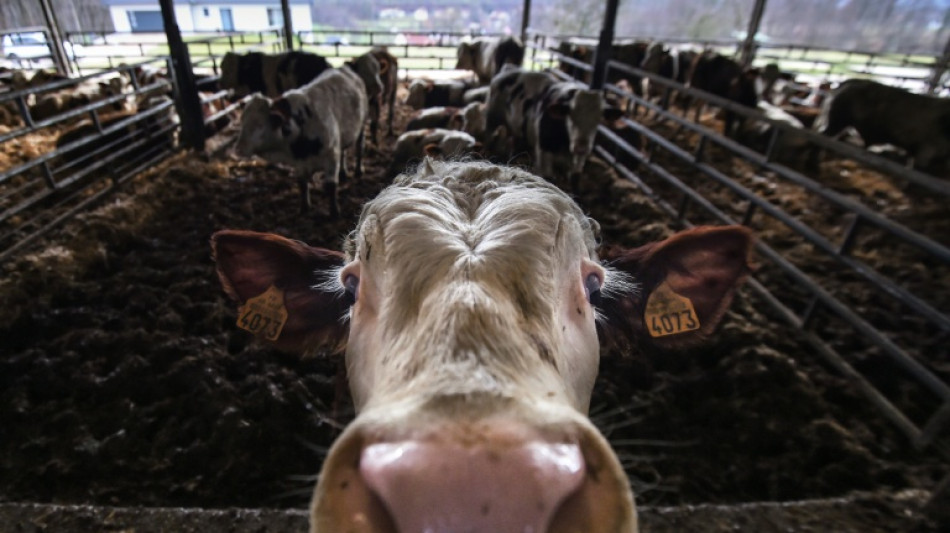
French farmers suffer arid crops, heat-stricken animals / Photo: Sebastien Bozon - AFP

French farmers suffer arid crops, heat-stricken animals

France's current heatwave is taking a toll on farmers, who are seeing livestock die and are racing against time to harvest cereals without sparking fires in the tinder-dry crops.

Text size:

Stephane Delapre, a farmer in Beauvoir-sur-Mer, near the western coast, said half his chickens had died of suffocation on Monday.

"In 42 years, I've never seen that," he told AFP as he waited for an official to collect the carcasses.

Depre raises around 17,500 free-range hens and 70,000 quails in sheds with outdoor runs.

"We put in a few fans but... it went up to 40–41C. There was nothing we could do," he said.

Sixty kilometres (40 miles) away, Regis Bonnin, 57, said he had set up misting systems to cool his 120 dairy cows, who were producing four to five litres less milk per day.

He had already lost a heifer with weak lungs and feared future reproductive problems.

He said he would hang on until next week to cut his wheat, for fear the combine harvester would spark a fire in the parched crop.

Neighbours had "already put out two blazes".

His main crop worry was his maize yield.

"If it flowers when temperatures are above 30C the pollen will be sterile," meaning the ears of corn will have fewer grains, he said glumly.

- Pressure cooker -

The heat also generates logistical headaches.

Sebastien Mery, who farms wheat and rapeseed in the Gatinais region, south of Paris, harvests early in the morning and late at night to avoid the worst of the heat.

But those timings mean he cannot get the cereal straight to a local silo because they are not open then.

Where regional authorities have banned harvesting between 2:00 pm and 7:00 pm, some silos are now opening overnight.

Stephane Baron, from Charente-Maritime, western France, is bracing for disastrous harvests, due to downpours in February and successive heatwaves in May and June.

His soft wheat yield was half what was needed for the crop to be profitable, he said.

France's powerful intensive-farming union FNSEA said maize and sunflowers were likely to survive this year "with a bit of water" but wheat could be problematic.

"Sometimes the wheat's too dry, so the grain is too small and risks being thrown out with the straw" by the combine harvester, said Franck Laborde, FNSEA's head of climate risk.

The worst heatwave in most French farmers' memory was the disaster of 2003.

But that came in August, when crops were already three-quarters grown, Bonnin pointed out.

This time, the searing heat has come much earlier in the growing cycle.

"The difference now is we've got a succession of extreme events," said Inaki Garcia de Cortazar-Atauri of research institute INRAE.

"There's no magic formula against the pressure-cooker effect," he said, but stressed that environmental farming practices offer a "framework" for adaptation that can be developed "in every region and every sector".

(L.Kaufmann--BBZ)