Berliner Boersenzeitung - Milky Way's fastest star discovered spinning around black hole

EUR -
AED 4.282075
AFN 76.364558
ALL 92.579442
AMD 425.974879
ANG 2.086602
AOA 1070.242019
ARS 1759.805072
AUD 1.632122
AWG 2.092685
AZN 1.976347
BAM 1.954787
BBD 2.348023
BDT 143.16583
BGN 1.977693
BHD 0.439464
BIF 3485.864631
BMD 1.165841
BND 1.481532
BOB 13.412706
BRL 6.00502
BSD 1.165766
BTN 111.564331
BWP 15.620907
BYN 3.49329
BYR 22850.483868
BZD 2.344625
CAD 1.615541
CDF 2655.207641
CHF 0.935861
CLF 0.027038
CLP 1064.121713
CNY 7.836959
CNH 7.838007
COP 3575.925849
CRC 528.212757
CUC 1.165841
CUP 30.894787
CVE 110.492601
CZK 24.092343
DJF 207.19305
DKK 7.475757
DOP 68.00932
DZD 155.140123
EGP 59.150926
ERN 17.487615
ETB 187.875031
FJD 2.600873
FKP 0.85444
GBP 0.855582
GEL 3.03701
GGP 0.85444
GHS 13.028278
GIP 0.85444
GMD 86.272417
GNF 10233.175444
GTQ 8.896391
GYD 243.907363
HKD 9.135804
HNL 31.325979
HRK 7.533895
HTG 152.517061
HUF 363.1008
IDR 20662.316869
ILS 3.499269
IMP 0.85444
INR 111.64076
IQD 1527.834648
IRR 1602535.911426
ISK 141.020455
JEP 0.85444
JMD 184.444445
JOD 0.826556
JPY 185.572737
KES 150.91771
KGS 101.953062
KHR 4712.90968
KMF 493.150461
KPW 1049.257255
KRW 1612.30018
KWD 0.35978
KYD 0.971497
KZT 533.339969
LAK 26173.130669
LBP 104401.063011
LKR 383.471335
LRD 211.774263
LSL 18.699756
LTL 3.442426
LVL 0.705206
LYD 7.373946
MAD 10.789854
MDL 20.145563
MGA 5042.262573
MKD 61.49814
MMK 2447.961416
MNT 4190.342945
MOP 9.409825
MRU 46.75969
MUR 53.949288
MVR 18.023873
MWK 2025.065755
MXN 19.781128
MYR 4.710813
MZN 74.503026
NAD 18.700306
NGN 1569.32721
NIO 42.780213
NOK 10.859407
NPR 178.507521
NZD 1.958193
OMR 0.44827
PAB 1.165766
PEN 3.909939
PGK 5.148584
PHP 72.035562
PKR 323.642297
PLN 4.307024
PYG 7006.370215
QAR 4.249533
RON 5.253628
RSD 117.304548
RUB 97.746562
RWF 1713.78629
SAR 4.383785
SBD 9.364336
SCR 17.081147
SDG 701.252482
SEK 11.078049
SGD 1.481749
SHP 0.863732
SLE 28.679126
SLL 24447.102234
SOS 666.281653
SRD 44.035568
STD 24130.555159
STN 24.832414
SVC 10.200715
SYP 15158.26475
SZL 18.682601
THB 38.158005
TJS 10.772319
TMT 4.080444
TND 3.378026
TOP 2.807065
TRY 56.051187
TTD 7.914696
TWD 37.130286
TZS 3089.476345
UAH 52.147484
UGX 4342.750155
USD 1.165841
UYU 46.725793
UZS 13826.874378
VES 908.169456
VND 30514.139771
VUV 138.179616
WST 3.166315
XAF 655.600483
XAG 0.017022
XAU 0.000252
XCD 3.150744
XCG 2.101111
XDR 0.82431
XOF 652.279107
XPF 119.331742
YER 276.391727
ZAR 18.699315
ZMK 10493.95923
ZMW 22.120971
ZWL 375.400331
  • JRI

    -0.0100

    12.37

    -0.08%

  • CMSC

    0.1264

    21.228

    +0.6%

  • BCE

    0.1200

    23.83

    +0.5%

  • RIO

    -0.4900

    104.81

    -0.47%

  • BCC

    -0.1130

    82.357

    -0.14%

  • NGG

    0.6390

    80.399

    +0.79%

  • RBGPF

    1.3300

    69.89

    +1.9%

  • GSK

    -0.6100

    51.8

    -1.18%

  • RYCEF

    -0.1200

    20.13

    -0.6%

  • AZN

    0.7700

    166.75

    +0.46%

  • BP

    -1.0100

    43.75

    -2.31%

  • BTI

    0.5000

    56.71

    +0.88%

  • RELX

    0.4900

    36.4

    +1.35%

  • CMSD

    0.0900

    21.07

    +0.43%

  • VOD

    0.0200

    15.98

    +0.13%

Milky Way's fastest star discovered spinning around black hole
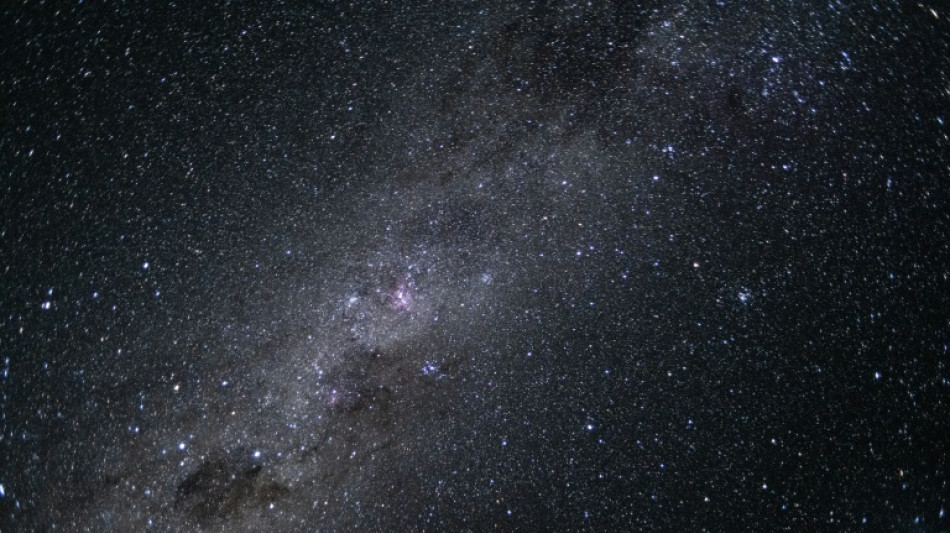
Milky Way's fastest star discovered spinning around black hole / Photo: Handout - NASA/AFP/File

Milky Way's fastest star discovered spinning around black hole

Astronomers have discovered the fastest star in the Milky Way zooming at 25,000 kilometres a second around the supermassive black hole at the centre of our galaxy.

Text size:

The star, named S301, orbits so dangerously close to the black hole that scientists believe it can shed light on this unimaginably powerful cosmic monster -- and test out Albert Einstein's theory of relativity.

"Decades carefully tracking stars orbiting our galaxy's central black hole, Sagittarius A*, have led to this breakthrough discovery," Reinhard Genzel of the Max Planck Institute for Extraterrestrial Physics in Germany said in a statement.

"Because it orbits so close to Sagittarius A*, S301 opens a new window to the fundamental properties of spacetime in this extreme black-hole environment," added Genzel, who shared a 2020 physics Nobel prize for discovering the black hole.

To spot S301 -- which is two billion times fainter than the star Betelgeuse in our sky -- the team of astronomers used the European Southern Observatory's Very Large Telescope in the Chilean desert.

They first noticed the star in 2023, and have been tracking its orbit since.

"What is special about this star is that it's orbiting Sagittarius A* on a very tight orbit, taking just 8.7 years to complete it," explained Felix Mang, a co-author of a new study describing the discovery.

The star gets roughly as close to the black hole as Saturn gets to our Sun, which is "unprecedented", the PhD student emphasised.

- Torn from its partner -

When the star gets closest to the immense suck of the black hole, it is travelling around 25,000 kilometres per second (15,500 miles per second).

That is 100,000 times faster than a commercial airplane, or more than eight percent of the speed of light, making it the fastest star ever detected in our galaxy.

Scientists believe that S301 was once part of a binary star system that was torn apart by the almighty pull of the black hole.

While S301 became trapped in the black hole's gravity, its partner star was blasted out with such force it likely left the galaxy entirely.

The astronomers will get another good look at the star when it makes its next closest approach to the black hole in 2031.

The team hopes that data from two complete orbits will allow them to determine the star's trajectory with enough precision they can also directly measure the black hole's rotation.

Like most objects in the universe, black holes are thought to spin.

Einstein's theory of general relativity predicted that a spinning black hole would drag spacetime along with it, twisting it in a way that changes the orbits of the surrounding stars.

Within the next 10 years, the astronomers hope to use S301 to measure the black hole's spin for the first time.

"Without this star, we would need to measure the motion of other stars for several more decades to get anywhere close to measuring the spin of the black hole," explained French astronomer and study co-author Juan Osorno.

The study was published in Nature on Wednesday.

(Y.Berger--BBZ)