Berliner Boersenzeitung - Nobel winner Halzen says years of October 'misery' finally over

EUR -
AED 4.092246
AFN 71.314817
ALL 90.501528
AMD 401.301637
ANG 1.994344
AOA 1022.920191
ARS 1711.84927
AUD 1.585025
AWG 2.008512
AZN 1.895726
BAM 1.946772
BBD 2.244562
BDT 138.348425
BGN 1.947595
BHD 0.420764
BIF 3344.410739
BMD 1.114293
BND 1.423742
BOB 13.5127
BRL 6.031332
BSD 1.114467
BTN 105.760345
BWP 15.39715
BYN 3.28278
BYR 21840.13491
BZD 2.241287
CAD 1.556149
CDF 2579.587837
CHF 0.919765
CLF 0.027936
CLP 1103.071727
CNY 7.422407
CNH 7.412748
COP 3538.88186
CRC 506.76585
CUC 1.114293
CUP 26.744973
CVE 109.755529
CZK 24.333139
DJF 198.445077
DKK 7.47355
DOP 67.549173
DZD 151.436341
EGP 62.391186
ERN 16.714389
ETB 179.915621
FJD 2.500138
FKP 0.833098
GBP 0.832594
GEL 2.893919
GGP 0.833098
GHS 12.983142
GIP 0.833098
GMD 82.457794
GNF 9863.260276
GTQ 8.519492
GYD 233.593028
HKD 8.741904
HNL 29.953096
HRK 7.542658
HTG 146.008145
HUF 365.612787
IDR 20238.896448
ILS 3.494555
IMP 0.833098
INR 105.772274
IQD 1689.365762
IRR 2081961.00374
ISK 135.932562
JEP 0.833098
JMD 177.08798
JOD 0.78997
JPY 175.282125
KES 144.802326
KGS 97.443437
KHR 4546.97514
KMF 491.403011
KPW 1002.863295
KRW 1487.101125
KWD 0.346746
KYD 0.928689
KZT 505.286791
LAK 25091.541605
LBP 99795.596297
LKR 370.671056
LRD 189.438949
LSL 18.571576
LTL 3.290216
LVL 0.674024
LYD 7.163747
MAD 10.957337
MDL 19.948209
MGA 5040.804804
MKD 61.295748
MMK 2339.913791
MNT 4009.094653
MOP 9.00492
MRU 45.190059
MUR 52.683444
MVR 17.215966
MWK 1931.992623
MXN 20.956394
MYR 4.522134
MZN 71.214411
NAD 18.571576
NGN 1499.971671
NIO 41.009822
NOK 10.282129
NPR 169.216353
NZD 1.978738
OMR 0.428439
PAB 1.114571
PEN 3.857113
PGK 5.071459
PHP 70.96815
PKR 308.293823
PLN 4.39974
PYG 6528.723801
QAR 4.062361
RON 5.341251
RSD 117.562462
RUB 89.978711
RWF 1645.049131
SAR 4.1835
SBD 8.979199
SCR 15.320754
SDG 670.240715
SEK 10.973609
SGD 1.424684
SHP 0.833864
SLE 25.513028
SLL 23366.163523
SOS 636.855231
SRD 41.919129
STD 23063.607019
STN 24.387671
SVC 9.750782
SYP 14488.032001
SZL 18.566566
THB 37.615184
TJS 10.257793
TMT 3.900024
TND 3.332546
TOP 2.682949
TRY 55.655979
TTD 7.55596
TWD 36.335524
TZS 2943.102851
UAH 50.546411
UGX 4736.185255
USD 1.114293
UYU 44.803836
UZS 13366.494255
VES 988.912173
VND 28752.649038
VUV 132.843138
WST 3.090938
XAF 655.957
XAG 0.022485
XAU 0.000284845446
XCD 3.011432
XCG 2.008386
XDR 0.787863
XOF 655.957
XPF 119.331742
YER 263.196528
ZAR 18.600418
ZMK 10029.970717
ZMW 22.472392
ZWL 358.801762
SSP 6401.832785
MXV 2.3619
  • CMSD

    -0.1200

    19.81

    -0.61%

  • JRI

    0.0000

    10.77

    0%

  • BCC

    -1.8200

    74.15

    -2.45%

  • CMSC

    -0.2228

    19.53

    -1.14%

  • BCE

    0.2000

    20.34

    +0.98%

  • RIO

    0.0100

    94.17

    +0.01%

  • AZN

    -2.7400

    161.47

    -1.7%

  • GSK

    -1.1800

    48.17

    -2.45%

  • RBGPF

    0.0000

    65

    0%

  • NGG

    0.8800

    75.82

    +1.16%

  • RYCEF

    -0.7300

    19.08

    -3.83%

  • BTI

    -0.4500

    54.4

    -0.83%

  • BP

    0.4700

    43.99

    +1.07%

  • RELX

    -0.0600

    33.18

    -0.18%

  • VOD

    -0.1800

    16.15

    -1.11%

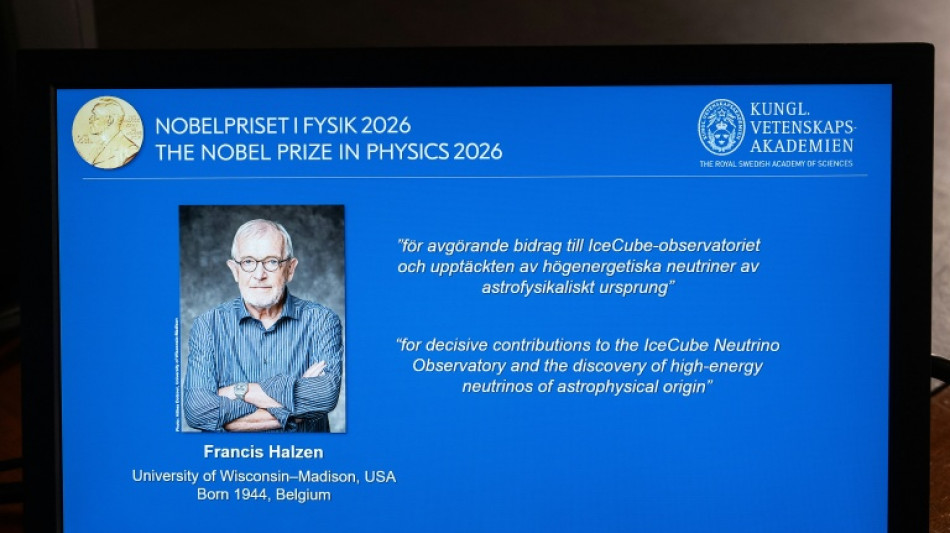
Nobel winner Halzen says years of October 'misery' finally over
Nobel winner Halzen says years of October 'misery' finally over / Photo: Jonathan NACKSTRAND - AFP

Nobel winner Halzen says years of October 'misery' finally over

Physicist Francis Halzen has an impressively long list of academic accolades -- but every October, as the Nobel Prize rolled around, his failure to bag the biggest award of them all left him "miserable," he admits.

Text size:

"It's a great relief for me, because this was not totally unexpected," he told a press conference Tuesday at the University of Wisconsin–Madison, where he serves as a professor. He spoke by video from a hotel room in Italy where he was attending a scientific meeting.

"Around this time of the year, I always felt miserable because I didn't win the prize, and thought... it was terrible for my collaborators who deserved it so much, and that I disappointed the whole IceCube collaboration every October," he added. "So that problem is finally solved. I'm very grateful for it."

The 82-year-old is the brains behind the IceCube Neutrino Observatory, a telescope embedded in a cubic kilometer of Antarctic ice that detects neutrinos -- particles with almost no mass that seldom interact with other matter.

Every second, about 65 billion neutrinos from the Sun pass through your little fingernail. Those from deeper in space carry clues about cosmic mysteries, like the supermassive black holes at the heart of galaxies.

Halzen, who grew up in Belgium, paid rich tribute to the roughly 450 people across more than a dozen countries who have helped turn an idea he conceived in the late 1980s into reality.

"UW took incredible risks on this project," he said of his university. "We had several milestones we had to pass, and at each point, this project could have failed."

He also thanked the National Science Foundation (NSF) for taking a chance on the project, "which in retrospect amazes me, I am not sure this could happen today, but it happened, and we were very lucky."

President Donald Trump's administration has called for deep cuts to the NSF, the US agency that funds fundamental research, and directed it to focus on the administration's technology priorities.

Physicists before Halzen had suggested water could capture neutrinos from space: when a neutrino hits an atomic nucleus, it produces a charged particle that travels in the same direction and emits blue light, which can be detected because water is transparent.

Halzen's great leap was to use ice instead -- unlike liquid water, it isn't disturbed by living creatures, and its darkness is constant at great depth.

Making it work was a struggle, but the first neutrino images, captured by an R&D precursor to IceCube, were "the greatest excitement I ever felt about this project," he said. "It was just incredible. It was the fact that we could make this work."

IceCube has been fully operational since 2011 and has detected high-energy neutrinos from a distant galaxy in the direction of the constellation Orion, as well as from our own Milky Way.

As for the future, Halzen noted that whenever humanity has opened a new "window on the universe," predictions about what would follow have proven wrong.

"What this will bring is impossible to predict, but it has always been great in the past, and there is no reason not to think that it will be great again."

(Y.Berger--BBZ)