Berliner Boersenzeitung - NASA eyes two more dates in September for possible Moon launch

EUR -
AED 4.299853
AFN 74.344052
ALL 95.789291
AMD 433.719736
ANG 2.095639
AOA 1074.815564
ARS 1636.80461
AUD 1.62784
AWG 2.11041
AZN 1.994123
BAM 1.959681
BBD 2.359032
BDT 143.712152
BGN 1.953053
BHD 0.442875
BIF 3485.487753
BMD 1.170824
BND 1.495656
BOB 8.092993
BRL 5.786225
BSD 1.1713
BTN 111.542422
BWP 15.917455
BYN 3.31581
BYR 22948.14436
BZD 2.355625
CAD 1.593895
CDF 2711.627319
CHF 0.915198
CLF 0.027011
CLP 1063.073056
CNY 7.997019
CNH 7.993787
COP 4366.423043
CRC 532.846143
CUC 1.170824
CUP 31.026828
CVE 110.483329
CZK 24.38931
DJF 208.572164
DKK 7.473075
DOP 69.787014
DZD 155.052231
EGP 62.883063
ERN 17.562355
ETB 184.169742
FJD 2.570484
FKP 0.865073
GBP 0.863079
GEL 3.143653
GGP 0.865073
GHS 13.129946
GIP 0.865073
GMD 86.05441
GNF 10279.181237
GTQ 8.940553
GYD 245.044238
HKD 9.175025
HNL 31.134659
HRK 7.536005
HTG 153.290958
HUF 361.484206
IDR 20365.658543
ILS 3.441754
IMP 0.865073
INR 111.315358
IQD 1534.312333
IRR 1539633.155108
ISK 143.190852
JEP 0.865073
JMD 184.313439
JOD 0.830071
JPY 184.554011
KES 151.255766
KGS 102.353993
KHR 4698.284389
KMF 492.319084
KPW 1053.745062
KRW 1718.494066
KWD 0.360672
KYD 0.976029
KZT 544.255516
LAK 25720.827524
LBP 104886.769177
LKR 374.805861
LRD 214.924718
LSL 19.601283
LTL 3.457138
LVL 0.708219
LYD 7.430652
MAD 10.825338
MDL 20.215949
MGA 4878.640795
MKD 61.6797
MMK 2458.386282
MNT 4189.917915
MOP 9.454283
MRU 46.76782
MUR 54.970603
MVR 18.095098
MWK 2031.013533
MXN 20.361456
MYR 4.639386
MZN 74.827202
NAD 19.601619
NGN 1601.839035
NIO 43.104628
NOK 10.832274
NPR 178.468438
NZD 1.984974
OMR 0.450165
PAB 1.171315
PEN 4.106262
PGK 5.093086
PHP 71.979909
PKR 326.397921
PLN 4.24797
PYG 7097.024595
QAR 4.28106
RON 5.238972
RSD 117.37161
RUB 88.335611
RWF 1712.584278
SAR 4.393426
SBD 9.396877
SCR 15.95634
SDG 703.082091
SEK 10.822744
SGD 1.492672
SHP 0.874138
SLE 28.860487
SLL 24551.582917
SOS 669.422862
SRD 43.879025
STD 24233.686538
STN 24.548196
SVC 10.24812
SYP 129.411992
SZL 19.597811
THB 38.074607
TJS 10.951341
TMT 4.103737
TND 3.414763
TOP 2.819063
TRY 52.944529
TTD 7.939588
TWD 36.962316
TZS 3047.064776
UAH 51.473217
UGX 4421.681138
USD 1.170824
UYU 47.163402
UZS 14095.674202
VES 572.465755
VND 30819.592041
VUV 138.771326
WST 3.179876
XAF 657.255818
XAG 0.015869
XAU 0.000256
XCD 3.16421
XCG 2.110871
XDR 0.816807
XOF 657.255818
XPF 119.331742
YER 279.387816
ZAR 19.500127
ZMK 10538.807125
ZMW 22.107688
ZWL 377.004751
  • CMSC

    0.0299

    22.9

    +0.13%

  • RBGPF

    1.6000

    64.7

    +2.47%

  • RYCEF

    0.1000

    16.45

    +0.61%

  • BCE

    0.2200

    24.15

    +0.91%

  • NGG

    0.4900

    87.99

    +0.56%

  • BCC

    0.0950

    74.425

    +0.13%

  • CMSD

    0.0550

    23.305

    +0.24%

  • JRI

    0.0550

    12.985

    +0.42%

  • RIO

    1.5000

    100.13

    +1.5%

  • VOD

    -0.2400

    15.81

    -1.52%

  • GSK

    -0.5900

    50.31

    -1.17%

  • BTI

    1.0650

    59.415

    +1.79%

  • AZN

    -2.1350

    181.325

    -1.18%

  • BP

    -0.1700

    46.77

    -0.36%

  • RELX

    -0.3350

    36.025

    -0.93%

NASA eyes two more dates in September for possible Moon launch
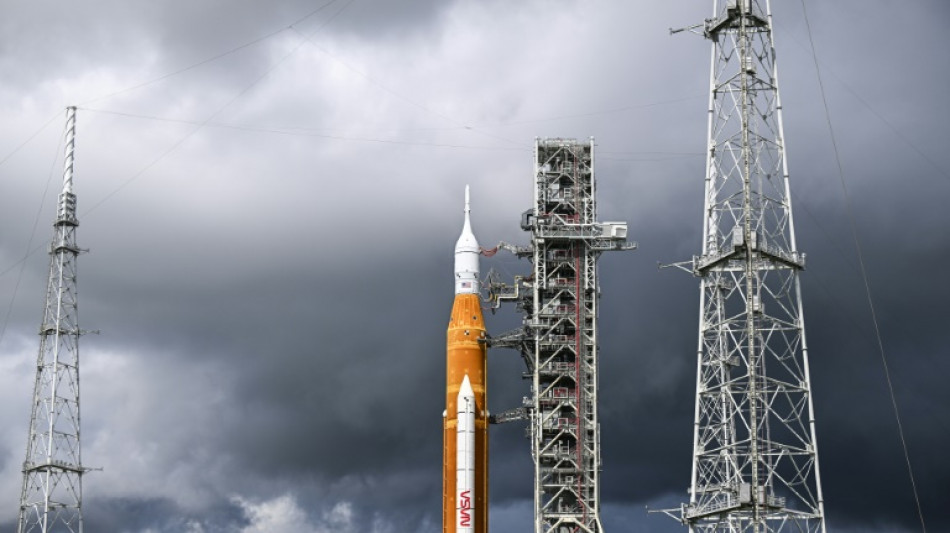
NASA eyes two more dates in September for possible Moon launch / Photo: CHANDAN KHANNA - AFP/File

NASA eyes two more dates in September for possible Moon launch

NASA is looking at September 23 and September 27 as possible dates for its next attempt at launching its Artemis 1 mission to the Moon, senior official Jim Free told reporters Thursday.

Text size:

Two previous attempts were scrapped after the giant Space Launch System rocket experienced technical glitches including a fuel leak.

The launch window for the 23rd would open at 6:47am (1047 GMT), while the 27th would open at 11:37am (1537 GMT), added Free, associate administrator for the agency's exploration systems development directorate.

The dates were chosen to avoid a conflict with the DART mission, in which a probe will strike an asteroid on September 26 to test its ability to divert the object.

Both missions require use of an international array of antennas called the Deep Space Network.

The launch dates still depend, however, on NASA receiving a special waiver to avoid retesting batteries on an emergency flight system that is used to destroy the rocket if it strays from its designated range to a populated area.

If it does not receive the waiver, the rocket will have to be wheeled back to its assembly building, pushing the timeline back several weeks.

Mike Bolger, exploration ground systems manager, added that teams were working to replace seals to fix the hydrogen leak issue -- work that could be completed by the end of Thursday, which would pave the way for a tanking test on September 17.

The Artemis 1 space mission hopes to test the SLS as well as the unmanned Orion capsule that sits atop, in preparation for future Moon-bound journeys with humans aboard.

Once launched, it will take several days for the spacecraft to reach the Moon, flying around 60 miles (100 kilometers) at its closest approach.

The capsule will fire its engines to get to a distant retrograde orbit (DRO) of 40,000 miles beyond the Moon, a record for a spacecraft rated to carry humans.

The trip is expected to last several weeks, and one of its main objectives is to test the capsule's heat shield, which at 16 feet (5 meters) in diameter is the largest ever built.

Artemis is named after the twin sister of the Greek god Apollo, after whom the first Moon missions were named.

The next mission, Artemis 2, will take astronauts to the Moon without landing on its surface, while the third -- set for the mid-2020s -- would see the first woman and person of color on lunar soil.

NASA wants to build a lunar space station called Gateway and keep a sustained presence on the Moon to gain insight into how to survive very long space missions, ahead of a mission to Mars in the 2030s.

(L.Kaufmann--BBZ)