Berliner Boersenzeitung - Webb telescope captures 'breathtaking' images of Orion Nebula

EUR -
AED 4.212777
AFN 72.835586
ALL 94.512843
AMD 422.248264
ANG 2.053494
AOA 1052.895931
ARS 1680.790338
AUD 1.635257
AWG 2.067368
AZN 1.95436
BAM 1.956354
BBD 2.309354
BDT 140.73988
BGN 1.939347
BHD 0.432422
BIF 3423.630825
BMD 1.146945
BND 1.480319
BOB 7.92328
BRL 5.90941
BSD 1.146625
BTN 108.087801
BWP 15.582008
BYN 3.185903
BYR 22480.122
BZD 2.305963
CAD 1.623185
CDF 2615.035015
CHF 0.925648
CLF 0.026299
CLP 1035.072439
CNY 7.764364
CNH 7.780559
COP 3960.034063
CRC 520.14739
CUC 1.146945
CUP 30.394043
CVE 110.569964
CZK 24.190336
DJF 203.835517
DKK 7.474072
DOP 66.986043
DZD 152.939427
EGP 57.331754
ERN 17.204175
ETB 181.647461
FJD 2.564
FKP 0.867567
GBP 0.866531
GEL 3.039852
GGP 0.867567
GHS 12.874504
GIP 0.867567
GMD 84.304874
GNF 10064.442782
GTQ 8.746478
GYD 239.84901
HKD 8.988436
HNL 30.606273
HRK 7.533254
HTG 149.77244
HUF 351.906109
IDR 20445.785654
ILS 3.394682
IMP 0.867567
INR 108.1919
IQD 1502.49795
IRR 1577049.375404
ISK 143.976448
JEP 0.867567
JMD 181.171337
JOD 0.813229
JPY 185.008009
KES 148.419043
KGS 100.300781
KHR 4599.249852
KMF 492.617229
KPW 1032.250901
KRW 1752.130969
KWD 0.353179
KYD 0.955446
KZT 559.543917
LAK 25295.872375
LBP 102708.92515
LKR 382.668433
LRD 208.916469
LSL 18.815678
LTL 3.386631
LVL 0.693776
LYD 7.311819
MAD 10.580612
MDL 20.248208
MGA 4817.169398
MKD 61.628611
MMK 2408.272435
MNT 4107.54883
MOP 9.256923
MRU 45.947051
MUR 54.881752
MVR 17.720734
MWK 1992.243861
MXN 19.872547
MYR 4.745948
MZN 73.301688
NAD 18.814173
NGN 1560.350288
NIO 41.990088
NOK 11.102662
NPR 172.945006
NZD 1.997675
OMR 0.441554
PAB 1.14663
PEN 3.881306
PGK 5.032508
PHP 69.638491
PKR 319.223511
PLN 4.259467
PYG 7041.056554
QAR 4.175458
RON 5.239364
RSD 117.183799
RUB 83.845404
RWF 1679.12748
SAR 4.299026
SBD 9.24601
SCR 15.693948
SDG 688.744688
SEK 10.98638
SGD 1.482316
SHP 0.85631
SLE 28.387314
SLL 24050.86738
SOS 655.483268
SRD 42.898615
STD 23739.445827
STN 24.544623
SVC 10.032843
SYP 126.774237
SZL 18.814083
THB 37.723444
TJS 10.63456
TMT 4.014308
TND 3.339618
TOP 2.761569
TRY 53.262066
TTD 7.775237
TWD 36.375404
TZS 3017.595134
UAH 51.508996
UGX 4173.182519
USD 1.146945
UYU 45.84299
UZS 13769.075108
VES 695.774297
VND 30176.12295
VUV 136.226685
WST 3.156058
XAF 656.142926
XAG 0.017685
XAU 0.000276
XCD 3.099677
XCG 2.066386
XDR 0.807102
XOF 648.024305
XPF 119.331742
YER 273.665193
ZAR 18.876464
ZMK 10323.885445
ZMW 20.552914
ZWL 369.315822
  • CMSD

    0.0000

    22.29

    0%

  • RBGPF

    -0.5300

    60.61

    -0.87%

  • RYCEF

    -0.0300

    18.4

    -0.16%

  • CMSC

    0.0500

    22.37

    +0.22%

  • NGG

    -1.2400

    79.44

    -1.56%

  • BP

    -1.0400

    39.1

    -2.66%

  • BCE

    0.0000

    23.28

    0%

  • GSK

    -1.4800

    50.67

    -2.92%

  • VOD

    -0.2300

    14.3

    -1.61%

  • RIO

    -2.5900

    100.08

    -2.59%

  • JRI

    0.0500

    12.67

    +0.39%

  • BTI

    -0.5800

    58.91

    -0.98%

  • BCC

    3.8500

    74.66

    +5.16%

  • RELX

    -0.8300

    31.18

    -2.66%

  • AZN

    -2.9600

    174.93

    -1.69%

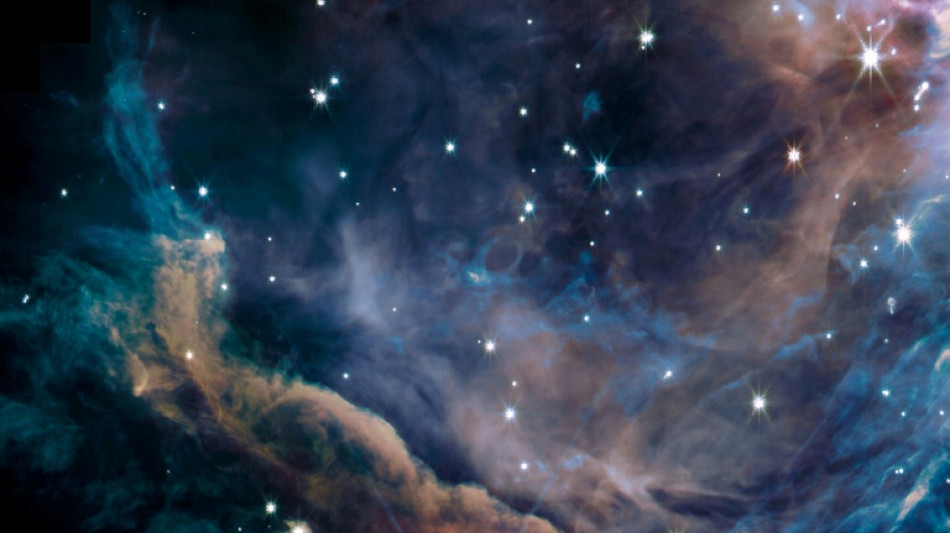
Webb telescope captures 'breathtaking' images of Orion Nebula
Webb telescope captures 'breathtaking' images of Orion Nebula / Photo: Handout - NASA/ESA/CSA/AFP

Webb telescope captures 'breathtaking' images of Orion Nebula

The wall of dense gas and dust resembles a massive winged creature, its glowing maw lit by a bright star as it soars through cosmic filaments.

Text size:

An international research team on Monday revealed the first images of the Orion Nebula captured with the James Webb Space Telescope, leaving astronomers "blown away."

The stellar nursery is situated in the constellation Orion, 1,350 light-years away from Earth, in a similar setting in which our own solar system was birthed more than 4.5 billion years ago.

Astronomers are interested in the region to better understand what happened during the first million years of our planetary evolution.

The images were obtained as part of the Early Release Science program and involved more than 100 scientists in 18 countries, with institutions including the French National Centre for Scientific Research (CNRS), Western University in Canada, and the University of Michigan.

"We are blown away by the breathtaking images of the Orion Nebula," Western University astrophysicist Els Peeters said in a statement.

"These new observations allow us to better understand how massive stars transform the gas and dust cloud in which they are born," she added.

Nebulas are obscured by large amounts of dust that made it impossible to observe with visible light telescopes, such as the Hubble Space Telescope, Webb's predecessor.

Webb however operates primarily in the infrared spectrum, penetrating the dust.

This revealed numerous spectacular structures, down to the scale of 40 astronomical units, or the size of our solar system.

These include dense filaments of matter, which could birth new generations of stars, as well as forming stellar systems that consist of a central proto-star surrounded by a disc of dust and gas, in which planets form.

"We hope to gain understanding about the entire cycle of star birth," said Edwin Bergin, University of Michigan chair of astronomy and a member of the international research team.

"In this image we are looking at this cycle where the first generation of stars is essentially irradiating the material for the next generation. The incredible structures we observe will detail how the feedback cycle of stellar birth occurs in our galaxy and beyond."

Webb is the most powerful space telescope ever built, boasting a primary mirror measuring 6.5 meters (more than 21 feet) that is made up of 18 hexagonal, gold-coated segments, as well as a five-layer sunshield the size of a tennis court.

(H.Schneide--BBZ)