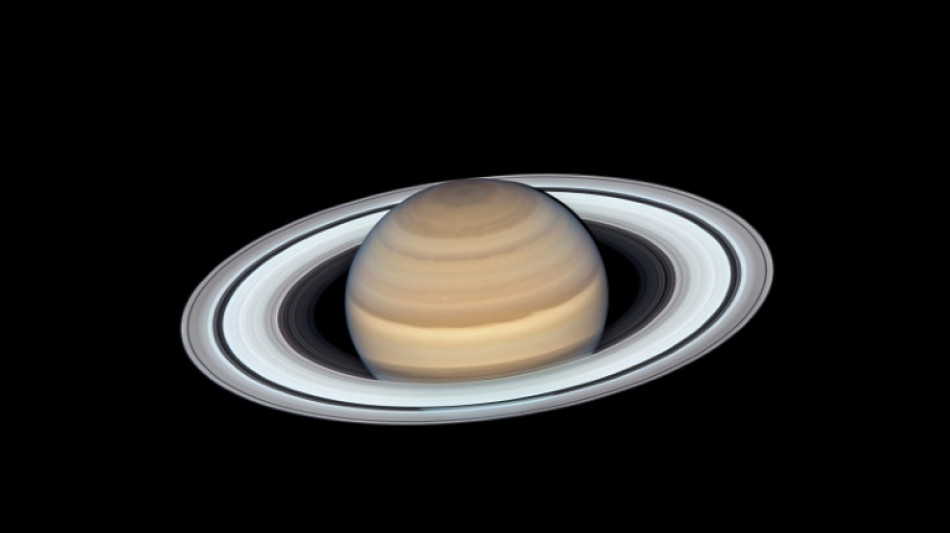
Long lost moon could have been responsible for Saturn's rings / Photo: A. SIMON, M.H. WONG - Hubble/AFP

Discovered by Galileo 400 years ago, the rings of Saturn are about the most striking thing astronomers with small telescopes can spot in our solar system.
But even today, experts cannot agree on how or when they formed.
A new study published Thursday in the prestigious journal Science sets out to provide a convincing answer.
Between 100-200 million years ago, an icy moon they named Chrysalis broke up after getting a little too close to the gas giant, they conclude.
While most of it made impact with Saturn, its remaining fragments broke into small icy chunks that form the planet's signature rings.
"It's nice to find a plausible explanation," Jack Wisdom, professor of planetary sciences at MIT and lead author of the new study, told AFP.
Saturn, the sixth planet from the Sun, was formed four and a half billion years ago, at the beginning of the solar system.
But a few decades ago, scientists suggested that Saturn's rings appeared much later: only about 100 million years ago.
The hypothesis was reinforced by observations made by the Cassini probe, which orbited Saturn from 2004 to 2017.
"But because no one could think of a way to make the rings 100 million years ago, some people have been questioning the reasoning that led to that deduction," said Wisdom.
By constructing complex mathematical models, Wisdom and colleagues found an explanation that both justified the timeline, and allowed them to better understand another characteristic of the planet, its tilt.
Saturn has a 26.7 degree tilt. Being a gas giant, it would have been expected that the process of accumulating matter that led to its formation would have prevented tilt.
- Gravitational interactions -
Scientists recently discovered that Titan, the largest of Saturn's 83 moons, is migrating away from the planet, at a rate of 11 centimeters a year.
This changes the rate at which Saturn's axis of tilt loops around the vertical -- the technical term is "precession." Think of a spinning top drawing circles.
Around a billion years ago, this wobble frequency came into sync with Neptune's wobbly orbit, creating a powerful gravitational interaction called "resonance."
In order to maintain this lock, as Titan kept moving out, Saturn had to tilt, scientists argued.
But that explanation hinged on knowing how mass was distributed in the planet's interior, since the tilt would have behaved differently if it were concentrated more at its surface or the core.
In the new study, Wisdom and colleagues modeled the planet's interior using gravitational data gathered by Cassini during its close approach "Grand Finale," its last act before plunging into Saturn's depths.
The model they generated found Saturn is now slightly out of sync with Neptune, which necessitated a new explanation -- an event powerful enough to cause the drastic disruption.
Working through the mathematics, they found a lost moon fit the bill.
"It's pulled apart into a bunch of pieces and those pieces subsequently get pulled apart even more, and gradually rolls into the rings."
The missing Moon was baptized Chrysalis by MIT's Wisdom, likening the emergence of Saturn's rings to a butterfly emerging from a cocoon.
The team thinks Chrysalis was a bit smaller than our own Moon, and about the size of another Saturn satellite, Iapetus, which is made entirely of water ice.
"So it's plausible to hypothesize that Chrysalis is also made of water ice, and that's what it needs to make the rings, because the rings are almost pure water.
Asked whether he felt the mystery of Saturn's rings stood solved, Wisdom replied, soberly, "We've made a good contribution."
The Saturn satellite system still holds "a variety of mysteries," he added.
(K.Müller--BBZ)