Berliner Boersenzeitung - Whale strandings: Five questions answered

EUR -
AED 4.278661
AFN 76.972265
ALL 96.540713
AMD 443.663031
ANG 2.085508
AOA 1068.353542
ARS 1670.714664
AUD 1.756079
AWG 2.097095
AZN 1.970474
BAM 1.955612
BBD 2.345474
BDT 142.476293
BGN 1.955656
BHD 0.439209
BIF 3440.768991
BMD 1.165053
BND 1.508555
BOB 8.047226
BRL 6.31668
BSD 1.164488
BTN 104.703275
BWP 15.471512
BYN 3.347964
BYR 22835.037223
BZD 2.342065
CAD 1.608688
CDF 2600.397817
CHF 0.938578
CLF 0.027417
CLP 1075.580909
CNY 8.23704
CNH 8.2328
COP 4467.977946
CRC 568.845276
CUC 1.165053
CUP 30.873902
CVE 110.25534
CZK 24.258501
DJF 207.370051
DKK 7.469055
DOP 74.53283
DZD 151.520976
EGP 55.366828
ERN 17.475794
ETB 180.628723
FJD 2.628245
FKP 0.873824
GBP 0.874867
GEL 3.139789
GGP 0.873824
GHS 13.246669
GIP 0.873824
GMD 85.048888
GNF 10118.983106
GTQ 8.920257
GYD 243.635516
HKD 9.064467
HNL 30.671049
HRK 7.532648
HTG 152.445334
HUF 383.361244
IDR 19448.519649
ILS 3.735515
IMP 0.873824
INR 104.913948
IQD 1525.546692
IRR 49063.33837
ISK 148.823543
JEP 0.873824
JMD 186.392069
JOD 0.82602
JPY 181.306736
KES 150.583249
KGS 101.883998
KHR 4662.551453
KMF 491.652703
KPW 1048.547475
KRW 1708.981376
KWD 0.357764
KYD 0.970502
KZT 588.920817
LAK 25252.462287
LBP 104282.820234
LKR 359.193903
LRD 204.962921
LSL 19.736317
LTL 3.440098
LVL 0.704729
LYD 6.330391
MAD 10.755665
MDL 19.814009
MGA 5194.500278
MKD 61.568832
MMK 2446.644943
MNT 4133.578153
MOP 9.338262
MRU 46.438533
MUR 53.732545
MVR 17.936903
MWK 2019.305739
MXN 21.199973
MYR 4.791898
MZN 74.458323
NAD 19.736317
NGN 1690.43337
NIO 42.855693
NOK 11.792101
NPR 167.522884
NZD 2.016375
OMR 0.447959
PAB 1.164588
PEN 3.914423
PGK 4.941503
PHP 68.846439
PKR 326.474692
PLN 4.229655
PYG 8009.229496
QAR 4.244746
RON 5.08965
RSD 117.407045
RUB 89.299023
RWF 1694.337001
SAR 4.373105
SBD 9.589075
SCR 15.747417
SDG 700.782152
SEK 10.960066
SGD 1.51073
SHP 0.874091
SLE 27.666933
SLL 24430.575028
SOS 664.33609
SRD 45.004845
STD 24114.243202
STN 24.497538
SVC 10.189976
SYP 12881.793236
SZL 19.721103
THB 37.106778
TJS 10.68471
TMT 4.089336
TND 3.416115
TOP 2.805168
TRY 49.587915
TTD 7.89502
TWD 36.254936
TZS 2857.291024
UAH 48.888497
UGX 4119.586008
USD 1.165053
UYU 45.546205
UZS 13931.71953
VES 296.566475
VND 30710.794959
VUV 141.953636
WST 3.248878
XAF 655.893902
XAG 0.019938
XAU 0.000277
XCD 3.148613
XCG 2.098789
XDR 0.815722
XOF 655.893902
XPF 119.331742
YER 277.923824
ZAR 19.779921
ZMK 10486.868965
ZMW 26.92341
ZWL 375.146565
  • RBGPF

    0.0000

    78.35

    0%

  • CMSC

    -0.0500

    23.43

    -0.21%

  • BTI

    -1.0300

    57.01

    -1.81%

  • NGG

    -0.5000

    75.41

    -0.66%

  • BCC

    -1.2100

    73.05

    -1.66%

  • BCE

    0.3300

    23.55

    +1.4%

  • RELX

    -0.2200

    40.32

    -0.55%

  • GSK

    -0.1600

    48.41

    -0.33%

  • AZN

    0.1500

    90.18

    +0.17%

  • SCS

    -0.0900

    16.14

    -0.56%

  • RIO

    -0.6700

    73.06

    -0.92%

  • CMSD

    -0.0700

    23.25

    -0.3%

  • RYCEF

    -0.0500

    14.62

    -0.34%

  • JRI

    0.0400

    13.79

    +0.29%

  • BP

    -1.4000

    35.83

    -3.91%

  • VOD

    -0.1630

    12.47

    -1.31%

Whale strandings: Five questions answered
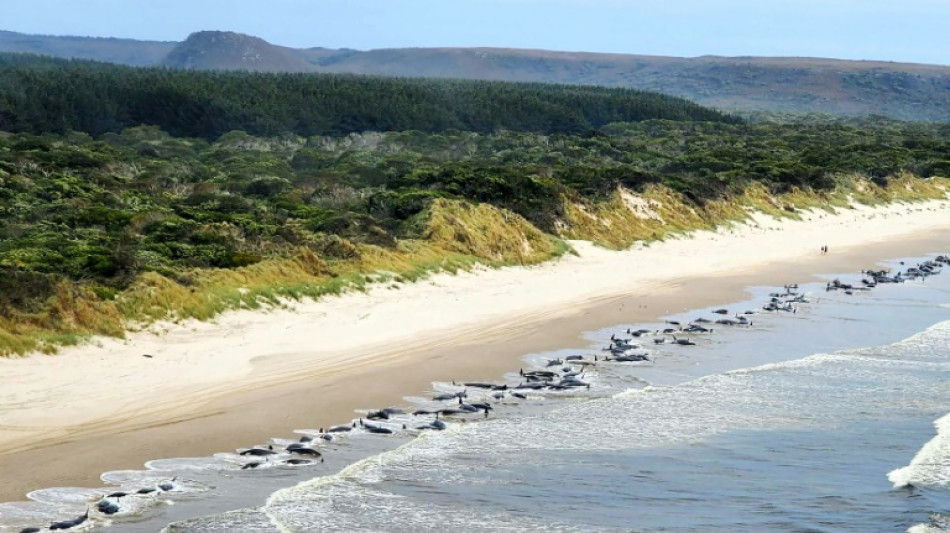
Whale strandings: Five questions answered / Photo: HANDOUT - AFP

Whale strandings: Five questions answered

The death of about 200 pilot whales at a Tasmanian beach has renewed questions about what causes such mass strandings and whether they can be prevented.

Text size:

With the help of Karen Stockin, a whale stranding expert at New Zealand's Massey University, here are the answers to five key questions:

What causes mass strandings?

Scientists are still trying to work that out. They do know that there are multiple types of stranding events, with several explanations that can overlap. The causes can be natural, based on bathymetry -- the shape of the ocean floor -- or they can be species-specific.

Pilot whales and several smaller dolphin species are known to regularly mass strand, especially in the southern hemisphere, according to Stockin. In some instances, a sick whale headed towards shore and a full group unwittingly followed them.

Does it happen in certain areas?

There are a few global hotspots. In the southern hemisphere, Tasmania and New Zealand's Golden Bay have seen several instances, and in the northern hemisphere, the United States bay of Cape Cod, Massachusetts, is another hotspot.

In those areas, there are similarities between the topography of the beaches and environmental conditions. For example, Cape Cod and Golden Bay share a prominent narrow coastal land feature and shallow water with large tidal variations. Some people call such areas "whale traps" because of the speed at which the tide can recede.

Are strandings becoming more common?

Possibly. Strandings are natural phenomena and have been documented since the days of Aristotle. The health of the oceans has, however, deteriorated in recent decades.

Strandings could become more common as human use of the seas, shipping traffic and chemical pollution all increase.

Epizootic diseases -- outbreaks of sickness that affect a specific animal species -- could also lead to more. But there is still much to understand about the phenomenon, Stockin said.

Is climate change a factor?

Research on how climate change is affecting marine mammals is still in its infancy. Experts know that climate change can give rise to changes in prey and predator distribution. For some species, this may result in whales coming closer to shore.

For example, recent research based on current climate prediction models suggests that by the year 2050, the distribution of sperm whales and blue whales in New Zealand could vary considerably.

Can strandings be prevented?

Not really. As strandings occur for a multitude of reasons, there is no one-size-fits-all solution. But Stockin said that by better understanding whether and how human-induced changes are causing more mass strandings, solutions could be found.

(H.Schneide--BBZ)