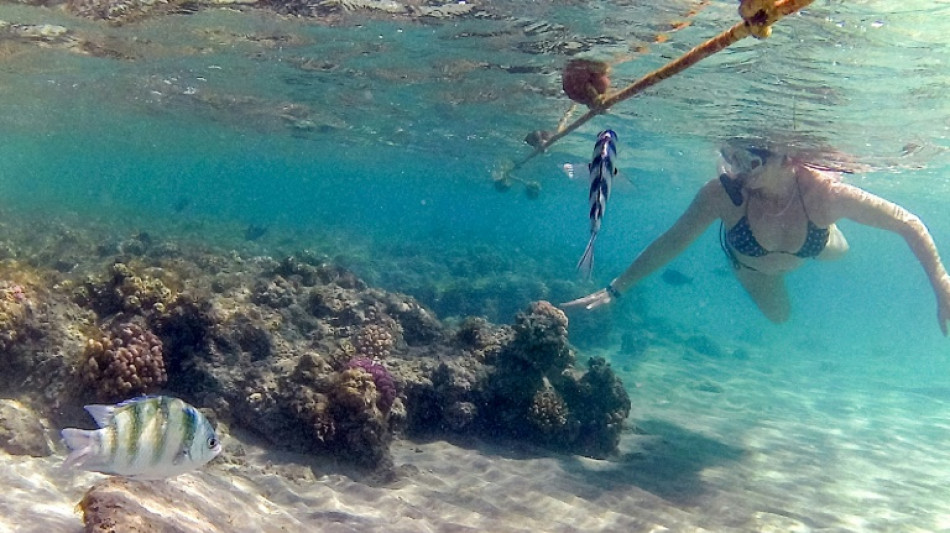
Heat-resilient Red Sea reefs offer last stand for corals / Photo: Khaled DESOUKI - AFP

Beneath the waters off Egypt's Red Sea coast a kaleidoscopic ecosystem teems with life that could become the world's "last coral refuge" as global heating eradicates reefs elsewhere, researchers say.
Most shallow water corals, battered and bleached white by repeated marine heatwaves, are "unlikely to last the century," the Intergovernmental Panel on Climate Change said this year.
That threatens a devastating loss for the hundreds of millions of people worldwide who depend on the fish stocks that live and breed in these fragile ecosystems.
Even if global warming is capped within Paris climate goals of 1.5 degrees Celsius above pre-industrial levels, 99 percent of the world's corals would be unable to recover, experts say.
But Red Sea coral reefs, unlike those elsewhere, have proven "highly tolerant to rising sea temperatures," said Mahmoud Hanafy, professor of marine biology at Egypt's Suez Canal University.
Scientists hope that at least some of the Red Sea corals -- five percent of the total corals left worldwide -- could cling on amid what is otherwise a looming global collapse.
"There's very strong evidence to suggest that this reef is humanity's hope for having a coral reef ecosystem in the future," Hanafy said.
Eslam Osman from the King Abdullah University of Science and Technology in Saudi Arabia said: "It is crucial that we preserve the northern Red Sea as one of the last standing coral refuges, because it could be a seed bank for any future restoration effort."
- Livelihoods for millions -
The impacts of coral loss are dire: they cover only 0.2 percent of the ocean floor, but are home to at least a quarter of all marine animals and plants, helping sustain livelihoods for half a billion people worldwide.
Global warming, as well as dynamite fishing and pollution, wiped out a startling 14 percent of the world's coral reefs between 2009 and 2018, according to the Global Coral Reef Monitoring Network.
Graveyards of bleached coral skeletons are now left where once vibrant and species-rich ecosystems thrived.
Recent studies have shown the northern Red Sea corals are better able to resist the dire impact of heating waters.
"We have a buffer temperature before the coral sees bleaching," Osman said. "One, two, even three degrees (Celsius) of warming, we're still on the safe side."
Osman said one theory explaining the corals' apparent resilience to heat is due to "evolutionary memory" developed many thousands of years ago, when coral larvae migrated north from the Indian Ocean.
"In the southern Red Sea, coral larvae had to pass through very warm waters, which acted as a filter, only letting through species that could survive up to 32 degrees Celsius (89 degrees Fahrenheit)," Osman said.
However, scientists warn that even if Red Sea corals survive surging water temperatures, they risk being damaged from non-climate threats -- pollution, overfishing and habitat destruction including from costal development and mass tourism.
"When non-climate threats increase, the vulnerability to climate change increases as well," Osman said.
- 'Global responsibility' -
Reefs off Egypt are hugely popular among divers, and some Red Sea dive sites are operating at up to 40 times their recommended capacity, Hanafy said.
Fishing, another huge pressure, must drop to a sixth of current rates to become sustainable, he said.
For Hanafy, protecting the reef is a "global responsibility" and one which Red Sea tourism businesses -- which account for 65 percent of Egypt's vital tourism industry -- must share.
Local professionals say they have already witnessed damage to parts of the delicate ecosystem.
One solution, Hanafy said, is for the environment ministry to boost protection over a 400-square-kilometre (154-square-mile) area of corals known as Egypt's Great Fringing Reef.
More than half already lies within nature reserves or environmentally-administered areas, but creating one continuous protected area would support the coral by "regulating activities and fishing, implementing carrying capacity plans and banning pollution", Hanafy said.
Further south, off Sudan, a near absence of tourism has shielded pristine corals from polluting boats and the wandering fins of divers.
But, despite their greater resilience, the corals are far from immune to climate change, and the reefs there have experienced several bleaching events over the past three decades.
For Sudan, a country mired in a dire economic and political crisis including a military coup last year, monitoring the coral is "difficult" without funding, Sudan's Higher Council for the Environment and Natural Resources said.
Off both the Egyptian and Saudi coasts, corals face the threats of coastal development, including sewage and sedimentation from construction runoff, Osman warned.
The great irony, he said, is that, while the natural wonders of the Red Sea corals that have drawn tourists and developers, the increased man-made pressures are in turn accelerating their destruction.
(P.Werner--BBZ)