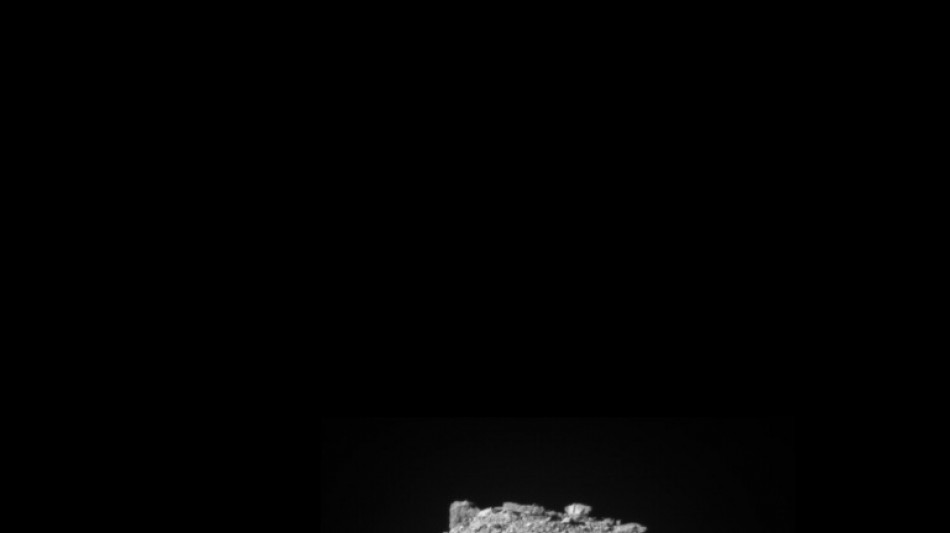
NASA spaceship deflected asteroid in test to save Earth / Photo: Handout - NASA/Jons Hopkins APL/AFP

NASA on Tuesday said it had succeeded in deflecting an asteroid in a historic test of humanity's ability to stop an incoming cosmic object from devastating life on Earth.
The fridge-sized Double Asteroid Redirection Test (DART) impactor deliberately smashed into the moonlet asteroid Dimorphos on September 26, pushing it into a smaller, faster orbit around its big brother Didymos, said NASA chief Bill Nelson.
"DART shortened the 11 hour 55 minute orbit to 11 hours and 23 minutes," he said. Speeding up Dimorphos' orbital period by 32 minutes exceeded NASA's own expectation of 10 minutes.
"We showed the world that NASA is serious as a defender of this planet," added Nelson.
The asteroid pair loop together around our Sun every 2.1 years, and pose no threat to our planet.
But they are ideal for studying the "kinetic impact" method of planetary defense, in case an actual approaching object is ever detected.
DART's success as a proof-of-concept has made a reality of science fiction -- notably in films such as "Armageddon" and "Don't Look Up."
Astronomers rejoiced in stunning images of matter spreading out thousands of miles in the wake of the impact -- pictures collected by Earth and space telescopes, as well as a mini satellite that had traveled to the zone with DART.
- Pseudo-comet -
Thanks to its temporary new tail, Dimorphos, which is 530-foot (160-meter) in diameter or roughly the size of a big Egyptian pyramid, has turned into a manmade comet.
But quantifying just how well the test worked required an analysis of light patterns from ground telescopes, which took a few weeks to become apparent.
The binary asteroid system, which was around 6.8 million miles (11 million kilometers) from Earth at impact, is visible only as a single dot from the ground.
Ahead of the test, NASA scientists said the results of the experiment would reveal whether the asteroid is a solid rock, or more like a "rubbish pile" of boulders bound by mutual gravity.
If an asteroid is more solid, the momentum imparted by a spaceship will be limited. But if it is "fluffy" and significant mass is pushed at high velocity in the opposite direction to impact, there will be an additional boost.
Never actually photographed before, Dimorphos appeared as a speck of light around an hour before impact.
Its egg-like shape and craggy, boulder-dotted surface finally came into clear view in the last few moments, as DART raced toward it at roughly 14,500 miles (23,500 kilometers) per hour.
- Mass extinction -
Very few of the billions of asteroids and comets in our solar system are considered potentially hazardous to our planet, and none are expected in the next hundred years or so.
But wait long enough, and it will happen.
The geological record shows, for example, that a six-mile wide asteroid struck Earth 66 million years ago, plunging the world into a long winter that led to the mass extinction of the dinosaurs along with 75 percent of all species.
An asteroid the size of Dimorphos, by contrast, would only cause a regional impact, such as devastating a city.
Kinetic impact with a spaceship is just one way to defend the planet, albeit the only method possible with current technology.
Should an approaching object be detected early, a spaceship could be sent to fly alongside it for long enough to divert its path via using the ship's gravitational pull, creating a so-called gravity tractor.
Another option would be launching nuclear explosives to redirect or destroy an asteroid.
NASA believes the best way to deploy such weapons would be at a distance, to impart force without blowing the asteroid to smithereens, which could further imperil Earth.
(G.Gruner--BBZ)