Berliner Boersenzeitung - Meteorite that smashed into Mars shook planet, NASA says

EUR -
AED 4.35724
AFN 77.710021
ALL 96.668143
AMD 443.408827
ANG 2.123843
AOA 1087.975931
ARS 1695.238337
AUD 1.715666
AWG 2.137392
AZN 2.015643
BAM 1.957171
BBD 2.365678
BDT 143.680677
BGN 1.992491
BHD 0.442812
BIF 3478.637473
BMD 1.186451
BND 1.502353
BOB 8.116722
BRL 6.305277
BSD 1.174528
BTN 107.817093
BWP 16.292485
BYN 3.325158
BYR 23254.446333
BZD 2.362275
CAD 1.62306
CDF 2586.463818
CHF 0.922146
CLF 0.025883
CLP 1021.995541
CNY 8.273833
CNH 8.248886
COP 4242.477121
CRC 581.309772
CUC 1.186451
CUP 31.440961
CVE 110.342782
CZK 24.261922
DJF 209.167445
DKK 7.468224
DOP 74.002165
DZD 153.297707
EGP 55.620723
ERN 17.79677
ETB 182.960771
FJD 2.669876
FKP 0.86965
GBP 0.868032
GEL 3.191631
GGP 0.86965
GHS 12.803025
GIP 0.86965
GMD 86.611343
GNF 10288.295698
GTQ 9.015279
GYD 245.743227
HKD 9.247747
HNL 30.98284
HRK 7.53385
HTG 154.047941
HUF 381.973858
IDR 19897.619547
ILS 3.719571
IMP 0.86965
INR 108.62846
IQD 1538.784707
IRR 49979.263032
ISK 145.779091
JEP 0.86965
JMD 184.890331
JOD 0.84123
JPY 182.919925
KES 151.395312
KGS 103.7547
KHR 4727.312416
KMF 498.309794
KPW 1067.930094
KRW 1709.11911
KWD 0.363533
KYD 0.97889
KZT 591.289299
LAK 25382.999745
LBP 105183.888632
LKR 363.888042
LRD 217.286758
LSL 18.958144
LTL 3.503283
LVL 0.717672
LYD 7.473268
MAD 10.758884
MDL 19.991176
MGA 5313.745722
MKD 61.674255
MMK 2490.712803
MNT 4229.03407
MOP 9.43405
MRU 46.960301
MUR 54.007514
MVR 18.33061
MWK 2036.735719
MXN 20.606998
MYR 4.707864
MZN 75.825876
NAD 18.958144
NGN 1670.594617
NIO 43.220649
NOK 11.551308
NPR 172.508603
NZD 1.990474
OMR 0.454671
PAB 1.174628
PEN 3.940478
PGK 5.023562
PHP 69.944903
PKR 328.646967
PLN 4.212709
PYG 7854.536755
QAR 4.282319
RON 5.124755
RSD 117.484301
RUB 88.866093
RWF 1713.10759
SAR 4.448953
SBD 9.638269
SCR 16.923589
SDG 713.643125
SEK 10.559643
SGD 1.504687
SHP 0.890146
SLE 28.944061
SLL 24879.290578
SOS 670.072342
SRD 45.228737
STD 24557.147375
STN 24.517386
SVC 10.277245
SYP 13121.647493
SZL 18.95336
THB 36.887368
TJS 10.98211
TMT 4.15258
TND 3.419382
TOP 2.85669
TRY 51.464108
TTD 7.978658
TWD 37.301434
TZS 3013.58665
UAH 50.646001
UGX 4151.926742
USD 1.186451
UYU 44.480418
UZS 14256.229622
VES 417.945775
VND 31048.838434
VUV 141.785655
WST 3.269374
XAF 656.419718
XAG 0.01101
XAU 0.000234
XCD 3.206444
XCG 2.116892
XDR 0.816375
XOF 656.419718
XPF 119.331742
YER 282.734094
ZAR 19.067468
ZMK 10679.425628
ZMW 23.043341
ZWL 382.036849
  • SCS

    0.0200

    16.14

    +0.12%

  • CMSD

    0.0900

    24.13

    +0.37%

  • RBGPF

    -0.8100

    83.23

    -0.97%

  • GSK

    0.5000

    49.15

    +1.02%

  • NGG

    1.3200

    81.5

    +1.62%

  • VOD

    0.2300

    14.17

    +1.62%

  • RYCEF

    0.3000

    17.12

    +1.75%

  • RIO

    3.1300

    90.43

    +3.46%

  • RELX

    0.0600

    39.9

    +0.15%

  • BCC

    -1.1800

    84.33

    -1.4%

  • CMSC

    0.1000

    23.75

    +0.42%

  • JRI

    0.0100

    13.68

    +0.07%

  • BCE

    0.4900

    25.2

    +1.94%

  • BTI

    0.9400

    59.16

    +1.59%

  • BP

    1.1000

    36.53

    +3.01%

  • AZN

    1.2600

    92.95

    +1.36%

Meteorite that smashed into Mars shook planet, NASA says
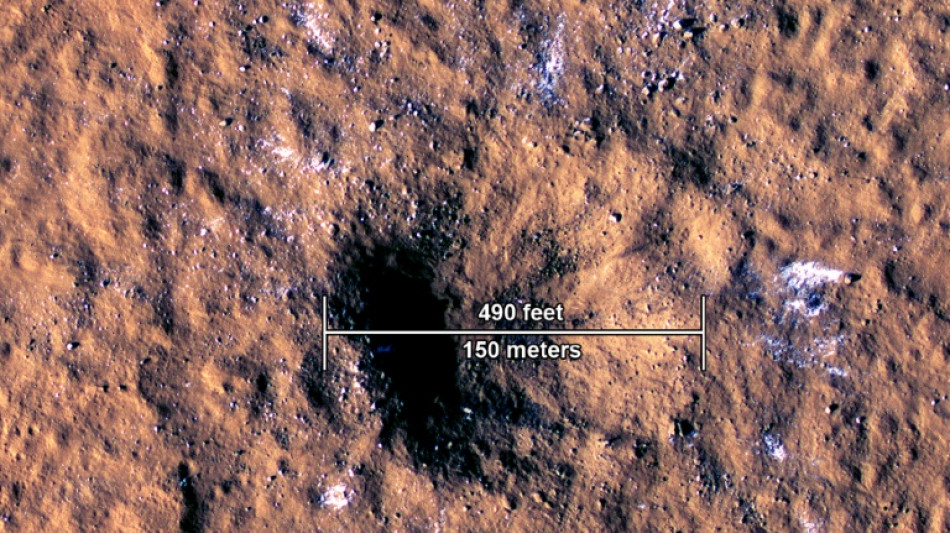
Meteorite that smashed into Mars shook planet, NASA says / Photo: - - NASA/JPL-Caltech/University of Arizona/AFP

Meteorite that smashed into Mars shook planet, NASA says

Scientists who study Mars on Thursday revealed the remarkable Christmas gift they received from the planet last year.

Text size:

On December 24, 2021, a meteorite hit Mars' surface, triggering magnitude 4 tremors, which were detected by NASA's InSight spacecraft -- which landed on the planet four years ago -- some 2,200 miles (3,500 kilometers) away.

The true origin of this so-called marsquake was only confirmed when the Mars Reconnaissance Orbiter (MRO) was able to take a picture of the newly formed crater created by the hit when it flew over the impact site less than 24 hours later.

The image is impressive, showing blocks of ice that were spewed up onto the planet's surface around the 492-foot (150-meter) wide and 70-foot (21-meter) deep hole.

The crater is the largest ever observed since the MRO began its Mars orbit 16 years ago.

And though meteorite impacts on Mars are not rare, "we never thought we'd see anything that big," Ingrid Daubar, who works on the InSight and MRO missions, told reporters at a press conference Thursday.

Researchers estimate that the meteorite itself would have measured between 16 to 39 feet across. An object of that size would have disintegrated in Earth's atmosphere before falling to the ground here.

"It is simply the biggest meteorite impact on the ground that we have heard since science has been done with seismographs or seismometers," said planetology professor Philippe Lognonne, who participated in two studies related to the observation published in the journal Science Thursday.

NASA released an audio recording of the collision, which was made by speeding up the vibrations collected by the seismometer.

- 'Useful' ice presence -

The valuable information gathered in studying the crash will contribute to deeper knowledge of Mars' interior and the history of how the planet was created, scientists said.

The presence of ice, in particular, is "surprising," said Daubar, who also co-authored the two studies.

"This is the warmest spot on Mars, the closest to the equator, we've ever seen water ice," she said.

In addition to the information this discovery offers about the Martian climate, the presence of water at this latitude -- and not just near the poles -- could prove "really useful" for future human visitors to Mars, director of NASA's Planetary Science Division Lori Glaze said.

"We'd want to land the astronauts as near to the equator as possible," she said, to take advantage of warmer temperatures.

"That ice could be converted into water, oxygen or hydrogen," Glaze said.

The impact was powerful enough to generate seismic waves both down to the planet's core and across its crust horizontally, making it possible to study Mars' internal structure -- revealing that the crust on which InSight sits is less dense than the crust the waves traveled over from the crater site.

The end of InSight's mission -- which recorded more than 1,300 marsquakes in total -- could come in the next couple of months, according to Bruce Banerdt of NASA's Jet Propulsion Lab, due to the expected accumulation of dust on the lander's solar power panel.

It's "sad," he said, while celebrating that the probe worked "marvelously" for four years.

(T.Renner--BBZ)