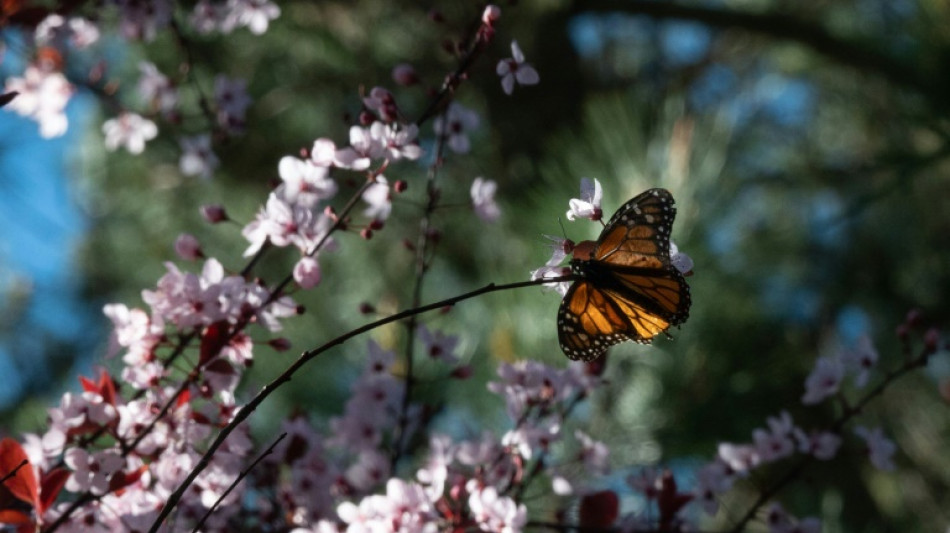
Endangered monarch butterflies face perilous storm / Photo: Amy Osborne - AFP

As devastating storms pounded California, nature lovers feared for endangered monarch butterflies that winter there as part of a seemingly magical migration pattern.
The colorfully winged insects that travel vast distances over the course of generations have been closely watched in the US state since they neared extinction just three years ago.
As the sun rose one January morning, volunteers began counting monarch butterflies, finding them clustered atop cypress and eucalyptus trees in various sites along the California coast.
The butterflies huddled in clusters of gray colonies until one spread its wings to reveal the orange spots for which they are known.
The sight provided a bit of reassurance for Stephanie Turcotte Edenholm, who counted more than a thousand monarchs at a sanctuary in the California coastal town of Pacific Grove.
The educator spent much of the morning explaining the lives of the butterflies to young school students. They got to watch as dozens of butterflies took flight, believing -- mistakenly -- that the mild temperature signaled the end of winter.
"It's too early for them to get so agitated, they're using up their fat reserves," Edenholm fretted.
She worried, too, that they would mate and the females would fly off in search of milkweed plants to lay eggs on. Milkweed is all that baby caterpillars eat once the eggs hatch, but it was too early in winter for the plants to be growing.
Volunteers counted more than 330,000 "western monarch" butterflies at the end of November, according to the Xerces Society conservation group.
- Pesticides and climate change -
That number came as a relief compared to the 2,000 butterflies counted at the end of 2020, and an encouraging step up from the 250,000 or so butterflies tallied in 2021.
But the ranks of butterflies were far from the millions observed in the 1980s, due to threats including habitat loss, pesticides and climate change, according to Xerces.
The monarch was added last year to the International Union for Conservation of Nature's Red List of threatened species and Xerces has asked the US Fish and Wildlife Service to place monarchs on its endangered list.
Such a designation would help monarch defenders fight real estate developers out to raze trees or build on terrain needed by migrating butterflies.
The question of whether to protect monarchs is a philosophical one, since the insects are known more for incredible migrations than being crucial for pollinating crops or flowers, according to Xerces biologist Emma Pelton.
"We wouldn't lose human crops or wild plants in particular if the monarchs disappeared," Pelton said.
But the world would lose butterflies "that perform a really incredible migration, and that people are very attached to, emotionally and culturally, throughout North America."
Some species of monarchs travel thousands of miles, from Canada to Mexico, while the lifespan of any single butterfly is typically measured in weeks.
- 'Magical' -
Bill Henry remembers a childhood here filled with butterflies.
"It was kind of a magical thing to be immersed in the abundance of the natural world," said Henry, now director of Groundswell Coastal Ecology group in Santa Cruz, not far from Pacific Grove.
"It paints a picture, it's something that dreams are made out of."
Flourishing monarchs are also a sign of enough milkweed and habitat along the long migration corridor, Henry said.
"Milkweed is linked to healthy landscapes, and it's linked to healthy floodplains, which means that our rivers are doing well," he told AFP.
"It also means that there aren't a lot of impasses to their migration, such as swaths where the pesticides that kill them are being used."
In 2020, the near absence of monarchs on the west Coast was a rallying cry for nature lovers, from gardeners who planted milkweed to hobbyists who raised butterflies in their homes despite the practice being illegal due.
But finding the right balance to protect nature has challenges. For example, monarchs love water-guzzling eucalyptus trees that are not native to drought-prone California.
Clearing vegetation or trees to reduce the risk of wildfires can eliminate butterfly habitats.
Monarchs being gone from our world would "suck too much," said Santa Cruz teenager Brody Robbins, who skipped school to photograph butterflies "way cooler than Civil War classes."
(G.Gruner--BBZ)