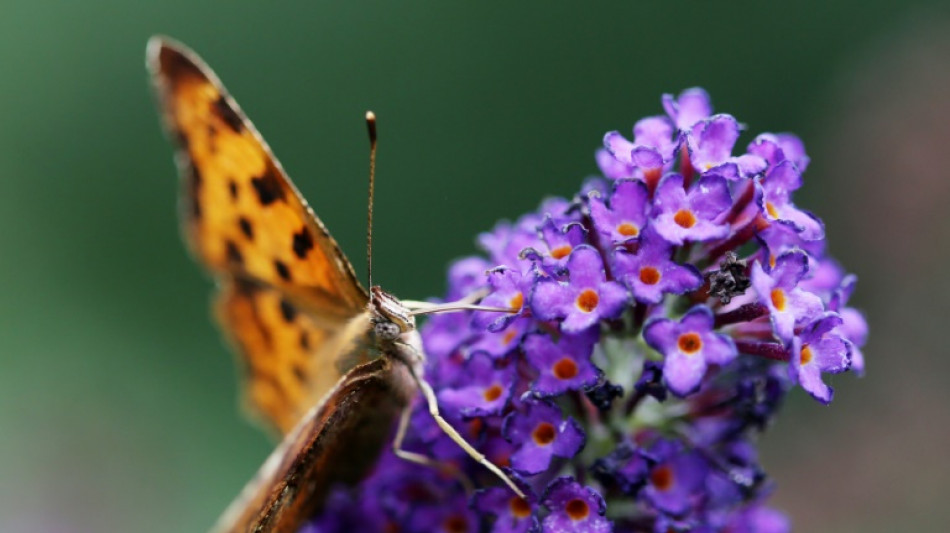
Wildlife lovers urged to join UK's annual butterfly count / Photo: Roland Weihrauch - dpa/AFP

Wildlife enthusiasts across Britain are being encouraged to log sightings of butterflies and some moths, as the world's largest annual survey of the increasingly endangered pollinating insects returns.
The UK-wide "Big Butterfly Count" -- which this year runs from July 14 to August 6 -- helps conservationists assess the health of the country's natural environment, amid mounting evidence it is increasingly imperilled.
Volunteers download a chart helping them to identify different butterfly species and then record their sightings in gardens, parks and elsewhere using a smartphone app and other online tools.
It comes as experts warn the often brightly coloured winged insects are in rapid decline in Britain as they fail to cope with unprecedented environmental change.
"It's a pretty worrying picture," Richard Fox, head of science at the Butterfly Conservation charity, which runs the nationwide citizen-led survey, told AFP at Orley Common, a vast park in Devon, southwest England.
"The major causes of the decline are what we humans have done to the landscape in the UK over the past 50, 60, 70 years," he added from the site, which is seeing fewer butterflies despite offering an ideal habitat for them.
A report published this year that Fox co-authored, based on 23 million items of data, revealed that four in every five UK butterfly species have decreased since the 1970s.
Half of the country's 58 species are listed as threatened, according to a conservation "red list".
- 'Citizen scientists' -
The UK, one of the world's most nature-depleted countries, has lost almost half of its biodiversity over recent decades, according to a 2021 UK parliament report.
Agriculture, and its use of fertilisers and pesticides, alongside changes to landscapes including the removal of hedge rows to maximise space for growing crops, is partly blamed.
Counting butterflies, which are among the most monitored insects globally, has helped track the grim trend.
Volunteers have been contributing to the effort since the 1970s but recording is more popular than ever, in part thanks to evolving technology.
The Big Butterfly Count launched in 2010 and claims to have become the world's biggest such survey.
Over 64,000 "citizen scientists" participated last year, submitting 96,257 counts of butterflies and day-flying moths from across Britain.
Butterfly Conservation and the UK Centre for Ecology and Hydrology have developed an iRecord Butterflies app to help identify and geo-locate different butterfly species sightings.
It has logged nearly one million submissions since launching in 2014.
Butterflies help identify the health of an ecosystem because they react quickly to environmental changes and are seen as an early warning system for other wildlife losses, conservationists note.
"One of the great things about butterflies and of this fantastic data that we have about butterflies is that they act as indicators about all the other groups," Fox explained.
"So we know a bit about how our bees are doing, we know a little about how bugs, and beetles, and flies, and wasps, and other important insects are doing."
- 'We'll starve' -
Amy Walkden, Butterfly Conservation's branch secretary in Devon, is one of many enthusiasts monitoring the insects year-round with the help of her eight-year-old daughter, Robin.
"Having a yearly record of what is around and what is not around I think is really good scientific data to indicate changes such as global warming, habitat destruction," she said.
Her daughter Robin appears equally aware of their value.
"If we don't have any butterflies and all the buzzy things, then the things that eat butterflies won't have any food," she noted.
"The food chain is basically what we eat and if there is none of them we'll starve and we won't really be able to survive, will we?"
Fox hopes that the latest annual count will help prompt policy makers to take more action, although he concedes the scale of the task is "enormous".
The UK government has said it wants to reverse biodiversity loss and climate change, partly by planting tens of millions of trees in the next three years.
Fox called the plan "fantastic" but said other areas such as low intensity agri-environment schemes are also needed, "so that the public money paid to farmers will benefit the environment and support biodiversity".
"There's a lot more we can do there to make sure that the margins around fields are being managed in a way to turn around the fortunes of our more common and widespread butterflies," he added.
(A.Lehmann--BBZ)