Berliner Boersenzeitung - Bashful golden mole detected in South Africa after 87 years

EUR -
AED 4.406854
AFN 77.997427
ALL 96.699641
AMD 450.935247
ANG 2.148026
AOA 1100.364447
ARS 1731.258254
AUD 1.715566
AWG 2.16143
AZN 2.040377
BAM 1.956813
BBD 2.397031
BDT 145.435266
BGN 2.015179
BHD 0.452423
BIF 3525.339121
BMD 1.199961
BND 1.507267
BOB 8.224291
BRL 6.221792
BSD 1.190111
BTN 109.163949
BWP 15.664172
BYN 3.391241
BYR 23519.235665
BZD 2.393629
CAD 1.632127
CDF 2687.912943
CHF 0.918474
CLF 0.026143
CLP 1032.266701
CNY 8.345309
CNH 8.326643
COP 4385.509478
CRC 591.303547
CUC 1.199961
CUP 31.798967
CVE 110.322554
CZK 24.225953
DJF 211.938799
DKK 7.467231
DOP 74.878439
DZD 155.038608
EGP 56.394324
ERN 17.999415
ETB 185.043993
FJD 2.63907
FKP 0.876141
GBP 0.869144
GEL 3.233859
GGP 0.876141
GHS 13.008787
GIP 0.876141
GMD 87.596885
GNF 10439.185447
GTQ 9.131764
GYD 248.9999
HKD 9.361514
HNL 31.408123
HRK 7.534435
HTG 156.082076
HUF 380.146451
IDR 20078.947469
ILS 3.727619
IMP 0.876141
INR 109.800572
IQD 1559.100369
IRR 50548.357454
ISK 145.195014
JEP 0.876141
JMD 186.987549
JOD 0.850807
JPY 183.338432
KES 155.071125
KGS 104.935387
KHR 4785.516479
KMF 494.383729
KPW 1079.988196
KRW 1714.972818
KWD 0.367368
KYD 0.991809
KZT 599.5878
LAK 25644.164503
LBP 106577.812016
LKR 368.51918
LRD 220.173944
LSL 19.084518
LTL 3.543173
LVL 0.725844
LYD 7.511856
MAD 10.808239
MDL 20.066217
MGA 5342.787259
MKD 61.638134
MMK 2519.977352
MNT 4278.022293
MOP 9.563409
MRU 47.546408
MUR 54.622161
MVR 18.551811
MWK 2081.932642
MXN 20.632973
MYR 4.705649
MZN 76.50917
NAD 19.084597
NGN 1680.73764
NIO 43.79595
NOK 11.523802
NPR 174.660663
NZD 1.995169
OMR 0.461379
PAB 1.190121
PEN 3.989031
PGK 5.092017
PHP 70.614698
PKR 333.214634
PLN 4.199191
PYG 7977.095064
QAR 4.326657
RON 5.097189
RSD 117.420962
RUB 91.500508
RWF 1736.405859
SAR 4.49976
SBD 9.692896
SCR 16.807959
SDG 721.789858
SEK 10.570306
SGD 1.513211
SHP 0.900282
SLE 29.158078
SLL 25162.58138
SOS 678.954201
SRD 45.954894
STD 24836.770057
STN 24.514525
SVC 10.413346
SYP 13271.058587
SZL 19.078953
THB 37.156187
TJS 11.116053
TMT 4.199864
TND 3.43179
TOP 2.889218
TRY 52.092826
TTD 8.093155
TWD 37.526984
TZS 3064.969164
UAH 51.087652
UGX 4249.216759
USD 1.199961
UYU 44.59345
UZS 14399.391968
VES 430.157401
VND 31314.182343
VUV 143.692105
WST 3.275045
XAF 656.299382
XAG 0.010437
XAU 0.000229
XCD 3.242954
XCG 2.144901
XDR 0.816226
XOF 656.29391
XPF 119.331742
YER 286.068876
ZAR 19.072361
ZMK 10801.091361
ZMW 23.499063
ZWL 386.386953
  • SCS

    0.0200

    16.14

    +0.12%

  • RBGPF

    0.0000

    82.4

    0%

  • CMSC

    0.0200

    23.8

    +0.08%

  • RYCEF

    0.1500

    17.27

    +0.87%

  • NGG

    1.7300

    84.31

    +2.05%

  • RELX

    -1.1500

    38.36

    -3%

  • GSK

    0.4800

    50.8

    +0.94%

  • BTI

    1.3500

    60.34

    +2.24%

  • RIO

    2.4400

    92.91

    +2.63%

  • BP

    0.8600

    37.62

    +2.29%

  • BCE

    0.3700

    25.52

    +1.45%

  • BCC

    -1.6600

    81.74

    -2.03%

  • CMSD

    -0.0630

    24.097

    -0.26%

  • JRI

    -0.0500

    13.68

    -0.37%

  • AZN

    1.3700

    95.6

    +1.43%

  • VOD

    0.2700

    14.5

    +1.86%

Bashful golden mole detected in South Africa after 87 years
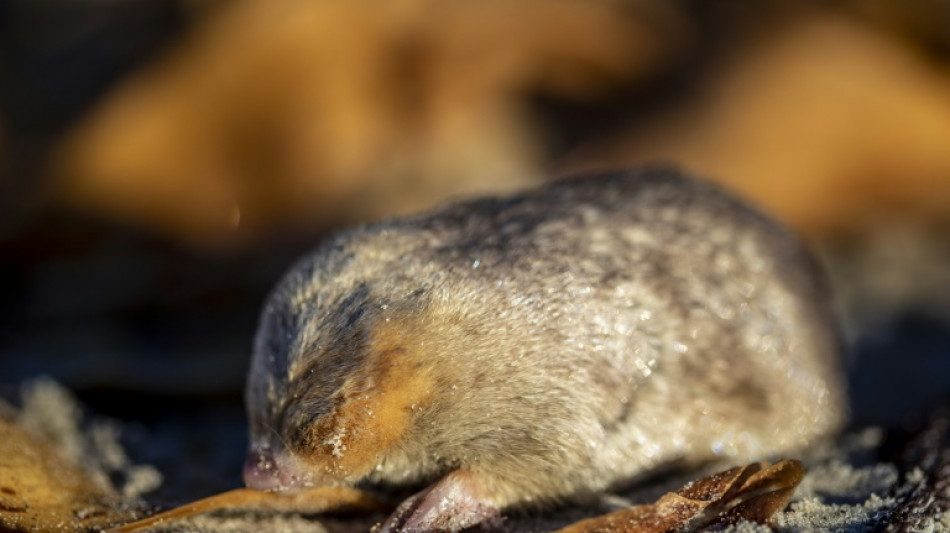
Bashful golden mole detected in South Africa after 87 years / Photo: Nicky Souness - Endangered Wildlife Trust/AFP

Bashful golden mole detected in South Africa after 87 years

A golden mole that "swims" in sand has resurfaced in South Africa after 87 years in the wilderness when many specialists feared it had become extinct, researchers have said.

Text size:

Traces of two De Winton's golden moles have been found under the sands of a beach after a "detective novel search", said Endangered Wildlife Trust (EWT) senior field officer Esther Matthew on Tuesday.

EWT and University of Pretoria researchers covered up to 18 kilometres (11.2 miles) of dune habitat a day as they spent months hunting for signs, said Matthew.

The blind moles are cute but excessively timid.

They pick inaccessible areas to burrow homes and have extremely sensitive hearing to detect ground vibrations made by anyone who could be looking for them. The last scientific trace dates back to 1936.

The team used a scent-detecting Border Collie dog, Jessie, to find traces of the moles' tunnels.

There are 21 species of golden moles and the De Winton's were detected using environmental DNA samples -- skin, hair and bodily excretions -- taken from soil at Port Nolloth beach on the northwest coast.

More than 100 samples were collected from the dunes.

Even now the researchers have not physically seen the blind mole that has an iridescent coat sheen that allows it to "swim" through sand.

To finally make a connection, they have made videos and taken photos.

The De Winton's golden mole was one of the top 25 animals on a list of long-lost species drawn up by the Re:wild non-government group in 2017.

Eleven have now been discovered again.

Christina Biggs, a lost species specialist for Re:wild, praised the persistence of the team that found the moles.

"They left no sandhill unturned and now it’s possible to protect the areas where these threatened and rare moles live," said Biggs.

The use of environmental DNA was a "case study on how such forward-thinking technologies can be utilised to find other lost species."

The team found traces of four other golden moles in the same region. Matthew said the De Winton's are still threatened by mining and residential developments near the beaches that are their home.

(K.Müller--BBZ)