Berliner Boersenzeitung - IVF breakthrough could revive nearly extinct rhino species

EUR -
AED 4.290054
AFN 72.42575
ALL 95.503191
AMD 432.173262
ANG 2.090865
AOA 1072.367827
ARS 1654.62964
AUD 1.63286
AWG 2.105602
AZN 1.993611
BAM 1.953427
BBD 2.352323
BDT 143.624334
BGN 1.948604
BHD 0.440759
BIF 3479.259433
BMD 1.168156
BND 1.491276
BOB 8.070164
BRL 5.842069
BSD 1.167872
BTN 110.358022
BWP 15.79568
BYN 3.29517
BYR 22895.862222
BZD 2.348937
CAD 1.597571
CDF 2715.963068
CHF 0.92379
CLF 0.026658
CLP 1048.933841
CNY 7.970505
CNH 7.99225
COP 4228.410171
CRC 531.250231
CUC 1.168156
CUP 30.95614
CVE 110.1303
CZK 24.37504
DJF 207.977405
DKK 7.472824
DOP 69.385135
DZD 154.88931
EGP 61.670358
ERN 17.522344
ETB 182.360337
FJD 2.570875
FKP 0.862058
GBP 0.867479
GEL 3.136506
GGP 0.862058
GHS 12.964199
GIP 0.862058
GMD 85.275208
GNF 10248.46517
GTQ 8.923086
GYD 244.343237
HKD 9.154081
HNL 31.045029
HRK 7.532388
HTG 152.992875
HUF 365.379465
IDR 20190.178748
ILS 3.492201
IMP 0.862058
INR 110.555532
IQD 1529.928754
IRR 1536125.450142
ISK 143.225439
JEP 0.862058
JMD 184.016506
JOD 0.828175
JPY 186.617663
KES 150.93771
KGS 102.131433
KHR 4680.275586
KMF 490.625211
KPW 1051.335721
KRW 1726.015078
KWD 0.359605
KYD 0.97331
KZT 535.335235
LAK 25638.751153
LBP 104645.057227
LKR 372.274673
LRD 214.308798
LSL 19.376201
LTL 3.449262
LVL 0.706606
LYD 7.410999
MAD 10.809879
MDL 20.199294
MGA 4855.082561
MKD 61.579187
MMK 2453.174057
MNT 4201.104491
MOP 9.42731
MRU 46.44819
MUR 54.646713
MVR 18.059189
MWK 2025.123085
MXN 20.39151
MYR 4.616526
MZN 74.635995
NAD 19.376201
NGN 1601.51884
NIO 42.977435
NOK 10.886603
NPR 176.573035
NZD 1.990567
OMR 0.449162
PAB 1.167877
PEN 4.094093
PGK 5.073794
PHP 71.589274
PKR 325.479535
PLN 4.248567
PYG 7321.045677
QAR 4.245743
RON 5.093627
RSD 117.391485
RUB 87.72965
RWF 1707.21192
SAR 4.381491
SBD 9.402002
SCR 16.008867
SDG 701.475152
SEK 10.847207
SGD 1.493026
SHP 0.872147
SLE 28.735721
SLL 24495.647708
SOS 667.483605
SRD 43.648182
STD 24178.475583
STN 24.470071
SVC 10.219501
SYP 129.13882
SZL 19.360321
THB 38.018235
TJS 10.955095
TMT 4.094388
TND 3.405778
TOP 2.81264
TRY 52.630925
TTD 7.941287
TWD 36.873982
TZS 3043.190704
UAH 51.469848
UGX 4344.686043
USD 1.168156
UYU 46.093623
UZS 14049.815763
VES 565.311069
VND 30778.580501
VUV 138.105975
WST 3.186512
XAF 655.155683
XAG 0.016108
XAU 0.000256
XCD 3.157
XCG 2.104826
XDR 0.815044
XOF 655.161285
XPF 119.331742
YER 278.702846
ZAR 19.433985
ZMK 10514.807479
ZMW 22.158992
ZWL 376.145831
  • RYCEF

    0.1000

    15.4

    +0.65%

  • CMSC

    -0.0400

    22.82

    -0.18%

  • JRI

    0.0650

    12.905

    +0.5%

  • BCE

    -0.0111

    23.54

    -0.05%

  • RBGPF

    0.0000

    64

    0%

  • NGG

    -0.3000

    86.93

    -0.35%

  • RIO

    -0.6000

    99.35

    -0.6%

  • GSK

    0.2850

    54.5

    +0.52%

  • VOD

    -0.1000

    15.41

    -0.65%

  • BTI

    0.5800

    57.88

    +1%

  • RELX

    -0.6150

    35.78

    -1.72%

  • BCC

    0.2950

    84.105

    +0.35%

  • CMSD

    -0.0900

    23.19

    -0.39%

  • AZN

    0.1560

    187.65

    +0.08%

  • BP

    0.6850

    46.65

    +1.47%

IVF breakthrough could revive nearly extinct rhino species
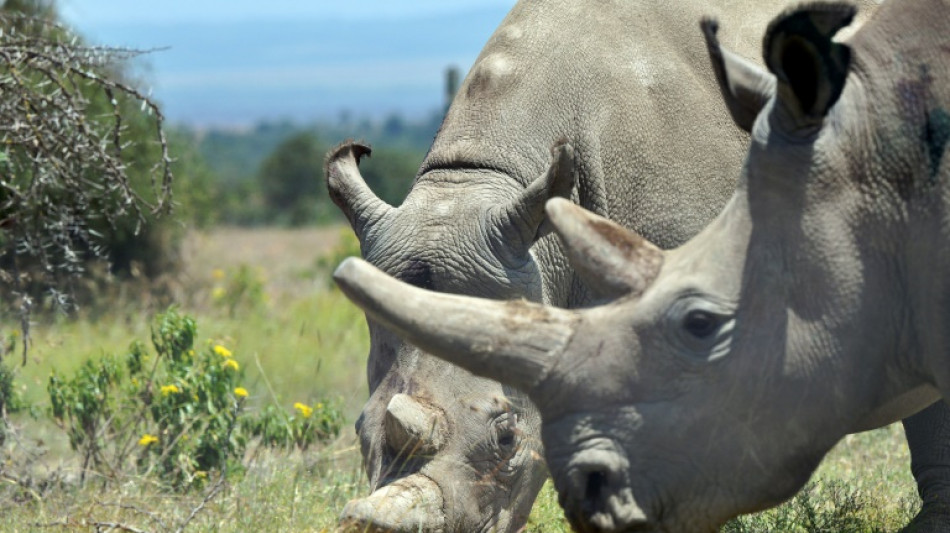
IVF breakthrough could revive nearly extinct rhino species / Photo: TONY KARUMBA - AFP/File

IVF breakthrough could revive nearly extinct rhino species

Scientists have carried out the first successful in vitro fertilisation of a southern white rhino, a major breakthrough that could pave the way to saving its highly endangered northern cousin.

Text size:

Only two female northern white rhinos remain in existence but neither is capable of carrying a pregnancy to term.

To save the functionally extinct species, researchers from the scientific consortium Biorescue are attempting to implant a lab-grown northern white rhino embryo in a southern surrogate.

The ambitious reproduction programme is the last chance at survival for the northern white rhino species, whose last two members live at the Ol Pejeta Conservancy in Kenya under 24-hour guard to protect them from poachers.

The successful impregnation of a southern white rhino with an embryo of the same species was a "milestone", project leader Thomas Hildebrandt said at a press conference in Berlin.

"We achieved something that was not believed to be possible," Hildebrandt said.

The successful recent trial ended in tragedy when the bull and the surrogate, along with the foetus, were killed by an unrelated infection the scientists believe was caused by bacteria released by a mudslide in their enclosure.

The foetus was only 70 days old at the time but the team said they were confident it could have survived the 16-month pregnancy period.

The next step will see scientists try to repeat the feat with other embryos made with eggs harvested from the surviving females and sperm preserved from two long-dead males.

The team aims to "produce northern white rhino calves in the next two to two-and-a-half years", Hildebrandt said.

- Delicate operation -

To place the embryo in the surrogate, the team of conservationists use a sterile "teaser" bull rhino, whose approaches to the female indicate she is ready to conceive.

The team subsequently carry out the delicate operation in just under an hour with the surrogate under anaesthetic.

The size and delicate anatomy of the white rhinos means the embryo is implanted via the rectum into the uterus.

The trials were carried out using southern white rhino embryos to preserve what scarce genetic material is left from the northern species.

Biorescue has collected eggs from the surviving females, Najin and Fatu, since 2019 but had to retire the elder of the two from the programme in 2021.

The last male, whose name was Sudan, died at the sanctuary in Kenya in 2018.

What northern white rhino sperm has been preserved from now-dead male donors is of "very poor quality", said Cesare Galli from the Italian lab Avantea where the new northern white rhino eggs are fertilised in vitro.

- 'Big day' -

The Biorescue team have 30 fertilised eggs in freezers "waiting for their big day", said Susanne Holtze from the Leibniz Institute for Zoo and Wildlife Research.

The IVF method could potentially provide a model for other endangered species of rhino, such as the endangered Sumatran rhino in South East Asia, according to project leader Hildebrandt.

Rhinos, which have roamed the planet for 26 million years, have very few natural predators but their numbers have been decimated by poaching since the 1970s.

(T.Burkhard--BBZ)