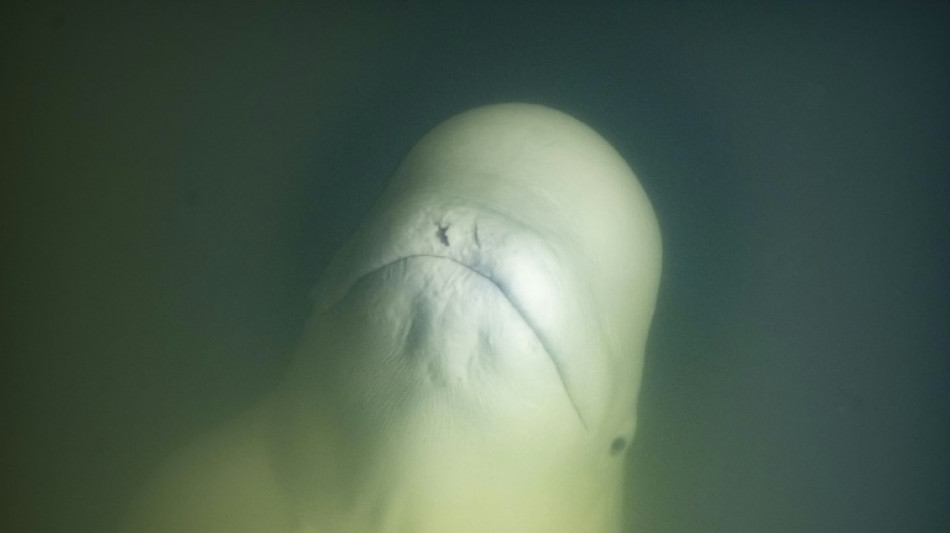
Whale menopause sheds light on human evolutionary mystery / Photo: Olivier MORIN - AFP/File

Why do humans experience menopause? It's a question that some women going through the symptoms might have asked themselves more than once.
Scientists are also baffled. From an evolutionary perspective, animals generally take every chance they can get to have as many offspring as possible to boost their odds of survival.
So why have some species evolved to have menopause, in which females live many years after they stop being able to reproduce?
That there are so few other examples in the animal kingdom only deepens the mystery.
Out of 5,000 mammals, just five species of whales with teeth -- including killer whales, beluga whales and narwhals -- are the only others known to have females that regularly live long after they stop reproducing.
However plenty of other toothed whales, such as dolphins, do not experience menopause.
By looking at the differences between these two groups, a UK-led team of researchers sought to discover why some whales evolved to get menopause -- and what this could tell us about ourselves.
Despite our many differences, humans share a "convergent life history" with these ocean giants that led to the independent evolution of menopause, the researchers concluded in a study published in Nature on Wednesday.
Their results tied together several existing hypotheses. The first piece of the puzzle involving lifespan.
- The grandmother hypothesis -
Females of the five species that have menopause live roughly 40 years longer than other similar-sized whales, the researchers found.
These female whales also easily outlive males of their own kind.
Female killer whales "regularly live into their 60s and 70s, but the males are all dead by 40," lead study author Samuel Ellis of the UK's University of Exeter told an online press conference.
This supports what is known as the "grandmother hypothesis" -- that older females care for their grandchildren, therefore helping their species survive in a different way.
But why would it be an evolutionary advantage for these grandmothers to stop having offspring?
"The second part of this story is about competition," study co-author Darren Croft said.
When killer whale "mothers and daughters try and breed at the same time, the calves of the older females" have a significantly lower survival rate as they compete for resources, he said.
"So they have evolved a longer lifespan while keeping a short reproductive lifespan," Croft added.
"This is just the same pattern of life history we see in humans."
Though we walk on land and they swim through the ocean, the similarities between human and whale social structures is "absolutely striking", Croft said.
- The importance of matriarchy -
"Older matriarchs" play an important role within both societies, he said.
For example, the experience older females have gathered over their lives helps the whale families get through hard times such as environmental challenges or a lack of food.
But just having a matriarchal society is not enough. Older female elephants, for example, look after their offspring but keep reproducing until the end of their lives.
The key difference could be that older whale mothers keep looking after their sons, Croft said. Young male elephants, however, leave the family group.
Both sons and daughters sticking around could even be a unique trait to the five whales -- and humans -- that get menopause, he speculated.
Rebecca Sear, an evolutionary demographer and anthropologist at the London School of Hygiene and Tropical Medicine not involved in the study, cautioned that this could not "provide definitive answers to the question of why menopause evolved".
Whales are incredibly difficult to study, and a lot of the data used for the research was from unnatural events such as mass strandings, she commented in Nature.
Meanwhile, there has been increasing criticism that menopause in human women remains badly under-researched due to a long-standing male-skewed bias in medical research.
"Human grandmothers, like whale grandmothers, are important in the lives of their adult children and grandchildren, but older women are too often ignored in policy circles and public health research," Sear said.
(F.Schuster--BBZ)