Berliner Boersenzeitung - In Ecuadoran Amazon, butterflies provide a gauge of climate change

EUR -
AED 4.301555
AFN 73.779193
ALL 95.50254
AMD 434.947725
ANG 2.096126
AOA 1075.065432
ARS 1645.082546
AUD 1.630337
AWG 2.109436
AZN 1.994608
BAM 1.958343
BBD 2.358242
BDT 143.985731
BGN 1.953507
BHD 0.441793
BIF 3484.00949
BMD 1.171096
BND 1.495028
BOB 8.090471
BRL 5.857467
BSD 1.17081
BTN 110.635712
BWP 15.835427
BYN 3.303461
BYR 22953.474287
BZD 2.354848
CAD 1.601837
CDF 2719.862066
CHF 0.924341
CLF 0.026513
CLP 1043.587015
CNY 8.007308
CNH 8.00936
COP 4228.919996
CRC 532.586998
CUC 1.171096
CUP 31.034034
CVE 110.55321
CZK 24.353637
DJF 208.127296
DKK 7.471391
DOP 69.387257
DZD 155.154914
EGP 61.875656
ERN 17.566434
ETB 184.301204
FJD 2.59954
FKP 0.864227
GBP 0.866488
GEL 3.156083
GGP 0.864227
GHS 13.046367
GIP 0.864227
GMD 86.067605
GNF 10279.291323
GTQ 8.945539
GYD 244.95807
HKD 9.177584
HNL 31.174087
HRK 7.532518
HTG 153.377846
HUF 363.749909
IDR 20198.998817
ILS 3.461744
IMP 0.864227
INR 110.80872
IQD 1534.135271
IRR 1541161.844741
ISK 143.178241
JEP 0.864227
JMD 184.47954
JOD 0.830277
JPY 186.88871
KES 151.17905
KGS 102.388421
KHR 4696.093159
KMF 493.031138
KPW 1053.981161
KRW 1724.29801
KWD 0.360182
KYD 0.975759
KZT 536.682281
LAK 25699.693433
LBP 104930.167935
LKR 373.211415
LRD 215.188405
LSL 19.36405
LTL 3.457941
LVL 0.708384
LYD 7.430593
MAD 10.839954
MDL 20.250121
MGA 4858.87593
MKD 61.648457
MMK 2459.346894
MNT 4211.675584
MOP 9.451031
MRU 46.843862
MUR 54.784212
MVR 18.093405
MWK 2038.877562
MXN 20.364357
MYR 4.62875
MZN 74.844323
NAD 19.381597
NGN 1604.600006
NIO 42.996808
NOK 10.911244
NPR 177.017339
NZD 1.989475
OMR 0.450263
PAB 1.170815
PEN 4.104394
PGK 5.088118
PHP 71.544577
PKR 326.298528
PLN 4.248325
PYG 7339.467371
QAR 4.256427
RON 5.096138
RSD 117.400013
RUB 88.209772
RWF 1710.385163
SAR 4.392759
SBD 9.399138
SCR 16.400969
SDG 703.245697
SEK 10.859019
SGD 1.494827
SHP 0.874341
SLE 28.83821
SLL 24557.285258
SOS 669.278604
SRD 43.875083
STD 24239.315043
STN 24.885782
SVC 10.245216
SYP 129.463768
SZL 19.382118
THB 38.061004
TJS 10.982661
TMT 4.10469
TND 3.377147
TOP 2.819717
TRY 52.745889
TTD 7.961269
TWD 36.926399
TZS 3053.775937
UAH 51.599359
UGX 4355.618426
USD 1.171096
UYU 46.209607
UZS 14135.124337
VES 566.733541
VND 30856.027577
VUV 138.453487
WST 3.19453
XAF 656.804229
XAG 0.015987
XAU 0.000255
XCD 3.164944
XCG 2.110122
XDR 0.817095
XOF 655.232581
XPF 119.331742
YER 279.482119
ZAR 19.378412
ZMK 10541.265481
ZMW 22.21475
ZWL 377.092314
  • RYCEF

    -0.2000

    15.2

    -1.32%

  • VOD

    -0.0200

    15.49

    -0.13%

  • RIO

    -1.4600

    98.49

    -1.48%

  • BTI

    1.1500

    58.47

    +1.97%

  • CMSC

    -0.0300

    22.83

    -0.13%

  • RELX

    -0.3800

    36.01

    -1.06%

  • GSK

    0.2500

    54.47

    +0.46%

  • RBGPF

    0.0000

    64

    0%

  • CMSD

    -0.0600

    23.2

    -0.26%

  • BCE

    -0.0600

    23.5

    -0.26%

  • BCC

    -1.2500

    82.61

    -1.51%

  • JRI

    -0.0200

    12.81

    -0.16%

  • AZN

    -0.8300

    186.68

    -0.44%

  • BP

    0.3800

    46.35

    +0.82%

  • NGG

    0.2200

    87.45

    +0.25%

In Ecuadoran Amazon, butterflies provide a gauge of climate change
In Ecuadoran Amazon, butterflies provide a gauge of climate change / Photo: Daniel MUNOZ - AFP/File

In Ecuadoran Amazon, butterflies provide a gauge of climate change

Biologists on a trail in the Ecuadoran Amazon hold their breath as they distribute a foul-smelling delicacy to lure butterflies, critical pollinators increasingly threatened by climate change.

Text size:

A team has hung 32 traps made of green nets, each baited with rotting fish and fermented bananas. They are meant to blend in with the forest canopy. Their pungent odor clearly does not.

Since last August, a team of biologists and park rangers has been monitoring butterfly numbers in the Cuyabeno Wildlife Reserve, a park famed for its abundant flora and fauna.

They catch and document the colorful insects, releasing most with an identifying mark on their wings. Some of them, possibly from previously unknown species, are kept for further study.

The results of the team's work, however, have been discouraging.

Butterflies are "bioindicators," living organisms whose well-being provides a measure of the health of their surrounding ecosystem, and their numbers are decreasing, biologist Maria Fernanda Checa told AFP.

While the number of species may not have declined by more than 10 percent, in terms of absolute butterfly numbers "the decrease is very significant... maybe 40/50 percent," she said.

"It is something that alarms us."

- Bioindicators -

Under expedition leader Elisa Levy, a team checks the nets for captured butterflies.

They hold the insects delicately by their tiny abdomens and manipulate their legs and wings with tweezers.

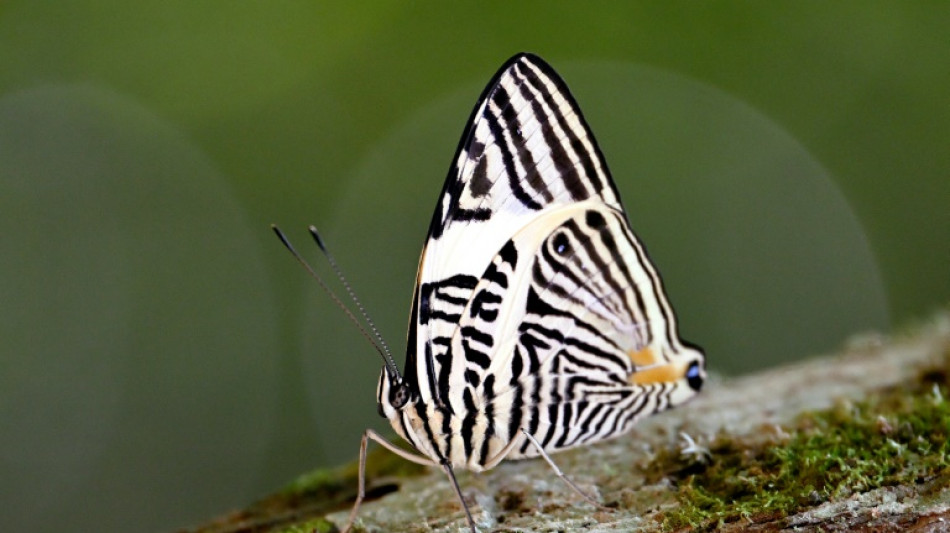
Some are bright red and blue, others have what resemble zebra stripes. Some are see-through, like glass.

About three-quarters of fruit- or seed-producing crops for human consumption depend on pollinators, which provide a free service worth billions of dollars.

The UN has warned that 40 percent of invertebrate pollinators -- particularly bees and butterflies -- risk global extinction, posing certain risks to humanity itself.

Butterflies, said Checa, are "very sensitive, even to small changes in the ecosystem" throughout their short lifespan from egg to caterpillar to reproductive adult.

Levy explained that tropical plants -- unlike ones in regions with distinct seasons -- are not accustomed to extreme weather variations.

If they do not adapt to a fast-changing climate, these plants could be lost, along with the butterfly larvae that feed on them.

Ecuador, relatively small but extremely biodiverse, hosts about 4,000 butterfly species -- nearly as many as its much larger neighbors Peru and Colombia.

Yet in places like the Yasuni National Park, which neighbors Cuyabeno, "the rate of species discovery is slower than the rate of extinction," said Checa.

(L.Kaufmann--BBZ)