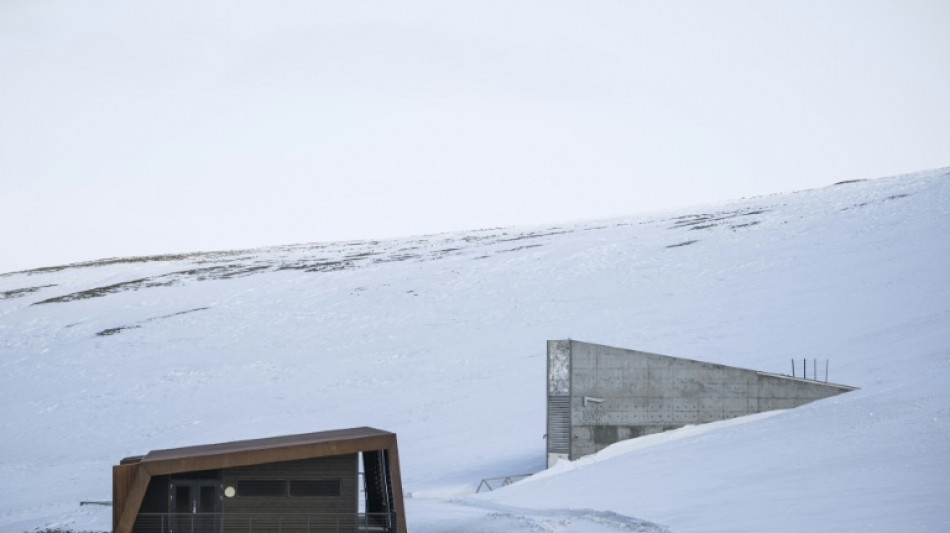
Scientists win World Food Prize for work on Global Seed Vault / Photo: Jonathan NACKSTRAND - AFP

Scientists Geoffrey Hawtin and Cary Fowler, who on Thursday received the prestigious World Food Prize for "their work to preserve the world's heritage of seeds", are on a mission.
Their vocation is to safeguard as many seeds as possible so that one day the world can benefit from their genetic characteristics. Their work is all in the name of protecting global food security.
Hawtin and Fowler helped set up a world reserve of seeds dug into a glacier on the Norwegian archipelago Svalbard in the Arctic -- where 1.25 million samples are now stored for preservation in the cold.
It was for this work they were named the 2024 winners of the World Food Prize, awarded to individuals who have increased the quality, quantity, or availability of food worldwide.
The goal is always to conserve as many agricultural seeds as possible, 75-year-old British-Canadian agronomist Hawtin told AFP.
"What actually changed a little bit since it opened in 2008 is the material going into it," he said.
After mainly collecting seeds from "domesticated" plants like wheat and barley, the reserve is now welcoming more wild species that are more or less related to cultivated plants.
The latter mainly "have genes that are particularly interesting with climate change", he said.
- Countless experiments -
The domestication of plants is "the result of thousands of years and countless experiments," said Fowler, a 74-year-old American seed specialist and the US Special Envoy for Global Food Security.
It would be "arrogant" to think that current genetic engineering tools, even the most sophisticated, could reproduce those experiments, he added.
That would be "a more expensive way of getting the diversity that we already have contained in the seeds in the seed banks".
Hawtin said that while gene editing had a huge role to play, the "problem is what to edit".
"There are tens of thousands, if not more, genes that in some way or another affect the plant's response to just the climate change, which could be heat, which can be cold, which can be drought, which can be flooding," he said.
He said he doubted that even artificial intelligence could allow "the full level of understanding" needed for such an approach.
He nevertheless predicts the rise of digital seed banks where more and more information detailing the genetic characteristics of plants will be stored.
- Saved in Syria -
Both men began their careers in the 1970s.
The aim then was not yet to adapt to climate change but to produce as much wheat, maize and rice as possible.
"There were famines in Ethiopia and in India and, most of the concern then was for filling people's stomachs," Fowler said.
To achieve this, experts at the time recommended concentrating on seeds with the highest yields and making massive use of fertilisers and pesticides.
Since then, they have understood the importance of developing more durable agricultural systems and enlarging the range of crops grown, said Fowler.
As the Special Envoy for Global Food Security, he promotes the use of traditional crops in Africa. Often neglected by research programmes in favour of corn, wheat and rice, they are potentially more nutritious and better adapted to the environment.
Hawtin began his career in the Middle East, meeting with farmers and collecting vegetable seeds in Afghanistan, Ethiopia, Lebanon and Jordan and then cross-referencing them.
Not wanting to just throw them away, he started to keep them.
- Seed banks 'caught in the middle' -
Three decades later, the war in Syria forced the Aleppo seed bank, where the agronomist had once worked, to "evacuate" its samples with urgency.
Many of them went to the Svalbard seed bank.
Some, including vegetable seeds collected by Hawtin and his team, have already been withdrawn from the reserve to join collections in Morocco and Lebanon.
"Two weeks ago, I was in Morocco, and I saw some of that material being planted out in the fields in Morocco and being tested for resistance to drought," Hawtin said.
The fact that the global reserve was used up so quickly leaves the scientists with a hint of bitterness.
"It's like an automobile insurance policy. You never want to be in a situation where you have to use it," Fowler said.
"I'm sorry to say it, but I think there will be more situations of conflicts around the world and of natural disasters with, unfortunately, seed banks getting caught in the middle," he added.
The World Food Prize, worth $500,000, was set up in 1986 by Dr Norman E. Borlaug who was awarded the Nobel Peace Prize in 1970 for his work in global agriculture.
It is presented every year in Iowa, the United States.
(S.G.Stein--BBZ)