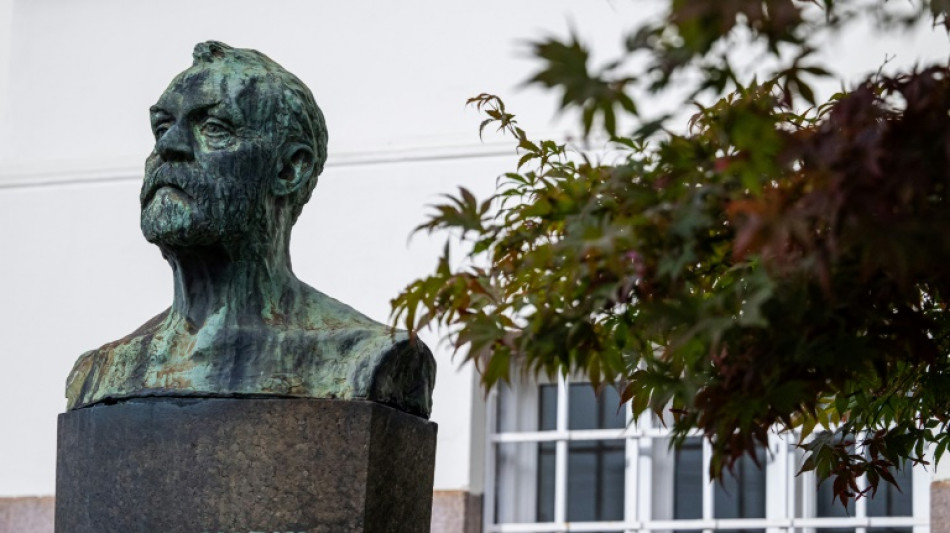
Nobel literature jury may go for non-Western writer / Photo: Jonathan NACKSTRAND - AFP/File

The Nobel Prize in Literature has honoured predominantly Western writers since it was first awarded in 1901, but the Swedish Academy may shine its spotlight further afield this year, experts say.
With no official shortlist, speculation is rife on who the Nobel committee will settle on, with their decision due to be revealed Thursday at 1:00 pm (1100 GMT).
Many believe Chinese author Can Xue -- the favourite on several betting sites -- will win, with Australian novelist Gerald Murnane also tipped.
Often likened to Franz Kafka, Can's experimental style transforms the mundane into the surreal.
The academy is known for its penchant for bringing lesser-known authors to a wider audience.
"I think they've gone to great pains to find some writer that will catch the culture commentariat with their pants down," Bjorn Wiman, culture editor at Sweden's newspaper of record, Dagens Nyheter, told AFP.
That was the case in 2021 -- when Zanzibar-born British author Abdulrazak Gurnah was chosen for his work exploring exile, colonialism and racism -- and in 2016, when US folk rock icon Bob Dylan won.
Wiman said the prize could just as easily go to a Mexican or Argentinian writer as an African author.
"I think it will be a woman from a language zone outside Europe," he said.
His personal pick would however be British Indian-born author Salman Rushdie -- a symbol of free speech after receiving death threats over his 1988 novel "The Satanic Verses" which was declared blasphemous by Iran's supreme leader, and the victim of a 2022 stabbing in New York state that saw him lose his right eye.
"But then they will be accused of honouring another middle-aged man," Wiman said.
Last year, the prize went to middle-aged Norwegian playwright Jon Fosse.
- Eurocentric, male prize -
Since its creation, the Nobel Prize in Literature has been a Eurocentric, male affair.
Of 120 laureates, only 17 have been women, with eight of them in the past 20 years.
And while 30 English-language authors have won and 16 French-language ones, only one Arabic writer has won: Egypt's Naguib Mahfouz in 1988.
In the case of China, its "literature is very vast", something not reflected in the history of the Nobel, said Carin Franzen, literature professor at Stockholm University.
The last Chinese author to win was Mo Yan in 2012.
One explanation for this under-representation could be the judges' lack of linguistic breadth, said Victor Malm, cultural editor at daily Expressen.
He predicted a win this year for Antiguan-American Jamaica Kincaid.
"I have a hard time believing that a Hindi author would suddenly be announced. No one in the Academy speaks Hindi, how could they have any credibility on the subject?" he said, noting they would have to rely on translated works.
The academy has always consulted experts in its selection process, and, vowing better representation, expanded its efforts in 2021 to include language experts.
"It's obviously not the same thing as being able to read in the original language," said Lina Kalmteg, literary critic at Swedish public radio SR.
She said it was rare for writers under Nobel consideration "to not be translated into Swedish at all".
- 'Non-European perspective' -
With such a predominance of Western laureates, how can the Nobel be considered one of the world's most prestigious literary prizes?
Historically, Western culture was considered superior, noted Rasmus Landstrom, literary critic at daily Aftonbladet.
The academy "said so outright" in the past, he said, noting that the jury's deliberations, sealed for 50 years, reveal that it has struggled with that prejudice for decades.
After a 2018 #MeToo scandal that left the Academy in tatters, the institution vowed to broaden the prize, both geographically and linguistically.
"It would therefore be interesting for them to open up to a non-European perspective," said Franzen.
Her favourite was Canadian poet Anne Carson.
Cultural editor of daily Goteborgs-Posten Johan Hilton is meanwhile putting his money on a Central or Eastern European writer.
"France, the United States, Britain, they've all won several times in recent years," Hilton said.
But there's no way a Russian could win this year, not even a Kremlin critic, he said, even though the academy insists it does not take nationality into consideration.
"It's politically impossible. I would be very surprised," he said, adding that would damage the prize's credibility.
Other names making the rounds in Stockholm's literary circles include Hungary's Laszlo Krasznahorkai, Romania's Mircea Cartarescu, Kenya's Ngugi wa Thiong'o and Haruki Murakami of Japan.
(T.Renner--BBZ)