Berliner Boersenzeitung - Pod of 157 dolphins stranded on remote Australian beach

EUR -
AED 4.30543
AFN 72.685036
ALL 95.427671
AMD 435.234986
ANG 2.098361
AOA 1076.212072
ARS 1630.101235
AUD 1.643089
AWG 2.11022
AZN 1.993778
BAM 1.955957
BBD 2.357389
BDT 143.611544
BGN 1.95559
BHD 0.442436
BIF 3481.479857
BMD 1.172344
BND 1.49512
BOB 8.08765
BRL 5.838976
BSD 1.170394
BTN 110.248862
BWP 15.853274
BYN 3.315567
BYR 22977.947073
BZD 2.353989
CAD 1.605467
CDF 2713.976479
CHF 0.922812
CLF 0.026708
CLP 1051.134495
CNY 8.014493
CNH 8.012128
COP 4166.734941
CRC 532.642816
CUC 1.172344
CUP 31.067122
CVE 110.273864
CZK 24.358384
DJF 208.426754
DKK 7.473816
DOP 69.725605
DZD 155.174474
EGP 61.632954
ERN 17.585164
ETB 180.938145
FJD 2.584609
FKP 0.866338
GBP 0.868693
GEL 3.141794
GGP 0.866338
GHS 12.994045
GIP 0.866338
GMD 86.166228
GNF 10273.825857
GTQ 8.947719
GYD 244.869684
HKD 9.185784
HNL 31.1015
HRK 7.537584
HTG 153.232318
HUF 365.208364
IDR 20226.103442
ILS 3.500678
IMP 0.866338
INR 110.494033
IQD 1533.223248
IRR 1543977.362022
ISK 143.788308
JEP 0.866338
JMD 184.704847
JOD 0.831135
JPY 186.056917
KES 151.332165
KGS 102.466644
KHR 4689.377272
KMF 492.383967
KPW 1055.10977
KRW 1731.165629
KWD 0.3608
KYD 0.975378
KZT 543.683704
LAK 25647.061628
LBP 104811.025191
LKR 373.07999
LRD 214.767264
LSL 19.462464
LTL 3.461628
LVL 0.70914
LYD 7.426597
MAD 10.82887
MDL 20.353636
MGA 4863.390942
MKD 61.644955
MMK 2462.168035
MNT 4193.6281
MOP 9.445259
MRU 46.713755
MUR 54.90151
MVR 18.112347
MWK 2029.563146
MXN 20.709452
MYR 4.64836
MZN 74.923844
NAD 19.462464
NGN 1590.871556
NIO 43.073462
NOK 10.922684
NPR 176.39818
NZD 2.000417
OMR 0.450356
PAB 1.170394
PEN 4.058026
PGK 5.080408
PHP 71.15542
PKR 326.283628
PLN 4.243827
PYG 7421.596582
QAR 4.266643
RON 5.088558
RSD 117.42944
RUB 88.247094
RWF 1710.737517
SAR 4.397229
SBD 9.43187
SCR 17.348395
SDG 703.992751
SEK 10.809424
SGD 1.496149
SHP 0.875273
SLE 28.869006
SLL 24583.468012
SOS 668.853766
SRD 43.920121
STD 24265.158781
STN 24.50197
SVC 10.240823
SYP 129.573333
SZL 19.454564
THB 37.907779
TJS 11.001984
TMT 4.109067
TND 3.417775
TOP 2.822724
TRY 52.773073
TTD 7.948639
TWD 36.909503
TZS 3046.044855
UAH 51.574546
UGX 4354.350023
USD 1.172344
UYU 46.363727
UZS 14062.130378
VES 566.435305
VND 30902.994124
VUV 137.819192
WST 3.198749
XAF 656.009733
XAG 0.015487
XAU 0.000249
XCD 3.168319
XCG 2.10937
XDR 0.815866
XOF 656.009733
XPF 119.331742
YER 279.779541
ZAR 19.358332
ZMK 10552.509387
ZMW 22.149781
ZWL 377.494366
  • RIO

    0.7600

    99.61

    +0.76%

  • NGG

    0.4600

    87.42

    +0.53%

  • RBGPF

    64.0000

    64

    +100%

  • CMSC

    0.0400

    22.95

    +0.17%

  • BCE

    -0.2200

    23.88

    -0.92%

  • BCC

    0.3300

    84.15

    +0.39%

  • BTI

    0.8100

    58.09

    +1.39%

  • RYCEF

    -0.1200

    15.3

    -0.78%

  • JRI

    0.0100

    12.89

    +0.08%

  • RELX

    0.4000

    36.53

    +1.09%

  • CMSD

    0.0900

    23.32

    +0.39%

  • VOD

    0.0100

    15.63

    +0.06%

  • GSK

    -1.1900

    54.44

    -2.19%

  • AZN

    -2.5500

    189.75

    -1.34%

  • BP

    -0.1000

    46.25

    -0.22%

Pod of 157 dolphins stranded on remote Australian beach
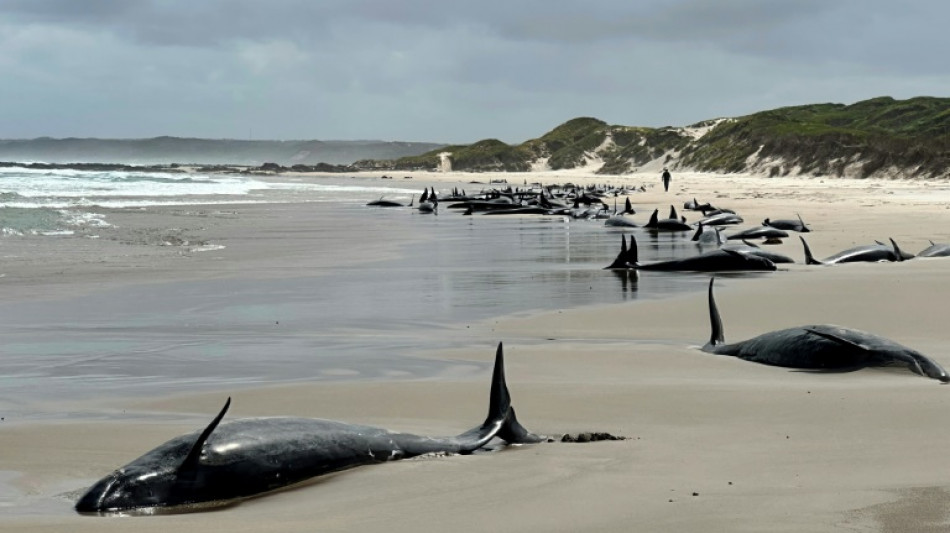
Pod of 157 dolphins stranded on remote Australian beach / Photo: Handout - Department of Natural Resources and Environment Tasmania/AFP

Pod of 157 dolphins stranded on remote Australian beach

Dozens of dolphins have died after a pod of more than 150 stranded on a remote beach in Australia's southern island of Tasmania, environment officials said Wednesday.

Text size:

A pod of 157 dolphins from a poorly understood deep-sea species was believed to have stranded in the past 48 hours -- with "approximately 90" still alive as of Wednesday morning.

They appeared to be members of a large dolphin species known as false killer whales, officials said, named for the orca-like shape of their skull.

State wildlife officer Brendon Clark said it would be difficult to refloat the surviving dolphins, which can weigh upwards of one tonne.

"As with any stranding euthanasia is an option to minimise suffering, and we do have vets on site to help make informed decisions if that is deemed necessary," he told reporters.

It is reasonably common for pods of false killer whales to strand themselves on Australia's beaches.

But Clark said it was the first time in 50 years they had beached in that part of Tasmania.

"They haven't displayed this type of behaviour in our waters for a long period," he said.

"They are migratory animals and they roam the open waters around the globe.

"The reasoning behind why they have stranded for the first time in 50 years, we haven't got any intel on that.

"That is something that hopefully post-mortem examination will provide some insight into."

- Poorly understood -

The dolphins were stranded on a beach near the Arthur River inlet on the west coast of Tasmania, a sparsely populated area known for its windswept coastline.

Dozens of sleek and dark-skinned dolphins were pictured Tuesday wallowing in wet sand as a shallow tide lapped against them.

"Stranding response in this area is complex due to the inaccessibility of the site, ocean conditions and the challenges of getting specialist equipment to the remote area," Tasmania's environment department said in a separate statement.

False killer whales can reach up to six metres (20 feet) in length and are known as a highly social species that gathers in pods of 50 or more.

Big adults can weigh more than one tonne, according to the US National Oceanic and Atmospheric Administration.

The species is often involved in mass strandings that can "wipe out whole schools involving hundreds of animals", according to the Australian Museum.

Little is known about false killer whales, according to a government factsheet, and there are no reliable estimates of their population size.

The Australian government lists their conservation status as "near threatened".

(A.Lehmann--BBZ)