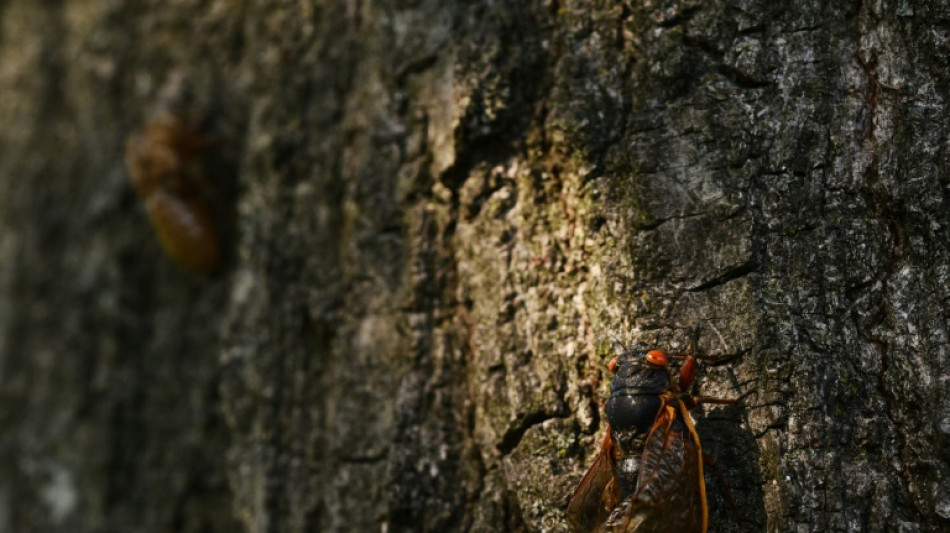
Seventeen years later, Brood XIV cicadas emerge in US / Photo: Mandel Ngan - AFP/File

The last time these thrumming, red-eyed bugs burrowed out of the ground across America's suburbs and woodlands was the early summer of 2008.
Global financial jitters were mounting, iPhones were a luxury item, and George W. Bush was still president.
Now, reports from the citizen-science app Cicada Safari show the first insects of Brood XIV -- which emerges every 17 years -- surfacing in the US South. As ground temperatures warm across the North, millions more are expected to follow.
Cicadas belong to the insect order Hemiptera, which includes stink bugs, bed bugs, and aphids.
But they are often mistaken for locusts, a confusion that dates back to early English settlers who likened the mass emergences to Biblical plagues. Brood XIV itself was first documented in 1634.
There are roughly 3,500 species of cicadas globally, many still unnamed.
But periodical cicadas -- which emerge en masse after 13 or 17 years -- are unique to the eastern United States, with two additional unrelated species found in northeastern India and Fiji, says Chris Simon, a leading cicada expert at the University of Connecticut.
"Everybody's fascinated by them, because you see nothing for 13 or 17 years, and then all of a sudden, your house and car are covered in these insects," Simon told AFP.
"This is a marvelous phenomenon that you can take your kids to see and marvel at, watch them come out of their shells and wonder about how they evolved," she added, urging the public to appreciate, not fear them.
"The world wouldn't survive without insects."
Because their emergence years are staggered, different periodical cicada broods appear in different years. In 2024, a rare "double whammy" occurred when the 13-year Brood XIX overlapped with the 17-year Brood XIII.
That's not the case in 2025, but excitement remains high around these mysterious critters, which continue to intrigue scientists -- especially given that the evolutionary logic behind their prime-numbered life cycles remains unresolved.
Cicadas are often thought of as "creatures of history," conjuring memories of past life chapters -- what you were doing when this brood last emerged.
They spend nearly their entire lives underground, passing through life stages called instars, before tunneling to the surface for a brief few weeks to molt, mate, and die -- while their newly hatched offspring drop from trees and burrow into the soil, beginning the cycle anew.
Males produce their deafening mating calls using tymbals, sound-producing membranes on either side of their abdomens, creating a chorus that's been likened to sirens or power tools.
They don't bite or sting, and they don't eat solid food in their adult form, though they drink water.
Instead, their defense is overwhelming abundance -— swarming in such numbers that they satiate predators like birds, raccoons, foxes, and turtles, playing a crucial role in the ecosystem.
But their survival strategy is increasingly challenged by human-caused changes.
Widespread deforestation and urbanization have destroyed habitat. And now, climate change is triggering more frequent occurrences of "stragglers" -- cicadas that emerge four years too early or too late, often in numbers too small to survive, which could threaten long term population numbers.
Simon added that in areas like the capital Washington, these asynchronous emergences are forming "a patchy mosaic" of overlapping broods.
Then there's the political climate. Under President Donald Trump, the federal government has fired scientists en masse and frozen funding for new research.
Simon submitted a grant proposal last August to the National Science Foundation for a major genetic study into cicadas' internal clocks -- biological mechanisms that somehow track the passage of years, unlike humans' 24-hour circadian cycles.
"Nobody knows what's happening," she said, decrying the current attacks on science.
(A.Lehmann--BBZ)