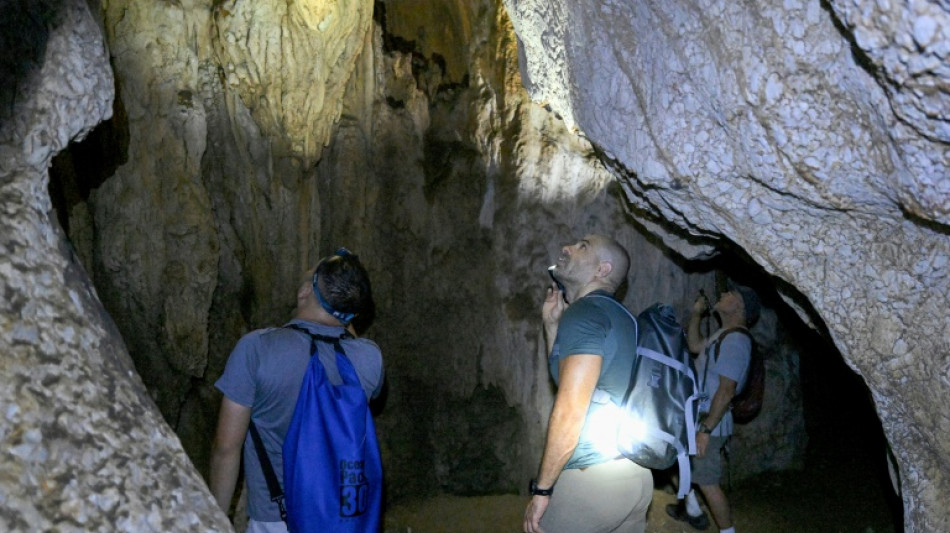
New species teem in Cambodia's threatened karst / Photo: TANG CHHIN Sothy - AFP

A biologist might go a lifetime without discovering a new species. It took a team exploring Cambodia's limestone karst a single night to find three.
The trio of newly discovered geckos illustrates the incredible and often overlooked biodiversity in these harshly beautiful landscapes, and the risks posed by the cement industry's appetite for limestone.
"You can quite literally go into a cave, collect a few specimens, and most likely there'll be some that are new to science," said Pablo Sinovas, a snake specialist and Cambodia country director at conservation NGO Fauna & Flora.
"That's one of the magical aspects of karst ecosystems."
Karst landscapes, like Vietnam's famed Halong Bay outcroppings, are ancient structures, formed millions of years ago from coral.
Rain erosion creates their characteristic fluted, pockmarked exteriors and vast interior caves and tunnels.
It also isolates one piece of karst from another, creating evolutionary islands where species develop differently, explained gecko expert Lee Grismer, a professor at La Sierra University.
"Species are being created in these harsh environments."
AFP joined a team in July that is surveying karst near the Cambodia-Thailand border to better understand these ecosystems and build the case for their protection.
The work is challenging.
There is an ongoing risk of mines and unexploded ordnance, and days into the survey in Battambang province, the team was forced to move away from the border as fighting erupted between Thailand and Cambodia.
- Venomous inhabitants -
There is also the delicate task of navigating sharp karst at night, and avoiding hidden holes.
Some harbour venomous inhabitants, though finding one delights the team.
"Great spot," shouted Grismer, as the green head of a type of pit viper -- recently discovered in Thailand and not previously recorded in Cambodia -- emerged from a karst overhang and was collected by his colleague.
The work started after dark, when the millions of bats that roost in the karst have streamed out to hunt.
Armed with headlamps, the team clambered over vines, ducked beneath dripping stalactites and dodged insects attracted by their lights.
In one cave, a plate-sized whip spider sat impassively, while elsewhere a scorpion scurried from under a rock, her offspring on her back.
The team looked for the slightest movement or the glint of an eye to find animals sometimes no bigger than a pinky finger.
Each catch was placed in a bag with enough air to keep it alive until cataloguing time in the morning.
The meticulous process is essential to proving a species is new and preserving it for future study.
It starts with a surreal photoshoot in the team's sparse hotel room.
Karst rocks were piled artfully on black velvet taped to a table and the wall, and then the models came out: frogs, snakes and geckos.
- Geckos on the loose -
Photographing species where they were collected is risky.
"These animals can escape and you've lost your new species," explained Grismer.
But even in the hotel room, several geckos made a break for it, sending scientists scrambling behind a fridge or into a bathroom to retrieve their precious finds.
Each animal was then euthanised, tagged and measured. Its DNA-rich liver was extracted for sequencing that will create a kind of family tree tracing its evolutionary history.
If an animal appears on their own branch, they are new to science.
Of the approximately 40 specimens collected in a single night, three seemed clear contenders: a large speckled gecko, a bent-toed gecko with a distinctive banded tail and a web-toed gecko.
Grismer, 70, has found dozens of new species in his career but said each find reminds him of his childhood excitement about animals.
"That same emotion, intensity and power... just comes rushing back."
Finally, the specimens are injected with formaldehyde and artfully arranged in boxes to display as many of their features as possible.
- Cement demand -
Fauna & Flora hopes the research will convince the government to protect more karst in the country, and said officials have already signalled interest at the local level.
But it can be a hard case to make in a country with growing demand for cement domestically and for export.
Prime Minister Hun Manet in May said Cambodia produces 11 million tons of cement annually and praised the sector for reducing imports, creating jobs and contributing tax, while insisting quarrying should be done "responsibly".
Tuy Noeun, a local villager guiding the scientific survey, said he and other residents believe spirits inhabit the karst, but would still be happy to see a cement firm move in.
"We want jobs for our people," he said.
Sinovas of Fauna & Flora hopes the survey will at least inform decision-making and help protect areas home to particularly rare species, comparing them to Cambodia's famed Angkor Wat temple complex.
"Would you turn Angkor Wat into cement?" he said.
"You wouldn't because it's a national treasure. Well, some of these species should be considered national treasures as well."
(O.Joost--BBZ)