Trio wins economics Nobel for work on tech-driven growth / Photo: Jonathan Nackstrand - AFP

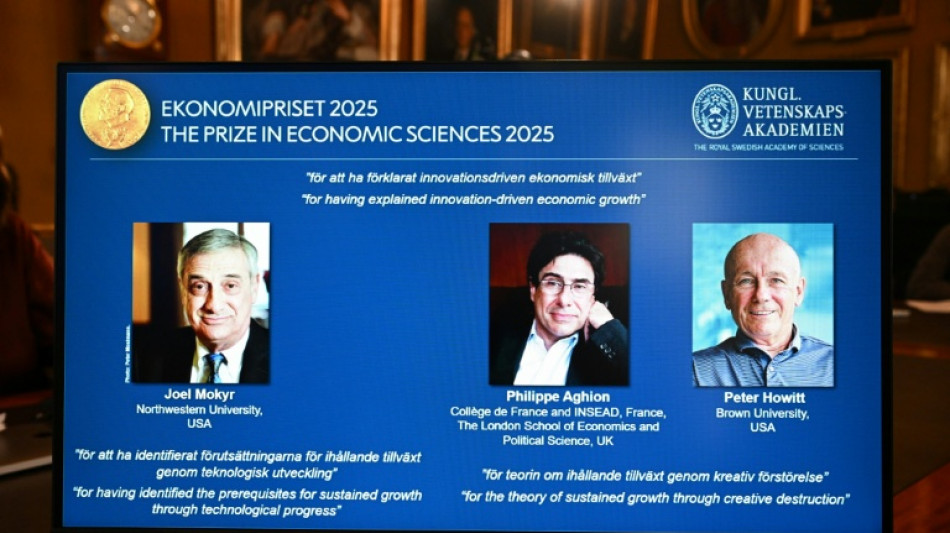
The Nobel prize in economics was awarded on Monday to American-Israeli Joel Mokyr, France's Philippe Aghion and Canada's Peter Howitt for work on technology's impact on sustained economic growth.
Mokyr, 79, won one half of the prize "for having identified the prerequisites for sustained growth through technological progress", the Royal Swedish Academy of Sciences said.
Aghion, 69, and Howitt, 79, shared the other half "for the theory of sustained growth through creative destruction", it added.
John Hassler, chair of the prize committee, told reporters their work answered questions about how technological innovation drives growth and how sustained growth can be maintained.
"During almost all of humankind's history, living standards did not change noticeably from generation to generation. Economic growth was, on average, zero, and stagnation was the norm," Hassler said.
But over the last two centuries "things have been very different."
- 'Creative destruction' -
"During the last 200 years, the world has seen more economic growth than ever before in human history," Kerstin Enflo, a member of the economics prize committee, explained to reporters.
However, she cautioned that "200 years is still just a short period compared to the long run history of stagnation that we saw before."
"The laureates' work reminds us that we should not take progress for granted. Instead, society must keep an eye on the factors that generate and sustain economic growth," Enflo said.
Mokyr, who is a professor at Northwestern University in the United States, "used historical sources as one means to uncover the causes of sustained growth becoming the new normal", the jury said in a statement.
Aghion and Howitt then created a mathematical model for "creative destruction", which refers to the process "when a new and better product enters the market, the companies selling the older products lose out".
- 'Openness' -
"I can't find the words to express what I feel," Aghion told reporters via telephone during the prize announcement.
"I'm still speechless. It came really as a huge surprise," he continued.
Speaking about what could risk upsetting growth, he mentioned the threats of steep tariffs introduced since US President Donald Trump's return to the White House.
"Openness is a driver of growth. Anything that gets in the way of openness is an obstacle to growth," Aghion said.
The economist also warned Europe not to let the United States and China dominate technological innovation.
"I think European countries have to realise that we should no longer let (the) US and China become technological leaders and lose to them," he said.
The economics prize is the only Nobel not among the original five created in the will of Swedish scientist Alfred Nobel, who died in 1896.
It was instead created through a donation from the Swedish central bank in 1968, leading detractors to dub it "a false Nobel".
But like the Nobels in chemistry and physics, the Royal Swedish Academy of Sciences chooses the winner and follows the same selection process.
The economics prize wraps up this year's Nobel season which honoured research into the human immune system, practical applications of quantum mechanics and the development of new forms of molecular architecture.
The literature prize went to Hungarian author Laszlo Krasznahorkai whose works explore themes of postmodern dystopia and melancholy.
Venezuelan opposition leader Maria Corina Machado was given the highly watched Nobel Peace Prize.
In a surprise move, Machado dedicated the prize to Trump, who had made no secret that he thought he deserved it.
The Nobel economics prize consists of a diploma, a gold medal and a $1.2 million cheque.
The laureates will receive their prizes at formal ceremonies in Stockholm and Oslo on December 10.
That date is the anniversary of the death in 1896 of scientist Alfred Nobel, who created the prizes in his will.
(Y.Berger--BBZ)