Berliner Boersenzeitung - 'Come and kill me': sick ants invite destruction to save colony

EUR -
AED 4.279356
AFN 77.342596
ALL 96.588267
AMD 445.245914
ANG 2.085849
AOA 1068.528103
ARS 1684.920478
AUD 1.758327
AWG 2.098895
AZN 2.000098
BAM 1.955554
BBD 2.352214
BDT 142.892029
BGN 1.955743
BHD 0.439286
BIF 3450.584485
BMD 1.165243
BND 1.512462
BOB 8.069985
BRL 6.188594
BSD 1.167858
BTN 104.909256
BWP 15.515982
BYN 3.380989
BYR 22838.771667
BZD 2.348815
CAD 1.624915
CDF 2598.493062
CHF 0.936046
CLF 0.027259
CLP 1069.37901
CNY 8.240193
CNH 8.235265
COP 4424.417736
CRC 572.625526
CUC 1.165243
CUP 30.878951
CVE 110.251134
CZK 24.189639
DJF 207.974736
DKK 7.468849
DOP 74.210348
DZD 151.576082
EGP 55.433829
ERN 17.478652
ETB 182.104716
FJD 2.635811
FKP 0.874078
GBP 0.872977
GEL 3.147734
GGP 0.874078
GHS 13.303327
GIP 0.874078
GMD 85.062585
GNF 10148.115621
GTQ 8.945913
GYD 244.339271
HKD 9.070704
HNL 30.750001
HRK 7.530381
HTG 152.976012
HUF 382.036136
IDR 19419.364756
ILS 3.765047
IMP 0.874078
INR 104.87832
IQD 1529.914154
IRR 49085.880544
ISK 149.011092
JEP 0.874078
JMD 187.165658
JOD 0.826133
JPY 180.489235
KES 150.723926
KGS 101.900195
KHR 4677.552222
KMF 491.733124
KPW 1048.710785
KRW 1714.28866
KWD 0.357567
KYD 0.973282
KZT 590.298294
LAK 25334.922447
LBP 104583.895701
LKR 360.496209
LRD 206.13496
LSL 19.825192
LTL 3.440661
LVL 0.704844
LYD 6.348229
MAD 10.775645
MDL 19.865587
MGA 5194.324444
MKD 61.632249
MMK 2446.898083
MNT 4137.528116
MOP 9.363463
MRU 46.272982
MUR 53.682574
MVR 17.956659
MWK 2025.136618
MXN 21.224828
MYR 4.788568
MZN 74.461422
NAD 19.825192
NGN 1689.89492
NIO 42.97607
NOK 11.773968
NPR 167.85317
NZD 2.018942
OMR 0.448036
PAB 1.167953
PEN 3.927406
PGK 4.953526
PHP 68.743516
PKR 329.927022
PLN 4.228238
PYG 8099.016174
QAR 4.268663
RON 5.09165
RSD 117.397105
RUB 88.493403
RWF 1699.278998
SAR 4.373004
SBD 9.582756
SCR 15.836503
SDG 700.891918
SEK 10.96772
SGD 1.509221
SHP 0.874234
SLE 26.800929
SLL 24434.570407
SOS 666.313342
SRD 45.029085
STD 24118.186847
STN 24.497865
SVC 10.218759
SYP 12883.973776
SZL 19.819422
THB 37.148464
TJS 10.732896
TMT 4.078352
TND 3.428084
TOP 2.805627
TRY 49.555241
TTD 7.918038
TWD 36.421782
TZS 2843.194009
UAH 49.242196
UGX 4140.47927
USD 1.165243
UYU 45.754442
UZS 13912.250317
VES 289.663092
VND 30718.730513
VUV 142.29241
WST 3.263056
XAF 655.8717
XAG 0.020092
XAU 0.000276
XCD 3.149128
XCG 2.104844
XDR 0.815694
XOF 655.877327
XPF 119.331742
YER 277.795391
ZAR 19.73052
ZMK 10488.581818
ZMW 26.831741
ZWL 375.207916
  • RBGPF

    0.0000

    78.35

    0%

  • CMSC

    0.0400

    23.48

    +0.17%

  • RYCEF

    0.4600

    14.67

    +3.14%

  • RIO

    -0.5500

    73.73

    -0.75%

  • RELX

    0.3500

    40.54

    +0.86%

  • NGG

    -0.5800

    75.91

    -0.76%

  • AZN

    -0.8200

    90.03

    -0.91%

  • VOD

    0.0500

    12.64

    +0.4%

  • GSK

    -0.4000

    48.57

    -0.82%

  • CMSD

    -0.0300

    23.32

    -0.13%

  • SCS

    -0.1200

    16.23

    -0.74%

  • BCC

    -2.3000

    74.26

    -3.1%

  • BP

    -0.0100

    37.23

    -0.03%

  • BTI

    0.5300

    58.04

    +0.91%

  • JRI

    0.0500

    13.75

    +0.36%

  • BCE

    0.0400

    23.22

    +0.17%

'Come and kill me': sick ants invite destruction to save colony
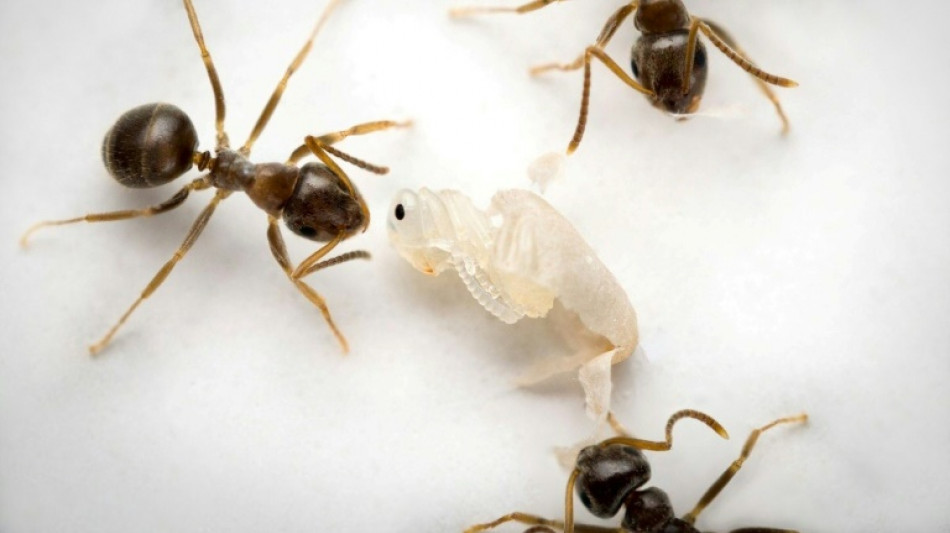
'Come and kill me': sick ants invite destruction to save colony / Photo: Christopher PULL - ISTA/AFP

'Come and kill me': sick ants invite destruction to save colony

Sick young ants release a smell to tell worker ants to destroy them to protect the colony from infection, scientists said Tuesday, adding that queens do not seem to commit this act of self-sacrifice.

Text size:

Many animals conceal illness for social reasons. For example, sick humans are known to risk infecting others so they can still go to the office -- or the pub.

Ant colonies, however, act as one "super-organism" which works to ensure the survival of all, similar to how infected cells in our bodies send out a "find-me and eat-me" signal, according to an Austria-led team of scientists.

Ant nests are a "perfect place for a disease outbreak to occur because there are thousands of ants crawling over each other," Erika Dawson, a behavioural ecologist at the Institute of Science and Technology Austria and lead author of a new study, told AFP.

When adult worker ants get an illness that could spread through the colony, they leave the nest to die alone.

Young ants, known as pupae, in contrast are still trapped inside a cocoon, making this kind of social distancing impossible.

Scientists had already figured out that when these pupae are terminally ill, there is a chemical change that produces a particular smell.

Adult worker ants then gather around, remove the cocoon, "bite holes in the pupae and insert poison," Dawson said.

The poison acts as a disinfectant, which kills both the colony-threatening pathogen and the pupae.

For the new research, the scientists wanted to figure out whether the pupae "were actively saying: 'hey, come and kill me'," Dawson said.

- 'Altruistic act' -

First, the scientists extracted the smell from the sick pupae of a small black garden ant called Lasius neglectus. When they applied the smell to a healthy brood in the lab, the workers still destroyed them.

Then, the team conducted an experiment showing that the sick pupae only produce the smell when worker ants are nearby, proving it is a deliberate signal for destruction.

"While it is a sacrifice -- an altruistic act -- it's also in their own interest, because it means that their genes are going to survive and be passed on to the next generation," Dawson said.

However, there is one member of the nest that does not sacrifice itself.

When queen pupae are infected inside their cocoons, they do not send out the smelly warning signal, the team found.

"Are they cheating the system?" Dawson said the team asked themselves.

However, they found that the "queen pupae have much better immune systems than the worker pupae, and so they were able to fight off the infection -- and that's why we think that they weren't signalling", she said.

Dawson hopes future research will investigate whether queen pupae sacrifice themselves when it becomes clear they will not beat their infection.

The study was published in the journal Nature Communications.

(A.Lehmann--BBZ)