Berliner Boersenzeitung - 'In her prime': Rare blooming of palm trees in Rio

EUR -
AED 4.305195
AFN 72.681647
ALL 95.422252
AMD 435.827436
ANG 2.098242
AOA 1076.151323
ARS 1637.931048
AUD 1.642996
AWG 2.1101
AZN 1.997526
BAM 1.958653
BBD 2.357256
BDT 143.807031
BGN 1.955479
BHD 0.44221
BIF 3481.282142
BMD 1.172278
BND 1.495035
BOB 8.098659
BRL 5.838651
BSD 1.170328
BTN 110.242601
BWP 15.852374
BYN 3.315378
BYR 22976.642144
BZD 2.353856
CAD 1.603618
CDF 2713.823208
CHF 0.920135
CLF 0.026659
CLP 1051.074801
CNY 8.014047
CNH 8.011674
COP 4178.1617
CRC 532.612567
CUC 1.172278
CUP 31.065358
CVE 110.633752
CZK 24.357004
DJF 208.414918
DKK 7.473392
DOP 69.721645
DZD 155.165661
EGP 61.629454
ERN 17.584165
ETB 180.927869
FJD 2.584462
FKP 0.86741
GBP 0.866172
GEL 3.142162
GGP 0.86741
GHS 13.016802
GIP 0.86741
GMD 86.166922
GNF 10273.242401
GTQ 8.959899
GYD 245.201957
HKD 9.185323
HNL 31.099734
HRK 7.537164
HTG 153.223615
HUF 365.188391
IDR 20224.954791
ILS 3.50048
IMP 0.86741
INR 110.48776
IQD 1533.136175
IRR 1543889.679138
ISK 143.780307
JEP 0.86741
JMD 184.694358
JOD 0.831191
JPY 186.820076
KES 151.611121
KGS 102.460824
KHR 4689.111052
KMF 492.357028
KPW 1055.030569
KRW 1731.032534
KWD 0.360781
KYD 0.975323
KZT 543.652828
LAK 25645.605119
LBP 104805.07292
LKR 373.058802
LRD 214.755067
LSL 19.461359
LTL 3.461432
LVL 0.7091
LYD 7.426175
MAD 10.844014
MDL 20.35248
MGA 4863.114747
MKD 61.636454
MMK 2462.196871
MNT 4211.458432
MOP 9.444723
MRU 46.711102
MUR 54.945098
MVR 18.112133
MWK 2029.447886
MXN 20.373721
MYR 4.648126
MZN 74.920708
NAD 19.461359
NGN 1590.781188
NIO 43.071016
NOK 10.922156
NPR 176.388162
NZD 1.994009
OMR 0.450331
PAB 1.171982
PEN 4.087777
PGK 5.08012
PHP 71.151438
PKR 326.265098
PLN 4.243587
PYG 7421.175106
QAR 4.273543
RON 5.088276
RSD 117.422771
RUB 88.13868
RWF 1710.640363
SAR 4.39724
SBD 9.431334
SCR 17.347409
SDG 703.957044
SEK 10.808811
SGD 1.495948
SHP 0.875224
SLE 28.867382
SLL 24582.071905
SOS 668.815781
SRD 43.917629
STD 24263.780751
STN 24.500578
SVC 10.240242
SYP 129.569183
SZL 19.453459
THB 37.905643
TJS 11.00136
TMT 4.108833
TND 3.377376
TOP 2.822563
TRY 52.770123
TTD 7.948188
TWD 36.907408
TZS 3045.871869
UAH 51.571617
UGX 4360.258615
USD 1.172278
UYU 46.426838
UZS 14128.880742
VES 566.403138
VND 30901.239128
VUV 138.501946
WST 3.198573
XAF 655.972478
XAG 0.015486
XAU 0.000249
XCD 3.168139
XCG 2.10925
XDR 0.815819
XOF 655.972478
XPF 119.331742
YER 279.764489
ZAR 19.382861
ZMK 10551.909878
ZMW 22.148523
ZWL 377.472928
  • CMSD

    0.0900

    23.32

    +0.39%

  • NGG

    0.4600

    87.42

    +0.53%

  • GSK

    -1.1900

    54.44

    -2.19%

  • BCE

    -0.2200

    23.88

    -0.92%

  • AZN

    -2.5500

    189.75

    -1.34%

  • RELX

    0.4000

    36.53

    +1.09%

  • RIO

    0.7600

    99.61

    +0.76%

  • RBGPF

    64.0000

    64

    +100%

  • CMSC

    0.0400

    22.95

    +0.17%

  • VOD

    0.0100

    15.63

    +0.06%

  • BCC

    0.3300

    84.15

    +0.39%

  • RYCEF

    -0.1200

    15.3

    -0.78%

  • BTI

    0.8100

    58.09

    +1.39%

  • JRI

    0.0100

    12.89

    +0.08%

  • BP

    -0.1000

    46.25

    -0.22%

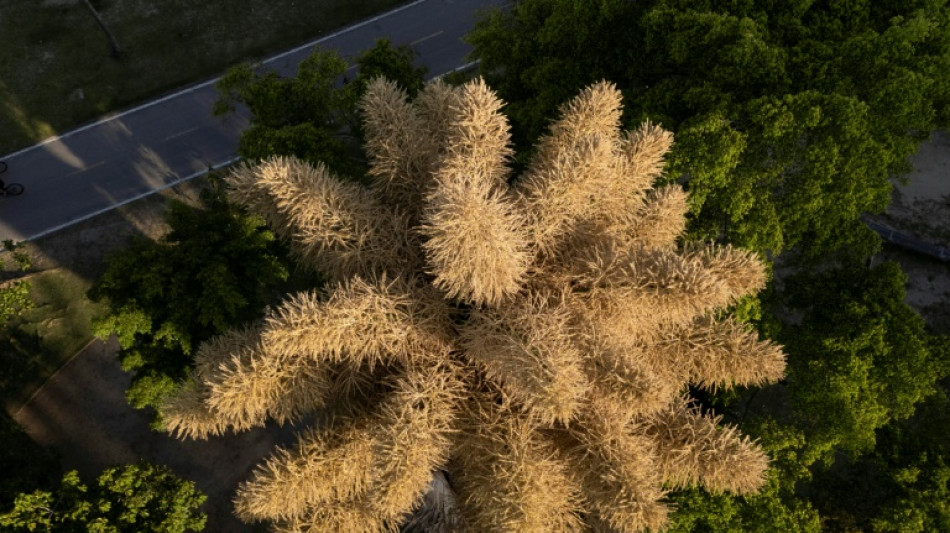
'In her prime': Rare blooming of palm trees in Rio
'In her prime': Rare blooming of palm trees in Rio / Photo: Pablo PORCIUNCULA - AFP

'In her prime': Rare blooming of palm trees in Rio

An extraordinary botanical spectacle is drawing crowds in Rio de Janeiro: several talipot palm trees, planted more than six decades ago, are blooming for the first -- and last -- time in their lives.

Text size:

The trees, growing in Rio's Aterro do Flamengo park and the Botanical Garden, were planted in the 1960s by the legendary landscape architect Roberto Burle Marx.

Now, some six decades later, these giants have reached the peak of their existence in the Brazilian seaside city.

The talipot palm (Corypha umbraculifera), native to southern India and Sri Lanka, is one of the largest palm species on the planet, some reaching more than 30 meters (98 feet) tall.

It flowers only once in its entire life, if it reaches between 40 and 70 years of age.

"The talipot palm only fruits once in its lifetime, and can produce up to five million fruits," Marcus Nadruz, from the Research Institute of the Rio de Janeiro Botanical Garden, told AFP.

The inflorescences, or flower clusters on stems, began to unfurl in October, forming enormous crowns atop the palm trees that teem with millions of tiny yellowish blossoms.

The entire process, from the opening of the first flowers to the ripening of the fruit, will take about a year, explained Nadruz.

But this splendor has an inevitable end. Once the fruit falls, the palm trees will slowly begin to die.

"I was born in 1961, so she's my age and in her prime," said Deborah Faride, who traveled to see the trees from Sao Paulo and was taking pictures of them with a friend.

"We're the same age and we're blooming together. Just one detail: the talipot is going to die. And I'm going to continue, God willing."

The Botanical Garden plans to collect the seeds to cultivate new seedlings to replace these older plants, and will also distribute them for landscaping projects in public spaces.

(A.Lehmann--BBZ)