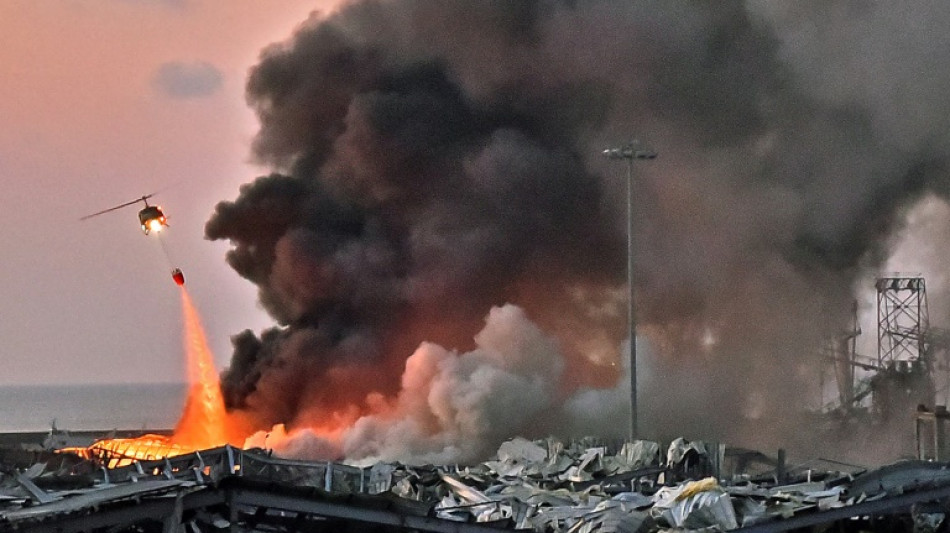
Two years after Beirut mega-blast, Lebanon hits new lows / Photo: STR - AFP

Crisis-hit Lebanon marks two years Thursday since a massive explosion ripped through Beirut, with victims' relatives planning protest marches as they keep demanding truth and justice.
The portside blast of haphazardly stored ammonium nitrate, one of the biggest non-nuclear explosions ever, killed more than 200 people, wounded thousands more and decimated vast areas of the capital.
Yet an investigation into the cause has been stalled amid political interference and no state official has yet been held accountable over the August 4, 2020 tragedy.
Several heavily damaged grain silos that became a grim symbol of the disaster collapsed last week, and more are dangerously close to coming down, experts warn.
"I hope that seeing the silos fall will give people the will to fight for justice, to battle with us," said Tatiana Hasrouty, who lost her father in the blast.
Politicians "are doing everything in their power to stop the investigation" into the explosion of the fertiliser, she said.
The mega-blast was a nightmarish moment in the chaotic history of Lebanon, which is mired in its worst-ever economic crisis marked by blackouts, runaway inflation and widespread despair.
When protesters in three separate marches starting from 1200 GMT Thursday later converge at the port, they will smell the smoke wafting from the silos where fermenting grain is smouldering in the blistering summer heat.
- 'A nightmare' -
The enormous explosion two years ago was felt as far away as Cyprus and sowed the kind of devastation normally caused by wars and natural disasters.
It further scarred the crisis-tested population and accelerated a massive exodus that recalls the flight during the 1975-1990 civil war.
Lebanon's ruling class, accused of misrule, graft and gross negligence, has however clung firmly to power even as the people endure shortages of fuel, medicine and clean water.
"This ruling class is killing us every day," Hasrouty said. "If we did not die in the blast, we are dying of hunger, from a lack of basic human rights."
Power cuts last up to 23 hours a day, streets are dark at night and traffic lights out of service, leaving some districts illuminated mainly by the silo fires.
Lara Khatchikian, 51, whose apartment was badly hit two years ago, has watched the blazes, calling the sight "a nightmare".
"My neighbours and I were stressed all the time," she said. "I have felt fear, we couldn't sleep. It takes superhuman strength to live when you are constantly reminded of the blast."
- No justice -
The government in April ordered the silos' demolition -- but this has been suspended, partially because of objections from victims' relatives who want them preserved as a memorial.
French civil engineer Emmanuel Durand, who monitors the silos, has warned that the danger of a further partial collapse "has never been so high" and could come "at any time".
Meanwhile, the probe is also at risk of falling apart, as officials have curtailed the work of the lead investigator Tarek Bitar with a series of lawsuits.
A judicial official close to the investigations said judge Bitar's work had been paused since December 23.
Victims' families are divided, with some accusing Bitar of bias and others regarding him as their only hope.
Amnesty International, Human Rights Watch and other groups Wednesday relaunched an appeal to the United Nations to send a fact-finding mission.
They jointly declared that "it is now, more than ever, clear that the domestic investigation cannot deliver justice".
(L.Kaufmann--BBZ)