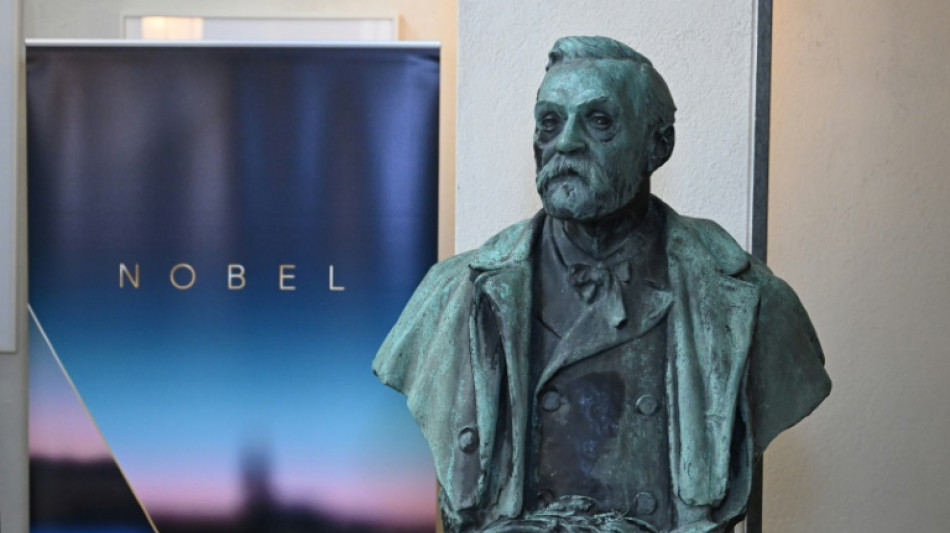
Latin American, Caribbean women top Nobel literature buzz / Photo: Jonathan Nackstrand - AFP
This year's Nobel literature prize could go to a Latin American or Caribbean woman when it is awarded on Thursday amid efforts to diversify an award that has most often gone to male, European authors, literary critics say.
There is no public shortlist for the Nobel, and since the nominees and the jury deliberations remain sealed for 50 years, Stockholm's literary circles engage in frantic guessing ahead of the announcement.
Antiguan-American author Jamaica Kincaid, 77, whose work explores Caribbean culture, family and identity as well as colonialism and race, has often been mentioned in Nobel speculation, as has China's Can Xue, whose avant-garde experimental writing has been compared to that of Franz Kafka.
The suspense will end at 1:00 pm (1100 GMT) Thursday when the 18-member Swedish Academy reveals its pick.
A 2018 sex assault scandal left the Academy in tatters and more than half of its 18 members were replaced.
Since then, every other literature laureate has been a woman -- making it likely that this year's nod could go to a woman, after last year's prize for Hungary's Laszlo Krasznahorkai.
Punters are this year putting their money on Can Xue and Mexico's Cristina Rivera Garza, as well as Spanish author Enrique Vila-Matas, Australia's Gerald Murnane, his Aboriginal compatriot Alexis Wright and American author Thomas Pynchon.
"It's about time for Jamaica Kincaid to get it," Victor Malm, culture critic at Swedish daily Expressen, told AFP.
"She has been mentioned for a long time," agreed Bjorn Wiman, culture editor at Sweden's largest daily Dagens Nyheter.
- Women under-represented -
Kincaid's 1990 novel "Lucy" is an autobiographical tale of an embittered young girl who travels from the West Indies to the United States to work as an au pair.
"It's exactly the kind of book where it's enough to read three lines to say: 'OK, we're talking about a Nobel laureate here'," Wiman said.
Giving her the nod could also be interpreted as a political choice, given her fierce criticism of US President Donald Trump, analysts say.
The Swedish Academy has long been criticised for the over-representation of Western male authors since the prize was first awarded in 1901.
There are only 18 women among the 122 laureates. Very few have worked in Asian or Middle Eastern languages. No African languages are represented.
The Academy insists however that its only consideration is the quality of a writer's work.
But unlike the Nobel prizes in medicine, physics and chemistry, there is no groundbreaking research on which to base speculation for the literature prize, Wiman said.
"In physics or chemistry, you can say that one discovery was more important than others", in terms of the impact it has had on mankind, he said.
"But when it comes to literature, it's different. There are easily 50 to 100 authors who could win the Nobel literature prize."
"That's why it's so interesting to follow the geographic distribution, the gender distribution, the kind of mark they want to make with the choice of laureate and so on," he said.
- 'Dark and violent' writing -
So what about the literature?
Lina Kalmteg, literary critic for Swedish public broadcaster SR, said it was time for a Spanish-language author from Latin America.
"In recent years, there has been a lot of talk about the 'Latin American literary miracle', this new generation that came after the male authors devoted to magical realism, like Gabriel Garcia Marquez," she told AFP.
"In this new wave, it's women who are taking the lead, with writing often tinged with feminism, but also often quite dark and violent, punctuated by surreal touches," she noted.
Argentine author Samanta Schweblin, 48, would be an interesting and surprising choice in this category, she said.
"But she is surely still too young," she added.
Literature laureates are honoured for their body of work, not a single publication.
The last writer from South America to be honoured was Peru's Mario Vargas Llosa in 2010.
Several new names getting Nobel buzz the past few years are Germany's Jenny Erpenbeck, who won the 2024 International Booker Prize for the novel "Kairos", and Duong Thu Huong, one of Vietnam's most popular writers whose first books in the late 1980s were bestsellers before they were banned. Her books are mainly published outside Vietnam.
(F.Schuster--BBZ)