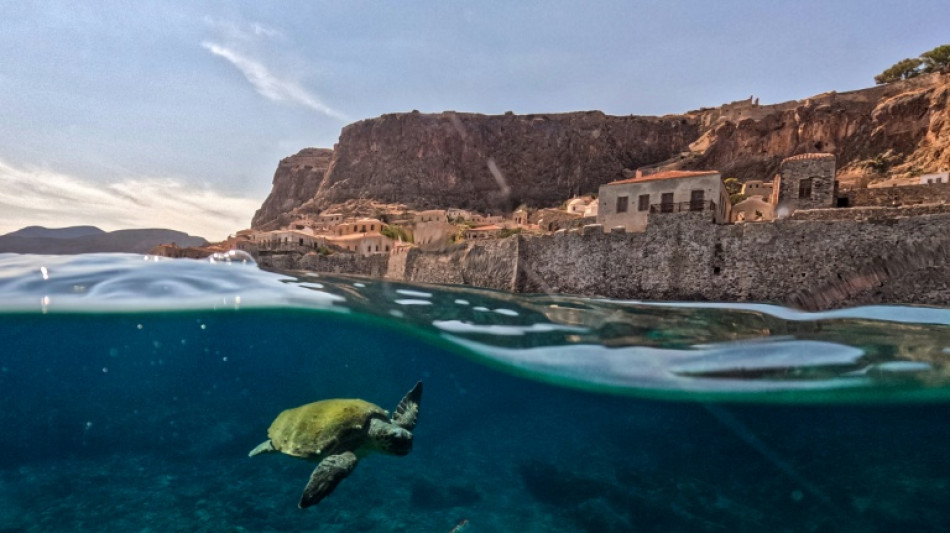
World leaders urged to 'course correct' as UN nature goals fall short / Photo: Will VASSILOPOULOS - AFP

Nations are steeling for a disappointing report card at this month's UN biodiversity summit, with governments falling short on their commitments to protect the plants, animals and ecosystems that sustain life on Earth.
The so-called COP17 summit in the Armenian capital, Yerevan, will be a reckoning for the nearly 200 nations that joined the landmark "Paris Agreement for Nature" in 2022 but have been slow to act on its objectives.
It set 23 targets for halting and reversing nature loss by 2030, including reducing pollution, protecting threatened species and conserving 30 percent of the world's land and oceans.
But the world is off-track to meet these goals, according to a draft review by the United Nations Convention on Biological Diversity (CBD), which oversees the biennial international negotiations on protecting the natural world.
"COP17 comes at a critical moment," An Lambrechts from Greenpeace International told AFP.
"The most important outcome from Yerevan must therefore be a clear course correction. Governments need to move beyond restating promises and agree on concrete actions."
Astrid Schomaker, executive director of the UN biodiversity convention, told AFP that progress was being made and the 2030 goals were "still reachable -- but only with significant change being made".
This includes reducing incentives for politically sensitive industries like agriculture and fossil fuel production, areas where governments have made very little headway to date.
"Do I think we're moving in the right direction? Yes, but way too slowly," Schomaker said.
Around 10 heads of state are expected in Yerevan for a leaders' summit on Friday to start proceedings "and tell the negotiators to be ambitious and constructive" when talks formally begin on October 19, she said.
- Money tensions -
The nature summit comes weeks before the annual international climate negotiations (COP31) in neighbouring Turkey, and is the first time nations have taken stock of progress since the biodiversity pact was adopted.
Drawing on national reports and other inputs, a "global review" of collective improvements and pitfalls is being finalised.
A draft scorecard published in July painted a mixed picture of progress.
Some countries have taken strides toward the "30x30" conservation goal (protecting 30 percent of Earth's land and waters by 2030), said Campaign for Nature in a September analysis.
But taken together, government pledges would cover only 27 percent of land and inland waters by the end of this decade if enacted in full. For oceans, the figure would be just 12 percent.
Money is a major barrier to the success of the biodiversity goals and an expected source of tension at COP17.
Nations are lagging behind a pledge to raise $200 billion a year for biodiversity by 2030 from public and private sources, including $30 billion a year in international finance for developing countries.
Wealthy countries are under pressure to fill the gap but face their own budget challenges, making the issue politically fraught.
The United States, which is not a party to the biodiversity convention, is not involved in the talks.
"The more time you spend talking about funding, the less you talk about objectives," said a French government official.
- 'Unite and fight' -
Attention at the Yerevan summit is expected to focus on how the private sector can make up the shortfall.
Under scrutiny will be the lacklustre performance of the Cali Fund, a milestone UN initiative launched in February 2025.
The fund aimed to raise $1 billion a year from corporations for conservation in developing countries but so far has attracted just $6,000.
"Everyone was hoping... this would be a game changer. And we continue to believe that it absolutely has the potential," although corporate engagement had been "slower" than anticipated, said Schomaker.
Subsidy reform has also proved to be a roadblock, with barely any movement toward the 2030 goal of reducing nature-harmful incentives by $500 billion a year.
For every dollar invested in protecting or restoring nature, about $30 still goes into activities that degrade it, according to UN figures.
In October, more than 130 businesses and financial institutions -- including Nestle and H&M Group -- called on governments to reform incentives, citing $2.6 trillion in annual public spending "that rewards practices depleting the soils, water and ecosystems".
Guido Broekhoven from nature conservation organisation WWF International told AFP that repurposing subsidies must be "a matter of priority" at COP17.
"At a time when geopolitical tensions are putting multilateral cooperation under pressure, it's even more important to show the world that our decision-makers can still be united in the fight for the survival of life on Earth," Greenpeace's Lambrechts said.
(B.Hartmann--BBZ)