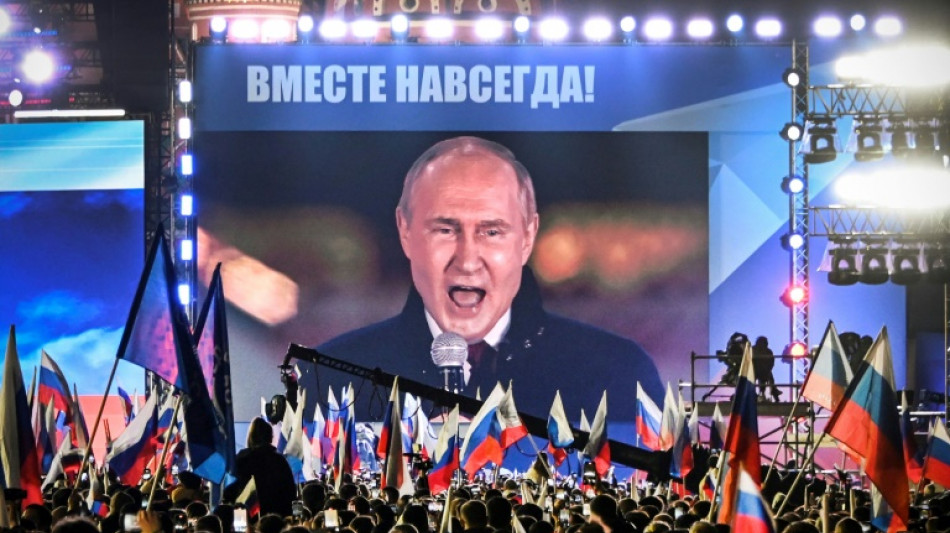
Putin, the leader dreaming of Russian grandeur at any cost / Photo: Alexander NEMENOV - AFP/File

Restoring Russia to its rightful place among the world's great powers has obsessed President Vladimir Putin, whose offensive in Ukraine was to be the culmination of over 20 years of iron-willed leadership.
But Putin, who turns 70 on Friday, has seen his army depleted by seven months of gruelling military action and his country diplomatically isolated.
The Russian leader has even brandished veiled threats of using nuclear weapons, dialling up geopolitical tensions over his campaign in Ukraine.
It is a far cry from the turn of the millennium, when a fresh-faced 47-year-old Putin replaced the ailing Boris Yeltsin in the Kremlin promising friendship and cooperation with the West.
US president George W. Bush hailed him as a "remarkable leader", while Germany's Gerhard Schroeder and Italy's Silvio Berlusconi were among his friends, even as he clamped down on Russian media and waged war in Chechnya.
But things have changed. Joe Biden -- the fifth US president of the Putin era -- looked into his soul and instead saw a "killer", even before the military intervention in Ukraine and the ensuing avalanche of unprecedented sanctions.
On the other hand, his popularity at home seems untouchable, with Russians grateful for their relative prosperity and Moscow's return to the world's top table after the economic and political chaos that followed the collapse of the Soviet Union.
To foes, however, Putin has dragged his homeland further from democracy, presided over a seizure of the state by a new elite of former secret police cronies and stoked nationalism in a bid to restore Moscow's lost empire.
- 'Shadow army' -
This alleged cronyism is embodied by the Rotenberg brothers and Yevgeny Prigozhin, the founder of the Wagner paramilitary group that acts as Russia's "shadow army" in conflict zones across the world.
A referendum on constitutional change held at the height of the Covid-19 pandemic in 2020 allowed him to stay in power until 2036, while the opposition has been decimated, with leading critic Alexei Navalny in jail after being poisoned.
For Putin and many of his generation, the demise of the USSR and its sphere of influence remains a painful wound. The rancour was especially bitter for Putin, a former KGB agent in East Germany.
The upheaval in post-Soviet Russia unleashed hardship that contrasted with Western triumphalism. Years later, Putin said he was forced to work as a taxi driver to make ends meet.
He famously in 2005 described the Soviet collapse as the "greatest geopolitical catastrophe" of the 20th century and made little attempt to back away from this claim, repeatedly emphasising the "historic mission" of Russians.
That narrative bred resentment against the perceived encroachment of NATO and the European Union in Moscow's backyard.
Convinced that the West sought to subordinate Russia, Putin made Ukraine his red line.
When crowds in Kyiv ousted Russia-backed leader Viktor Yanukovych in February 2014, the Kremlin faced losing its dominance over a key neighbour.
Within days, Putin ordered special forces to seize the strategic Crimea peninsula and -- after a hasty, internationally rejected referendum -- signed off on the region's annexation.
- Genocide and nationalism -
The redrawing of Russia's border sparked the worst standoff with the West since the Cold War and unleashed a wave of nationalism at home that saw Putin's popularity soar.
Then, using claims of a "genocide" perpetrated by the Ukrainian government against the Russian-speaking population of eastern Ukraine, he sent Russian tanks into his pro-Western neighbour on February 24, 2022, a first in Europe since World War II.
In 2015, Putin summed up his philosophy as: "If fighting is inevitable, you must strike first."
"In his mind... if this war in Ukraine or for Ukraine is lost, then the Russian state will soon no longer exist," said Tatiana Stanovaya, founder of the R.Politik analysis firm.
The military operation was to have been a resounding success -- after 22 years of Putin at its helm, Russia's army has been modernised under a seasoned command fresh from experience in Syria.
But plagued by corruption and taken aback by the Ukrainians' determination, Moscow was forced to give up on Kyiv by spring.
Taking the east and the south proved costly in troops and ammunition.
Autumn saw a series of military setbacks. On September 21, Putin announced a mobilisation drive recruiting hundreds of thousands of reservists.
Slapped with Western sanctions, Russia is cut off from international finance and advanced technology.
And its diplomatic isolation was made blatantly clear when Putin was not invited to attend the state funeral of Queen Elizabeth II.
- Russians fleeing -
And tens of thousands of Russians, likely hundreds of thousands, are fleeing mobilisation and repression.
In the West, some evoke the "drifting away" of this president, who spent two years largely cut off from the world to protect himself from Covid-19.
Just days before the launch of the Ukraine offensive, French President Emmanuel Macron worried of a Putin "more unbending, more isolated."
He was no longer the person who went horseback riding bare-chested or explored the Baikal Lake in a sort of submarine, but someone who sits metres from his guests on the opposite ends of a giant table.
On television, he has appeared fierce against a West in a moral decline, rotting from its liberal ideas and the LGBT movement. At the end of September, he saw the coming of "satanism".
"Macron or (German Chancellor Olaf) Scholz need to choose their words, but not Vladimir Vladimirovich. He says what he thinks, does what he wants," said Russian political analyst Konstantin Kalachev. "He has complete freedom, nothing is holding him back."
With this same conviction, he repeats that Ukraine is not a nation, that its independence is a bad turn of history.
Following this logic, on September 30 he announced the annexation of four more Ukrainian regions, even as his army was suffering setbacks there.
"Victory will be ours," he shouted to a crowd gathered on Red Square in Moscow.
Stanovaya, the political analyst, said: "He truly believes that he is the one to reunify Russian lands. And from my point of view, this could end badly."
As Putin himself has said, "this is not a bluff."
(Y.Yildiz--BBZ)