Berliner Boersenzeitung - In Costa Rica, climate change threatens 'cloud forest'

EUR -
AED 4.312929
AFN 77.614184
ALL 96.718499
AMD 447.885668
ANG 2.102622
AOA 1076.910747
ARS 1684.665547
AUD 1.766005
AWG 2.113892
AZN 2.001718
BAM 1.956174
BBD 2.362352
BDT 143.337416
BGN 1.955536
BHD 0.442185
BIF 3466.733567
BMD 1.174385
BND 1.514777
BOB 8.10455
BRL 6.361717
BSD 1.172924
BTN 106.071288
BWP 15.540973
BYN 3.457761
BYR 23017.938669
BZD 2.358951
CAD 1.616264
CDF 2630.621898
CHF 0.934158
CLF 0.027326
CLP 1071.966169
CNY 8.284694
CNH 8.277961
COP 4465.574052
CRC 586.712221
CUC 1.174385
CUP 31.121193
CVE 110.286095
CZK 24.282287
DJF 208.869951
DKK 7.469169
DOP 74.564262
DZD 151.638713
EGP 55.574111
ERN 17.615769
ETB 183.267854
FJD 2.667962
FKP 0.878731
GBP 0.878516
GEL 3.168336
GGP 0.878731
GHS 13.464575
GIP 0.878731
GMD 85.730058
GNF 10200.86427
GTQ 8.983718
GYD 245.386935
HKD 9.140194
HNL 30.879906
HRK 7.535086
HTG 153.738097
HUF 384.664394
IDR 19569.651811
ILS 3.784801
IMP 0.878731
INR 106.336241
IQD 1536.493887
IRR 49468.014111
ISK 148.395229
JEP 0.878731
JMD 187.79592
JOD 0.832679
JPY 182.411354
KES 151.248422
KGS 102.699679
KHR 4695.858197
KMF 492.652086
KPW 1056.945796
KRW 1734.283949
KWD 0.360178
KYD 0.977487
KZT 611.717004
LAK 25427.863618
LBP 105034.290035
LKR 362.429322
LRD 207.019597
LSL 19.788685
LTL 3.467653
LVL 0.710373
LYD 6.371219
MAD 10.790664
MDL 19.827792
MGA 5195.993844
MKD 61.561513
MMK 2465.34558
MNT 4164.209668
MOP 9.405299
MRU 46.939978
MUR 53.927786
MVR 18.084284
MWK 2033.889024
MXN 21.14617
MYR 4.802094
MZN 75.055099
NAD 19.788685
NGN 1701.860126
NIO 43.167889
NOK 11.889088
NPR 169.714461
NZD 2.031128
OMR 0.449556
PAB 1.172924
PEN 3.948955
PGK 5.055924
PHP 69.371492
PKR 328.708572
PLN 4.222799
PYG 7878.506931
QAR 4.274718
RON 5.091076
RSD 117.401956
RUB 93.302751
RWF 1707.126524
SAR 4.406528
SBD 9.602651
SCR 17.572211
SDG 706.397517
SEK 10.878049
SGD 1.516277
SHP 0.881093
SLE 28.331997
SLL 24626.262717
SOS 669.127985
SRD 45.270159
STD 24307.390684
STN 24.504478
SVC 10.262963
SYP 12984.797151
SZL 19.781784
THB 37.027764
TJS 10.779062
TMT 4.12209
TND 3.428856
TOP 2.827637
TRY 50.144348
TTD 7.959522
TWD 36.749787
TZS 2901.991297
UAH 49.558779
UGX 4168.797371
USD 1.174385
UYU 46.028804
UZS 14130.642623
VES 314.07713
VND 30889.838816
VUV 142.250431
WST 3.259484
XAF 656.08249
XAG 0.018738
XAU 0.000271
XCD 3.173833
XCG 2.113904
XDR 0.815956
XOF 656.08249
XPF 119.331742
YER 280.089731
ZAR 19.811982
ZMK 10570.858023
ZMW 27.065177
ZWL 378.15137
  • RBGPF

    0.0000

    81.17

    0%

  • VOD

    0.0500

    12.59

    +0.4%

  • NGG

    0.2400

    74.93

    +0.32%

  • RYCEF

    -0.2500

    14.6

    -1.71%

  • AZN

    -0.4600

    89.83

    -0.51%

  • SCS

    0.0200

    16.14

    +0.12%

  • GSK

    -0.0700

    48.81

    -0.14%

  • BP

    -0.2700

    35.26

    -0.77%

  • RELX

    0.1000

    40.38

    +0.25%

  • RIO

    -1.0800

    75.66

    -1.43%

  • CMSD

    -0.1500

    23.25

    -0.65%

  • BTI

    -1.2700

    57.1

    -2.22%

  • CMSC

    -0.1300

    23.3

    -0.56%

  • BCC

    0.2500

    76.51

    +0.33%

  • JRI

    -0.0200

    13.7

    -0.15%

  • BCE

    0.3100

    23.71

    +1.31%

In Costa Rica, climate change threatens 'cloud forest'
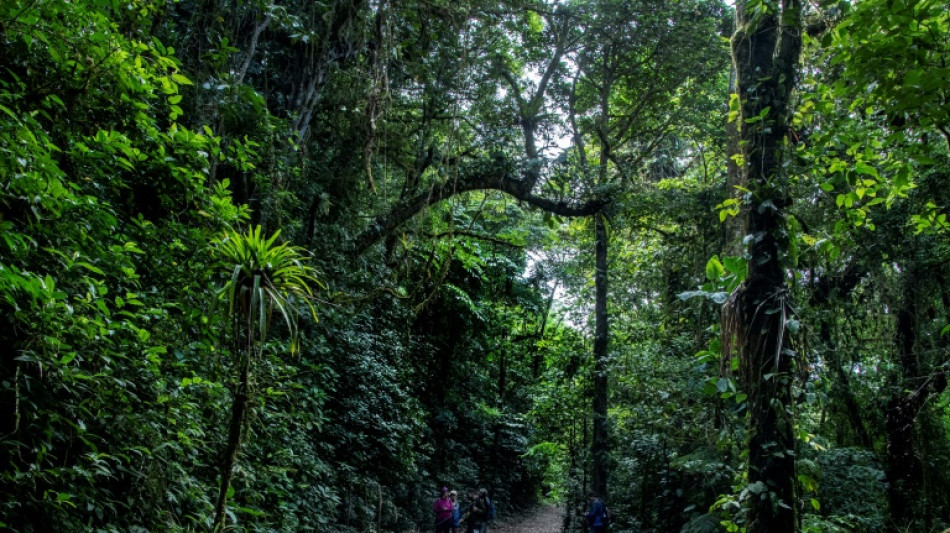
In Costa Rica, climate change threatens 'cloud forest' / Photo: Ezequiel BECERRA - AFP

In Costa Rica, climate change threatens 'cloud forest'

The "cloud forest" of Monteverde, in the center of Costa Rica, will soon no longer be worthy of the name: climate change threatens this unique ecosystem, and its fauna and flora face an unclear future under a brilliant blue sky.

Text size:

In the forest, what a visitor should hear is the constant drip of moisture falling from the trees. Instead, it is the sound of dead branches snapping underfoot that breaks the silence on the dry trails.

The high-altitude forest is still clinging to life, and it delights walkers with an infinite variety of greens under an uncomfortably bright sun: the fog which reigned supreme here only a short time ago dissipates as the temperature rises, explained 24-year-old forest guide Andrey Castrillo.

"The forest should be cool," he said. "You should hear the drops falling all over the forest, but that only happens during the wettest and windiest days of the rainy season."

"Here there was no sun... We had about 30 days of sunshine a year. Now we have more than 130," he said.

At 1,400 meters (4,600 feet) above sea level and 140 kilometers (86 miles) northwest of the capital San Jose, the private nature reserve extends over 14,200 hectares (35,000 acres) and is home to a hundred species of mammals, 440 bird species and 1,200 types of amphibians.

- 'Walking in the clouds' -

This exceptional type of altitude forest represents only one percent of the world's tropical and subtropical areas.

"Near-ground cloud cover forms when the humidity saturation is above 90 percent with temperatures between 14 and 18 degrees Celsius (57 to 64 degrees Fahrenheit)," researcher Ana Maria Duran, of the University of Costa Rica, told AFP.

The researcher said she had been coming here regularly for more than twenty years.

Normally, the "almost permanent" fog gives the impression of "practically walking in the middle of the clouds," with visibility down to barely a meter (three feet).

As she spoke, she stared into the forest where the temperature had risen to more than 25 degrees Celsius, under a blue sky where only a few clouds crowned the peaks.

"Coming to Monteverde to find such dry conditions and not being in the clouds like it was 20 years ago when I started coming is obviously very sad," said Duran.

Rising temperatures mean lower humidity and more sun. The mosses have dried on the tree trunks, the rivers are no more than streams, and the amphibians here have been the first victims of climate change.

"The decline of amphibians in cloud forests may serve as a wake-up call," warned biologist Andrea Vincent, who teaches at the University of Costa Rica.

Already, the species Incilius periglenes, known as the golden frog, has been considered extinct since 2019 by the International Union for Conservation of Nature (IUCN).

"A cloudless cloud forest, it will disappear, it has to," said Vincent, warning that "there will be a lot of extinctions" of various species.

But this "dispiriting scenario" can still be avoided, she said.

"Ecosystems are resilient. If we make efforts to stop climate change it is possible that cloud forests will recover... not during our lifetime but perhaps for the next generations".

(K.Müller--BBZ)